
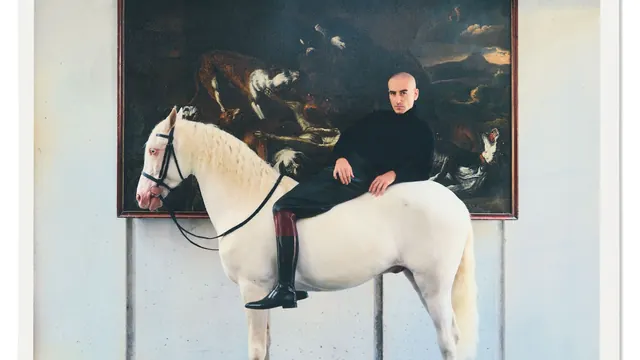
These are the opening lines of Genesis, Francesco Risso’s manifesto for the Bureau of Imagination, his new creative factory housed in a 1920s cheese factory in Milan. The building, known as La Fattoria delle Alpi (“The Farm of the Alps”), is tucked away near the Navigli, the city’s old canal district, with its bohemian mix of artists’ studios, bars, galleries, and workshops.
The directions for getting here were a little vague—no signs, no names—but when I finally reach the address on a sweltering summer afternoon, I ring a slightly mysterious buzzer. The whole premise takes me back to the years in Italy before cell phones and social media when you could just go around saying, “Ti citofono e scendi”—I’ll buzz you and you come down.
There was a thrilling sense that anything could happen.
After 10 years at Prada and almost a decade transforming Marni into one of fashion’s most distinctive brands, Risso has recently taken on the creative direction of GU, Uniqlo’s sister brand, while simultaneously opening the Bureau, which he calls “a manufacturing house for objects.”
Tall, long-limbed, and effortlessly elegant, he welcomes me dressed in a pair of slightly flared leather pants that fall loosely on his hips and immediately introduces me to his partner, collaborator, and the Bureau’s curator, Alex Sossah. The couple met three years ago through a mutual friend and spent a month texting before Sossah flew to Paris during one of Risso’s fashion shows.
“We literally lived a movie,” Risso says, laughing. (They were also born on the very same day.) A Paris-raised curator and creative consultant with a background spanning fashion, art, and music, Sossah brings a more structural mind to Risso’s instinctive way of working.
“He’s the logical brain of the Bureau,” Risso says. “I’m not sure that I want to define myself as the illogical one, but that’s how we play together.”
While the building that houses the Bureau was originally intended to be their home, not long after Risso and Sossah settled in, the space began to transform into something else. Risso has never been particularly interested in separating life from work, or work from imagination, and by now those boundaries have all but disappeared.
He might wake up and paint, work on a garment, cook, welcome a friend, or find someone already making something in another room. “The Bureau has become less my house and more a house for imagination,” he says.
“I happen to sleep in it.”
Today, all around us, workers are painting, drilling, sewing, sawing, and moving extremely large objects. We sit on chairs hand-painted by Orfeo Tagiuri, together blame Mercury in retrograde for all recent mishaps and construction setbacks, and drink water while overlooking the vast Engine Room.
“It’s where ideas first take physical form,” Risso says. “It houses our ateliers—patternmakers, sewing specialists—and the laboratories where garments and objects are conceived, tested, and manufactured.
It is also home to the ceramics studio.” At parallel tables, seamstresses and pattern cutters work among bolts of fabric, bright yarns, and half-finished garments. Someone is stitching a hat by hand.
A deconstructed dress stands at the center of the room.
After more than 20 years in fashion, Risso wanted to enter different rhythms of making, where garments could exist alongside furniture, glass, silverware, and performance. Frequent travel to Japan for his new role at GU seems to have altered his sense of time—in particular, what he began to see as the increasingly neurotic demands of Western work culture.
“Making clothes is quite fast,” he says. “Making objects, or silverware, is a completely different planet—and so your brain readapts on different layers of time.
You have to surrender.” He smiles. “What’s happening in culture right now is not delivering a lot of mystery,” he continues.
“[That’s why] I’m curious about complicating the transaction.”
Curiosity has been driving Risso for a long time. He remembers his first meeting with Miuccia Prada, when he announced the only condition under which he wanted the job: “I told her, ‘I’m going to be here as long as I’m having fun.’ ” He laughs: “This is my mantra whenever I start a new job.”
Risso sees his work with GU and Uniqlo as a counterpoint to the Bureau: The Bureau, he says, is “intentionally intimate,” while the other asks, “How far can an idea travel without losing its integrity?” Working with Uniqlo CEO Tadashi Yanai, “one of the rare entrepreneurs who thinks in decades rather than seasons,” has deepened that thinking. “For me, the future is not choosing between intimacy and scale,” Risso says.
“It is learning how each can make the other more meaningful.”
There is too much to see for me to sit still, so I ask Risso to show me around, starting with the basement. Along one side are racks and shelves of vintage pieces gathered by Risso and Sossah on their travels: floral dresses from the 1920s and ’30s, old furs and leather jackets and silk slippers.
Several garments might be layered and intertwined into a new body, then bound together by intricate handwork, with threads, beads, stones, and other fragments added like archaeological deposits. “Every piece has its own story,” Risso says.
(Paloma Elsesser’s Met Gala dress, designed by Risso for the Bureau and assembled from more than 30 vintage garments spanning three decades, was born in precisely this way.) Elsewhere are uniforms and one-of-a-kind cashmere, mohair, and silk pieces alongside simple white T-shirts and sweaters.
In the central room downstairs, on a table adjacent to the racks, are visual references and books, along with stacks of sketches and photographs and an array of glasses, vases, and silverware. “We wanted to make objects that are part of our daily life—that’s where we started,” Risso says.
I fall in love with animal-themed vases, Murano glasses, and detailed cutlery. Risso grew up with animals and returns to them constantly.
“Animals have been central to my creative language,” he says. “They are not decorative motifs—they are companions, guides, and symbols of a deeper connection to the world.” The Murano glass, meanwhile, comes with its own story.
It took his team months to earn the trust of the 79-year-old glassmaker Gianni Seguso, from the historic Seguso glassmaking dynasty. “When we asked him to leave the imperfections, he looked at us like we were crazy,” Risso says.
“And now he has the excitement of a child.”
We head upstairs, where the main room, organized around an enormous Brutalist table in poured concrete, is still being constructed. (Many of the architectural elements—the concrete table, lighting, suspended neon structures, ceramic tiles, and custom furniture—were developed by Risso with longtime collaborator and scenographer Mario Torre.)
The people moving through the building belong to what Risso calls three overlapping constellations: the Makers, the External Makers, and the Muses. The Makers are the Bureau’s daily inhabitants, while External Makers include artisans and craftspeople like Seguso. The distinctions are porous. “What matters,” he says, “is mastering techniques.”
Risso’s circle also includes the artists, musicians, and friends he calls the Muses—among them Tagiuri, Flaminia Veronesi, Piero Golia, and Dozie Kanu. There is no audition process for the Bureau.
Collaborators tend to emerge organically—from friendships, nights out, or simply spending enough time with someone to discover what they secretly dream of making. Risso resists programming those encounters too carefully.
Instead, a shared curiosity often leads to a simple question: “What if we made something together?”
Commercially, the Bureau will sell directly to consumers, either by appointment in the Milan space or online. Alongside a core of seasonless pieces—from knitwear, shirts, jackets, and trousers to shoes, bags, and small leather goods—there will be changing monthly releases.
One-of-a-kind and more elaborate objects, including silverware, vases, and ceramics, will be made-to-order. Clients will be informed of releases by newsletter, but, as Risso stresses, the Bureau is open to anyone who discovers it.
Among the Bureau’s historical references is Claes Oldenburg’s The Store, the radical early-1960s project in which he displayed and sold his sculptures in a storefront as if they were everyday merchandise. “We wanted to imagine another relationship between the maker and the audience—one that feels more direct, more intimate, and more personal,” Risso explains.
That spirit of discovery carries into the Bureau Library, conceived as a living archive that changes several times each year.
We keep climbing. On a small mezzanine, three intimate rooms feel suddenly removed from the scale of the building.
(One is what Risso calls the Boat Room, a wood-wrapped tribute to his childhood and the idea of refuge.) Further upstairs is the Cantine, “where we come together every day for breakfast, lunch, and dinner,” Risso says. “It is the communal heart of the Bureau.” It opens onto a secret garden, surrounded by tall trees and covered in a striped mosaic.
Nearby, the Glass Room is a quieter space for reading, thinking, or resting, while at the top are two residences: one for Risso and Sossah, the other for visiting artists, collaborators, and friends. After all these stairs and doors opening onto more doors, I can’t help wondering how the couple manages to live with so much perpetually up in the air.
Very soon, the place will change again, and everything I’m looking at now will shift form.
To navigate the ebbs and flows, Risso and Sossah share a number of rituals. They play sports and music together and walk constantly, usually with their dogs, George and Ginza.
From the Bureau, they can step outside and wander along the canals or toward the park, surrounded by trees and water. They also escape Milan whenever they can, often without a plan, driving into the countryside in search of unfamiliar places, strange houses, forgotten buildings, architecture, exhibitions, or landscapes.
“Of course, we also share the intimacy, and the responsibility, of the work,” Risso says. “Building the Bureau together has meant making an almost endless number of decisions, from the very practical to the completely irrational.
But then evening arrives, somebody puts music on, something goes wrong, somebody starts laughing, and the seriousness dissolves.”
Later in the day, as I leave, I have the strange feeling of emerging from a time warp. Risso seems to have found a way to, as he puts it in Genesis, “stitch the past to the present.” Perhaps that is the true heart of the Bureau—now we just have to watch it unfold. As Risso is fond of saying: “You have to surrender.”
In this story: hair, Mayuko Nakae; makeup, Andrea Severino Sailis.