
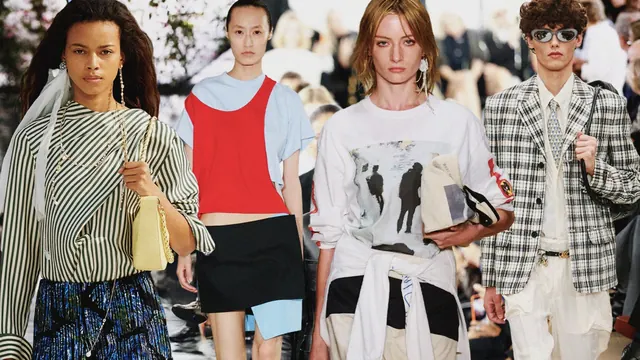
“Is fashion art?” is the perennial question in this industry. Designers are inherently creative people, who, both out of natural habit and in perpetual search for inspiration, are constantly engaging with different mediums and the cool communities that surround them.
What is changing is the public prominence of these conversations, exemplified by the creators with which they partner, such as Amelia, a 32-year-old TikTok art historian and Columbia student better known as Meelz on Art, whose analysis has gotten her seated at shows by Loewe, Dries Van Noten, and Dior.
“I think art is probably the largest, most influential cultural movement on fashion designers, on designers of all kinds,” Dr. Elizabeth Way, curator of Art X Fashion at the Museum at FIT, tells Vogue.
For proof, look no further than brands like Louis Vuitton and Dior who flexed their cultural prowess with cruise shows at The Frick and LACMA, respectively, earlier this year. But you don’t need a museum to make a connection.
Vogue’s Laird Borrelli-Persson combed through over 400 of our spring 2027 reviews for explicit art callouts. Naturally wide-ranging—some Dadaism here, some 18th-century-inspired contemporary art there—the list provides a fun window into designers’ brains.
Some polar opposite sources can produce strikingly complementary results. Lii’s love for Alex Katz’s graphic flair is miles away from Loewe’s references to 17th century Spanish painters Francisco de Zurbarán and Diego Velázquez (the former of which is now on view at the Louvre), and yet both spring 2027 collections were filled with unique visions of futuristic sportswear.
“Loewe was especially intriguing because it was so paradoxical,” says Amelia. “It was at once extremely contemporary and simultaneously steeped in tradition.
Many of the pieces were bright and saturated and exhibited severe, geometric purity. This showed up in dramatic drapery a la Zurbarán and courtly embellishment, like the clothes in a Velázquez portrait.”
At Dior things followed in a more traditional vein. “The most explicit art historical connection in his recent show came in the form of Jonathan Anderson’s replication of an 18th-century wooden chair from his personal collection which served as seats for some of the guests,” Amelia says.
That said, the airy refinement of the clothing took on the precise motion blur of Gerhard Richter’s paintings. For further classical tradition, Bora Aksu drew inspiration from 17th-century portrait artist Mary Beale, while Zimmermann’s Nicky Zimmermann looked to the 19th-century natural history illustrators Harriet and Helena Scott.
In contrast, the whimsical Alexander Calder popped up as inspiration on multiple occasions, both at Givenchy, where Sarah Burton drew reference from Cirque Calder, and at Michael Kors, who zeroed in on the more mod aspects of the sculptor’s shapes. Rachel Comey’s 25th anniversary show was an ode to the visual artist and novelist Rosalyn Drexler, and Kiko Kostadinov took on an experimental edge with the works of Italian artists Agostino Bonalumi and Nanda Vigo.
Meanwhile, Prada’s 63 skirts made a subtle nod to one of its own traveling exhibitions from the early 2000s, titled “Waist Down.” “We used the skirt as a framework for different ideas, different approaches, like a raw material to express concepts,” said Miuccia Prada in the show notes. “The limitation of its simple shape, almost like a canvas, can force ideas, make you reinvent the form within its strict confines.” The skirts’ gradient dyed leather was rather reminiscent of the emotionally charged works of Mark Rothko.
“Art teaches clothing how to transcend its necessity,” says Anne Higonnet, art historian and professor at Barnard. “Every day, people out there are using color, shape, texture, composition, and rhythm to go beyond covering our vulnerable, knobby, oozing, mobile anatomies, beyond even expressing our position in society.” If you’re going to wear it, you might as well know the reference, too.