
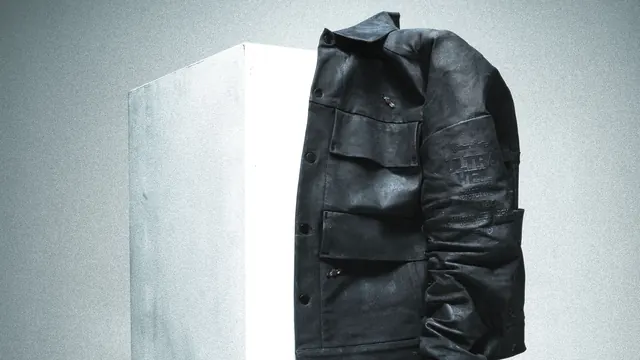
Thirty years into his career Aitor Throup says he is finally ready to be a successful fashion designer. Given this revelation, “Ultra Veil,” a new exhibition of his work opening this week at the Ambika P3 (a former concrete testing facility and now exhibition space at University of Westminster in London) can be read as a statement of intent.
Who is Aitor Throup and why should you care? He’s an Argentinian-British designer who has a cultish status within streetwear, having been scouted by C.P.
Company on the day he graduated from the Royal College of Art in 1996 with an unforgettable collection titled When Football Hooligans Become Hindu Gods. His graduation collection merged his experience with racism as an immigrant in England and his attraction-slash-repulsion for the dandy style of the country’s sports agitators.
At C.P. Company, he would go on to design the kits that would be peacocked at the pitches. Recent projects have included a hookup with Umbro (with whom he created the uniforms of the British national team in 2009) and Maharishi. Up next in 2027 is a collaboration with Fred Perry which, is supporting “Ultra Veil,” along with The Westminster Menswear Archive (a treasure trove of 2000+ garments available for study).
Throup is often described as an “insider’s designer” and it’s true that he operates on the fringes of fashion, as far as forward facing visibility goes. He didn’t grow up wanting to be a designer, rather he discovered in it a connection to other worlds, even those beyond day-to-day reality.
Since childhood, Throup’s means of self expression has been drawing; in clothing he saw the possibilities in his illustrations come to life. As he put it on a recent call: “When I saw the first goggle jacket, it wasn’t about the person in the jacket.
It was the fact that I could become that character. It was an extension.
I could finally become Batman in many ways.”
There is a uniform (as in utilitarian/militaryish) feeling to many of the designs in “Ultra Veil.” That’s intentional and makes the fact that they’re “all constructed from lingerie, women’s lingerie mesh” more dramatic. Throup said he “vandalized” his designs by painting in 3D (i.e. on the body) with a liquid glitter rubber finish that took weeks for him to concoct.
Asked to share examples of his design language he singles out “masks and veils integrated into hoods and hats (objects that have a ‘face’)”; integrated gloves; and trousers with “engineered transforming foot covers... thus my trousers have the immediate appearance of ‘legs.’”
What Throup shares with many other designers is the desire to achieve harmony between opposites, but with him this extends beyond aesthetics to a desired left brain/right brain that unites intuition with deep study of anatomy. In his world, ethereality is matched by a darker energy, to which 100 skull sculpturescontribute. The idea is that the 70 or so prototype garments in the exhibition will be sold like artworks.
“For the last 20 years, essentially what I’ve been trying to figure out is how does one breathe life into an inanimate object?” he said. Throup does not ascribe to the idea that a garment is completed by a body, but rather that a garment can be perfected as an object, and that all objects have anima (soul).
“I would say that everything I create is anthropomorphic in the deepest sense. My work aims to capture the essence of humanity objectified into inanimate objects.
Be it garments, sculptures, drawings, the aim is to capture the essence of life and in particular, human life.”
For all these years the designer has supported himself mainly through consultancies in music and fashion, which allowed commerce to take a second seat to his theoretical practice. This designer proposes fashion as service, saying: “I instinctively felt I had something important and I felt a sense of service, like my work had a purpose…. I know this sounds big, but [I thought] my work would be in service to humanity in some way.”
If one were to assign a natural element to Throup it would be air, this despite the deep weightiness of his philosophies. His installations, like his drawings, capture moments of suspended animation.
That temporary state of existence, floating, is an in-between state in which Throup seems to thrive. “The etymology of the word inspiration is pivotal in the point I’m trying to make,” he explained on a call.
“Inspire” means in spirit; your breath being your spirit comes into your body. So when we are inspired, we are in our spirit.
When we’ve expired, we’re out of our spirit. So to create something that’s inspiring and to be inspired is foundational.”’
With his homework done and the prospect of his own line, Aitor Ultra, on the horizon, Throup seems ready to come down to earth. While waiting for that to happen we’ll be caught in a suspended state of anticipation.
“Ultra Veil” will be open from October 30 to November 8.