
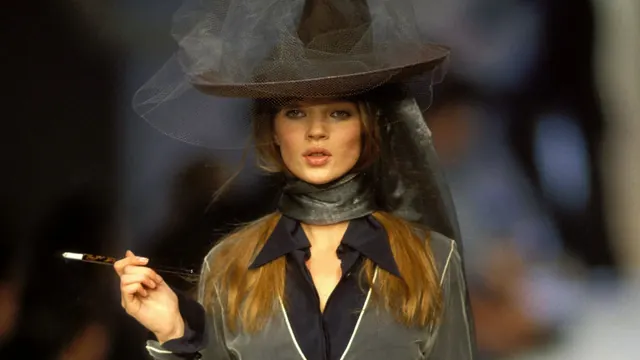
Get out your spell book, warm up your broom, and dust off your pointy hat—this fall is the season of the witch.
No, it’s not just that Practical Magic 2 cast its spell on theatergoers (though the return of the Owens sisters was certainly exciting), or that Ryan Murphy is reviving the sorceress-centric chapter of American Horror Story. It’s not even because Disney is dropping a new animated feature about a magically inclined teenager titled Hexed, or even that we’re this close to Halloween.
I’m talking about that distinctly witchy vibe that cast its spell on the fall collections. There’s no better time than now, as the first chill of autumn hits the air, to embrace your inner enchantress.
“I think we’re all craving escapism from everything that’s going on in the world, and the witchy look feels oddly comforting yet unfamiliar and satisfying for those who want to dress for themselves firmly through the female gaze,” says Kristen Bateman, a fashion writer and Vogue contributor who, herself, has a bit of a magical look.
Looking back at the fall collections, trickling into stores now, you can see a strong sense of the supernatural present in subtle shades ranging from the magical to the macabre. A diverse group of designers—Comme des Garçons, Rick Owens, Erdem, Lanvin, to name just a few—all indulged, to a certain degree, in some toil and trouble.
Indeed, the dizzying breadth of subcategories of witchy aesthetics on display—scary, glamorous, melancholic, avant-garde, and so on—reveals that we’ve shed our clichéd ideas of how a witch should look, and opened the aperture of what, in fact, a witch can be. Indeed, a recent email pitch from Urban Outfitters highlighted a “whimsical witchcore aesthetic” was trending, and pointed toward frilly topos and loose trousers in muddy tones.
It’s something that evoked more of an Earth goddess than the pointy-hatted crone of yore.
“The aesthetic has definitely evolved over the years into something more glamorous than it used to be,” says Bateman, who sees Comme des Garçons and Simone Rocha as go-to brands for enchantress-core (plus vintage piano shawls and antique jewelry) and counts Michèle Lamy as her ultimate fashion witch. “And I think anyone who likes dressing differently can appreciate a witchy vibe and the power of black and a good symbol.”
“Romantic goth is having a moment,” adds Tiffany Hsu, chief buying officer at MyTheresa, who calls out brands like Alexander McQueen, Maria Lucia Hohan, and David Koma for making clothes worthy of a high-fashion high priestess. “It's romantic more than black. We’re seeing cape details, fishtail hems, and long trumpet sleeves, especially in evening and cocktail styles. Corsetry and lace are part of it too—that whole Wuthering Heights mood but very witchy.”
“I think fashion and spirituality always work together,” says Ebony Jasmine Harris, a glamour witch (who uses presence, intention, and personal energy to shape how you are perceived by others), spiritual occultist, and spiritual deconstructionist. Harris explains that, because glamour magic has “been around for thousands of years at this point,” there is no singular way to dress as a witch, but that fashion is deeply important to it as a practice.
She also points to “color magic,” one of the oldest forms of magic: “So depending on the color you wear, you could wear black to be less seen, almost like cloaking, or you could wear black to feel stronger, or more powerful, or more protected. You could wear white because you want to represent purity, or you could wear white to tap in deeper to the spiritual realms.”
But why is this special strain of enchantment trending right now? “We need it,” says Bateman.
“Aside from Practical Magic 2 and other spooky cultural releases, I feel like people are embracing their darker, weirder sides more than ever.” She points to younger people collecting antiques and the rise of Victorian influence as notable examples. “It overlaps with a dark, witchy moment.
We also all want to believe in what others think is impossible.” Perhaps, as the greater world feels so beyond our control, witchcraft is a way to feel like you have a sort of agency that is separated from existing systems—political, societal—that are working actively against us.
Aside from making wonderful clothes that will see us gleefully part with our money, designers also strive to somehow intuit the mood of the moment. In landing on a decidedly witchy vibe, they are, indeed, divining a general hope for a little magic in our lives.
“I think sometimes we get to see a little bit of the fashion designer's own magic in their own path,” Harris says. “Because to me, fashion is an expression of your mental state, of your spiritual state, of what’s going on personally.”
Or, as Bateman so eloquently puts it: “It’s a way of thinking and a mode of dressing for oneself, far away from the male gaze. It’s deeply, divinely feminine.”