
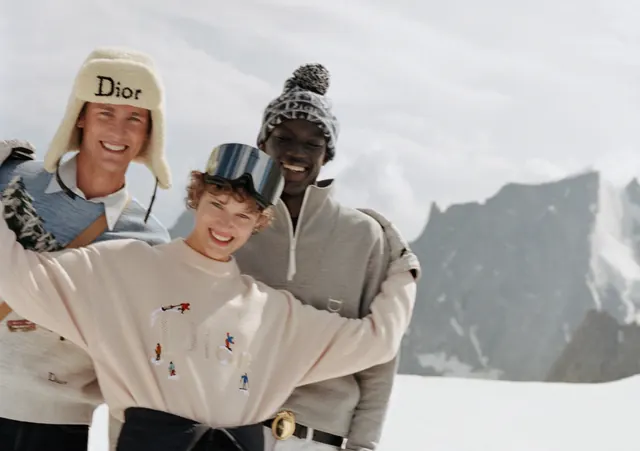
Pack your fanciest skis — we’re going to the Alps with Dior this winter. For his first interpretation of the house’s winter sports universe, Jonathan Anderson has re-engineered the Dior Alps 2027 capsule , relying on illustrative prints, enveloping textures and playful après-ski details.
Shot by photographer Angelo Pennetta , the accompanying campaign follows models Noor Khan, Alassane Ndao and Thomas Finn as they navigate a sequence of snow-covered chalets and alpine backdrops in the warmest, lushest skiwear.
Two specific archival prints turn the collection’s knitwear and carryalls into their own winter tales: the first, Dior d’Hiver, acts as a living postcard of the slopes, scattering miniature, joyful illustrations of skiers hurtling past mountain chalets across the surfaces of thick sweaters. While the second, Dior Snow, captures a still lake landscape, settling across the structured panels of the signature Dior Book Tote and finding its way onto fluffy, insulating shearling pieces.
For serious mountain utility, the collection deploys the emblematic Dior Oblique pattern across high-volume puffer jackets, technical coats, protective face masks and heavy-duty ski goggles equipped with three interchangeable lenses. The matching accessories — including beanies, gloves and oversized scarves — carry the same graphic branding, with several styles subtly punctuated by hand-applied rhinestone ice crystals.
The handbag line-up is equally stylish. The new Dior Médaillon Flap Bag and the slouchy Diorly bags arrive refitted in plush shearling and rich suede, while classics like the Lady Dior and the Dior Bow are constructed from deep midnight-blue leather.
The skins come dappled with delicate rhinestone embellishments that evoke a clear, starry alpine night. The accompanying bag charms capture all the fun of the snowy landscape, featuring miniature, mischievous representations of the historic Bar suit, the Medallion chair and a tiny, round penguin clipped straight onto the zipper pulls.
The menswear line balances this technical precision with unforced luxury, re-envisioning the timeless Dior Normandie jacket in dense shearling detailed with embroidered pine cones and tiny, precious thimble hardware. The lower-half choices include the Dior Valto boots and derbies, which take the rough silhouette of a traditional hiking boot and polish it for post-slope dinners, alongside the velvety, highly practical Dior Aqua mules.
To round out the lifestyle presentation, Dior Maison has extended the snowy escape directly into the home, introducing heavy wool throws, plush cushions and a pair of hardbound notebooks filled with Anderson’s original design sketches.
The new Dior Alps collection by Jonathan Anderson will be available across global flagships and online starting this October. Find out more here .
photography. courtesy of Angelo Pennetta for Dior words. Gennaro Costanzo
Earlier this year, we tracked how Watches & Wonders 2026 served as the definitive stage for Cartier to declare itself the true watchmaker of shapes. The Maison has now taken the smooth, fluid loop of its Baignoire watch and completely rethought how it can stylishly catch the light.
First appearing in 1958, this oval silhouette has always behaved like a piece of jewellery that just happens to tell the time, but the latest incarnation changes the piece entirely through texture. The new edition of the bangle model is covered in Cartier’s signature Clou de Paris hobnail motif, extending the geometric pattern across the bracelet, case and dial.
The integration of this textured pattern — a house signature since the 1920s — demands exceptional craftsmanship to mould the precious metal while preserving the evenness of its volume. The monochrome yellow gold texture flows seamlessly from the bangle bracelet across the case and right onto the dial surface.
To ensure the lines fit the watch’s famous curves as closely as possible, every proportion has been carefully adjusted, extending down to yellow gold push-buttons on the clasp that disappear into the sweep of the bracelet. Master jewellers then polish every single hobnail pyramid entirely by hand to enhance the relief and structure of the metalwork.
Denis Boulze and Anaïck Lejart for Cartier.
The collection splits into two primary aesthetic interpretations alongside classic leather-strapped iterations. The core monochrome yellow gold model houses a golden dial and quartz movement within sizes 15, 16 and 17.
The pinnacle of the launch arrives via an ultra-precious, diamond-set edition that functions as a serious technical feat of gem-setting. This version features a case and bangle set with 171 brilliant-cut diamonds.
The dial uses an intricate snow setting composed of 100 brilliant-cut diamonds, contrasted by an inverted setting on the case where the stones are flipped to display a slightly less pronounced tip, creating a harmony of shifting reflections.
The traditional selection rounds out the family across alternative dimensions and dial textures. For a more conventional profile, a larger model pairs a grained silvered dial with a high-autonomy quartz movement and a shiny black alligator-skin strap.
A compact variant offers a diamond-paved dial mounted on a sleek black patent calfskin strap, while another version introduces a stark black lacquered dial paired with shiny alligator leather. Water-resistant up to 3 bar, the entire lineup uses premium 750/1000 gold.
The new Cartier Baignoire collection is available to explore now through global boutiques and online. Find out more here .
photography. courtesy of Cartier , Denis Boulze , Anaïck Lejart words. Gennaro Costanzo
Levi’s and sacai are returning for their third collaboration, with Chitose Abe once again taking familiar denim shapes apart and rebuilding them into quintessential sacai. For Autumn/Winter 2026 , the labels are deepening a relationship built around the hybridisation of contrasting denim staples. The twelve-piece capsule spans both men’s and women’s wardrobes, focusing on four main re-engineered silhouettes rendered in a choice of either rigid indigo or a beautifully faded washed indigo.
The new chapter follows the 2025 collaboration, which brought together Levi’s Type I, Type II and Type III trucker references in a single jacket, alongside a reversible blouson, matelassé twill pieces and wide-leg denim.
Key pieces include the sherpa jacket, blouson jacket, belted wide pants and belted flare pants, with matching washes allowing the separates to be worn as coordinated looks or independently. The collection retains Levi’s denim language while revolutionising it with sacai’s characteristic combinations of contrasting textures, altered proportions and unexpected construction.
The sherpa jacket continues the partnership’s indigo selvedge story, wrapping the denim in faux shearling with genuine leather pocket detailing and classic trims. Men’s and women’s versions follow the same construction, although the men’s jacket adds side-seam pockets. Meanwhile, the blouson jacket reworks denim into a more streamlined shape, finished with elasticated cuffs and a tight hem, sacai’s signature utility sleeve pocket and, on the women’s version, a side-seam vent.
The bottom halves match this unforced restructuring, designed to be worn as coordinated denim suits or as individual statement pieces. The belted wide pants offer a mid-rise, loose silhouette crafted from rigid selvedge cloth, equipped with an integrated industrial webbed belt and specialty branded buttons stamped across the loops. The belted flare pants take a standard-rise route, introducing a complex seven-pocket construction by layering welt back pockets directly over the traditional Levi’s spade-shaped versions.
The collection launches first on 29 September exclusively at a dedicated Levi’s x sacai pop-up inside Landmark Hong Kong. A wider global digital release follows on 30 September online and the Levi’s App, before arriving in Japan on 1 October via select boutiques and an online lottery system on the sacai digital platform.
photography. courtesy of Levi’s words. Gennaro Costanzo
Nothing about London Fashion Week ever behaves the way you expect it to, and Spring/Summer 2027 carried on that tradition with real enthusiasm. Alongside the big returns, Mulberry’s Christopher Kane debut, McQueen back on home soil and Marks & Spencer finally joining the official schedule, the week’s real energy sat with a run of independent designers using the runway as something closer to a personal manifesto.
Politics turned up uninvited more than once, grief got stitched into fabric and at least one designer spent six months hand embroidering lace as an act of patience. Churches, warehouses and hospital wings all stood in for conventional runway space, and craftsmanship, in Labrum’s case, became the entire subject rather than a footnote.
Schön! went backstage to capture the highlights of London Fashion Week, through the magical lenses of Holly Lavelle , Morgan Layla Williams and Lee Scullion .
Mithridate opened the season with a collection built on London’s ‘New Romantic’ scene, drawing on the Blitz Club era and figures like Steve Strange for a mash-up of Victorian military tailoring and theatrical excess. Feather-covered bodices, tulle-trimmed gowns and candyfloss-pink tutus sat alongside oversized studded denim, shrunken cable knits and broad-shouldered jackets, while Bicorn hats by milliner Noel Stewart and cummerbunds worn over silk shirts rounded out the styling.
Creative director Daniel Fletcher pushed proportion throughout, pairing micro shorts with billowing trenches, and leaned into an unconventional palette of hot pink, scarlet, cornflower blue and acid tones rarely seen together. Fletcher has spoken about wanting the collection to reflect Mithridate’s own growing ambitions, and on this evidence, self-expression without much restraint seems to be exactly where the brand is heading next.
Agro Studio returned to London Fashion Week for its third season on the official schedule with ‘Glass Body’, a collection built around transparency and distorted surfaces. Thousands of antique and discarded buttons were embroidered into garments to mimic shattered glass, while corsetry pulled tight against featherlight tulle and Chantilly lace, marking the first season the London duo’s ready-to-wear has actually been available to buy.
If Madonna’s ‘Confessions II’ has been the summer’s unofficial soundtrack, lilac made a solid case for being its visual equivalent here, turning up across the palette with enough conviction to claim the unofficial title of colour of the season. George Oxby and Angus Cockram , the pair behind the brand, continue to lean on the couture techniques that first made their name dressing Lady Gaga and Madonna, proving those skills translate just as convincingly into ready-to-wear as they ever did into a red carpet showstopper.
Dusty purple and muted blue rounded out the palette, giving the whole collection a slightly worn, lived-in quality instead of expected prettiness.
Bora Aksu took his Spring/Summer 2027 collection inside St Cyprian’s Church in Marylebone, building an entire show around the life of Mary Beale, one of the first women to establish herself as a professional artist in 17th century England, whose own husband gave up his career to manage her studio. Structured menswear tailoring, waistcoats and masculine closures were softened through lace, embroidery and delicate fabrics, with Antep embroidery from Gaziantep, Turkey, some pieces taking up to six months to complete, adding intricate texture throughout.
Veils lent the collection a ceremonial quality, whites and powder blues sitting against black and deep oxblood red, while the show closed with the full cast standing together, a tribute to Beale’s own defiance of the constraints placed on women in her time.
Susan Fang took over the Barbican Centre with ‘Air-Illusion’, a collection unfurling a narrative of fantasy and seduction through pearls, petals and porcelain-inspired detailing. A white mini dress arrived covered in delicate cobalt-blue flowers, while an organza gown carried layers of pale blue and white three-dimensional blooms, and broken porcelain was reworked into jewellery alongside jade repaired with gold in the Japanese kintsugi tradition, worked with a Beijing-based jade master into petal-shaped earrings.
Fang pushed further into 3D printing this season too, rendering lace patterns drawn from porcelain motifs in neon filaments layered over transparent blouses and shorts. The collection’s headline collaboration came via Crocs, introducing the ‘Echo Blume’, the first design built on Crocs’ new Echo Lume silhouette, its surface smothered in metallic 3D-printed wildflower clusters ahead of a global release next spring.
Elsewhere, 3D-printed flip-flops looked like a simple thong from the front and revealed a pixelated, geometric sweep from the side.
Dreaming Eli presented ‘Dreamers in Exile’ at St Bartholomew’s Hospital’s North Wing, with designer Elisa Trombatore reworking memories of a Sicilian childhood and the experience of building a new life in London. Distressed silks, hand-painted surfaces and screen printing referencing Baroque Sicilian churches and tattoo imagery gave the collection real narrative weight, while denim, lace and vinyl were combined to fake a leather-like finish.
Ruffles and pearls were layered to resemble fragments of old photographs, and the returning Wild Hearts Bleed platform heels came back in new blush and rose satin colourways, tying the collection’s romantic distress back to something wearable.
Keburia brought its first ever menswear showcase to a warehouse space at Truman Brewery, opening with a look that had nothing to do with equestrian tailoring at all. The first model walked out with a guitar strapped to his back, painted in red with the words ‘Hope you burn, Putin,’ a blunt political statement from Georgian designer George Keburia that set the tone before a single Western reference even appeared.
From there, exaggerated shoulders, architectural collars and oversized pockets ran through the collection under a loud techno soundtrack, while camouflage and metallic tweed added a utilitarian edge. Rhinestone saxophones and French horns brought unexpected humour, alongside a pig insignia stamped onto belts, all set against a base palette of black, cream, khaki and tobacco lifted occasionally by flashes of red and turquoise.
Keburia has never shied away from politics on the runway, and this season proved no exception.
LABRUM closed its ‘Osmosis’ trilogy with a Spring/Summer 2027 collection staged once again in the grand hall at One Great George Street, this time turning attention to craft itself and the knowledge carried in people’s hands. Handcrafted raffia trousers drew on Mende masquerade traditions, while woven headwear made with British milliner Lucy Barlow and sculptural leather bags connected techniques from West Africa, India and Britain.
One of the collection’s most personal moments came through embroidery depicting Foday Dumbuya ’s grandmother, who worked as a produce seller in Sierra Leone, her story stitched directly onto the garments. A geometric motif referencing Olokun, the Yoruba deity of the sea, ran across white fil coupé, while the label’s signature passport jacquard motif returned once more, built from the dates and destinations stamped across Dumbuya’s own family passports, mapping migration in fabric.
Grete Henriette closed the week with ‘Mourn’, the latest presentation from a designer best known for turning chainmail and gemstones into wearable armour. Having built a cult following through pieces worn by Tems, Tyla and Lil Nas X, Henriette continues to explore ritual, protection and the body as a surface for storytelling, this season leaning into a more elegiac mood than the mythic, divine femininity that shaped her earlier collections, swapping celebration for something closer to reckoning.
photography. courtesy of Holly Lavelle , Hyunji Kim, Morgan Layla Williams and Lee Scullion words. Gennaro Costanzo