
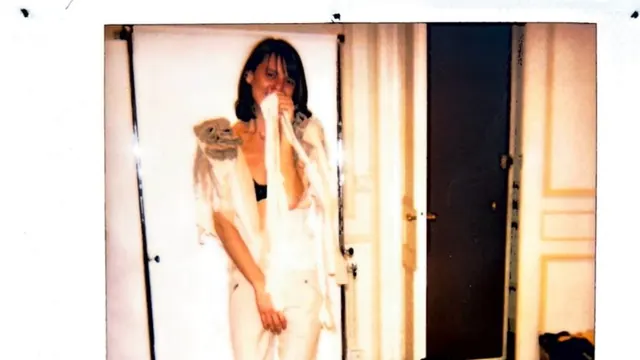
Among the striking, seductive and undeniably stylish photos that make up The World To Come: Visions of an Image Maker, a book that opens a window into stylist and creative director Marie-Amélie Sauve’s extensive body of work, there is one that stands out for a different reason. It captures a moment of sheer giddiness between Sauvé and Nicolas Ghesquière from his Balenciaga days when she was his fit model.
Whatever prompted this outburst of giggling, the photo attests to the closeness they established early on as their respective careers were rising.
Arriving on October 8th, the tome in all its chicness starts off with Polaroid and hazy film throwbacks to this era 30 years ago chez Balenciaga and beyond, when today’s established fashion figures such as Inez van Lamsweerde and Vinoodh Matadin or PR Consulting’s Pierre Rougier brought a fresh and, sometimes disruptive way of doing things to the industry. Interspersed with cerebral essays by the likes of Donatien Grau, Alexander Fury, Emanuele Coccia and Sophie Abriat, the sections gain slickness as Sauvé shifts into stylist mode, shaping editorials and campaigns for major magazines and luxury houses.
But Sauvé—who has gained mononym “Marie-Amélie” status among a core group of fashion people—has proven polyvalent and even a little mysterious in the ways she has transcended her stylist title. The book’s timing coincides with the 10-year anniversary of Mastermind, a magazine she founded that explores broader cultural and contextual subjects that fascinate her beyond what appears on the runway from one season to the next.
That each hefty issue contains profiles of Nobel Prize-winners or emerging literary voices is essentially Sauvé flexing her creative director taste as substantive versus superficial. And perhaps because many of the additional roles she assumes—whether repositioning a brand’s identity or advising designers—happen out of the spotlight, she often operates like an éminence grise working with a constellation of talents that are determining a certain ‘look’ to Parisian high fashion without most of us even realizing.
When we met at the Café de Flore last week ahead of her auspicious dual debut—also ahead is a Mastermind podcast, plus an exhibition at the Galerie Thaddaeus Ropac—she pointed to her nose, explaining how the innate act of sniffer (English word, French accent) leads her to what’s next. Wearing a Louis Vuitton leather jacket and jodhpur-like jeans with Phoebe Philo oxblood ballerinas, she delved into her enduring friendship with Ghesquière (they spent the Covid lockdown together in the countryside along with Julien Dossena) before moving on to how she separates her work and personal interests (spoiler: she doesn’t).
Vogue: Many people are already familiar with your work. What might surprise them in the book?
MAS: There are some Balenciaga fitting photos; these truly belong to Nicolas. Nobody has ever seen them, and nobody could imagine what it was actually like inside Balenciaga back then.
At the time, Balenciaga was very closed off, like a laboratory of ideas. He even created fabrics.
When fabrics were presented to him, he might say that it was not what he had in mind. So he had them made.
He managed to push people right out of their comfort zone.
What went through your mind as you revisited these moments?
MAS: It was amazing to transport myself back to that era. And the way we worked, it was a constant building process over several months. You go right down to the bone when you are truly in sync with your team for a certain amount of time. It was like a community. We were truly dedicated.
When did you make the choice to enter fashion?
MAS: I did not really make that choice because my mother is the one who found me that internship at Vogue. I think she did what psychoanalysis calls projection. Perhaps she projected onto me the career she could not pursue. She is completely an artist, she loved fashion. My grandmother, too. She was an artist, she designed furniture.
But then was there a moment that you decided to dedicate yourself to fashion?
MAS: You do not decide that; you go with the flow. I started at Vogue when I was 19.
It became a bit of a drug—especially back in those days when there were still no cell phones. We went out every single night.
There were parties. Life was completely different.
And then at Vogue, everyone had incredible, extravagant personalities. My friend Francis d’Orléans went out to Le Palace every single night; he did reports for Vogue.
So you can imagine that when you went to dinner with girlfriends who had normal jobs, it was a bit boring. I always wanted to get back into that extraordinary realm.
You get hooked because of the adrenaline. And we had insane fun.
The era was very lighthearted and very carefree. Now it is very different.
Given that you have been doing this for some 30 years, do you feel you can see when things are changing?
MAS: I would say you have to sniff out what is going to happen. You see, you have to be a bit of a sociologist.
That is why I asked Sophie Abriat to write a text, because her writing is very sociological. It is interesting to anticipate what is going to happen.
We are here for that, too—to sense not just the present moment, but to sense the future… We are lucky because we are older, I find that to be an advantage, meaning we are cultured. You are much more clear-sighted about what is coming.
It is extremely useful and you are much more perceptive. Even when judging a designer, when judging a collection.
But this begs the question, can you put taste into words?
MAS: Taste is something else entirely. It is also learned, you change your taste.
It is not set in stone. I think that I had a structure, it comes from how you were raised.
Taste comes from very, very far back for me—since your birth or even in your mother’s womb—until you meet people who will make your taste evolve. But there is a backbone.
I come from a very classic background. So, I started from a very academic and very classic taste; but which, of course, evolved.
If I had stayed classic, it would be extremely boring. But I am very conceptual, because I come from a rather intellectual family.
What were your first impressions of Nicolas? How did you meet?
He was charismatic, Nicolas. I met him through Pierre Hardy.
When I met him, he was not yet at Balenciaga. He was doing lots of different freelance jobs and he was very young, maybe 22.
But he was such a man; such determination in his gaze, in what he wanted to do when he talked to you. When I was working at Vogue, he showed me a portfolio he had done for Celine at the time.
And he was already very talented. I saw right away that this guy was going to go extremely far.
It was an encounter like that: friendly. That is how I went and asked at Trussardi [editor’s note: where he was appointed head designer in the early ’90s].
That is how our collaboration started.
What is something we learn about you—or you and Nicolas—from the book?
MAS: There is a photo I love. I am crying from laughter, a fit of the giggles. We laughed all the time. It is adorable. It is very, very profound because it shows the deep connection with another person. It is a common language.
You have supported and assisted many designers through their careers. Beyond Nicolas, there’s been Julien Dossena at Rabanne and Natacha Ramsay-Levi at Chloé. What do you notice about the way these different waves of designers work?
There are a lot of good young designers. I see some of them at the LVHM Prize presenting very personal work.
I think that since the world has changed and information now arrives via the internet, people create more based on what information they receive through the internet. Nicolas himself remains an extremely strong source of inspiration.
Of course, when we were at Balenciaga, we looked at the archives. It is a source of information, but first of all, it had to come from within.
You have to pull what you have out of your guts, and also from what inspires you. When I think of Natacha, of Julien, of course, they went to the same school, which was a very demanding school.
And that is what can lead to a wave of talent.
MAS: Yes, because they do not compromise. If you want to deliver a clear message, your message has to be concentrated, not diluted.
There are the photographers like Inez and Vinoodh, Juergen Teller, Steven Meisel along with a younger generation that you prefer to work with over and over again.
MAS: You feel more secure. I have this stable of photographers that I work with, but I love trying new ones—like Karim Sadli early on, or Julien Martinez Leclerc at the beginning, too. We are also here for that, to push the new generation. It is super important.
What might people not understand about what you do?
MAS: I am completely atypical because I created my own role. I do not see myself as a stylist at all.
I started as a stylist; that was the beginning of my career. I can do styling, of course.
It is very easy for me. But I have done many other things besides that.
I tried to push the barriers further. In a day, I do billions of things.
It is like a Rubik’s Cube. One thing helps me with the next.
And everything interests me. It can range from producing a campaign, artistic direction.
Mastermind, I created it all by myself. I was helped by people, but the idea came to me all on its own.
It was good for me, reflecting on a concept. That is branding, too.
Where does your professional life end and personal begin?
MAS: Everything is mixed together. On the weekend I go see a film to treat myself; but all of a sudden, I will see an actress I like and put her in Mastermind. Even the act of reading during vacations, I will want to feature that writer. For sure, everything is mixed together.
There is this sense that you preserve your life outside of work.
MAS: I do not necessarily put my life on display. I do a lot of sports.
I take more and more time for myself with meditation, yoga. Taking the time to read is time for myself.
To create, you need to be secluded. Because otherwise, if you are always in this kind of anthill, it is exhausting.
You have girls who go out every night. I could not do it.
I need that time for myself. And I try to preserve it as much as possible.
That, for me, is a luxury.
You never talk about your age.
MAS: No, I do not want to; I am too old!
What do you see or admire in young people today?
Young people inspire me a lot. During vacations, we often go away with the same friends, and they bring their children. I love it; it is refreshing. I love having a table with all ages. I find that we are more transgenerational. We will glorify a Grace Coddington who is 85 and then a very young girl. We are interested in all ages. Today everything is more fluid.
I have always been curious, can good styling save a bad collection?
MAS: Of course. It does nothing else. I am exaggerating, but of course.
Mastermind has arrived at its 10-year anniversary: what made you launch a biannual print project in the first place?
MAS: I think that when I launched Mastermind, regardless of the era, it was stronger than me—meaning I absolutely had to express myself. It is a matter of life or death even, I would say.
It is like when people say, ‘But how do you manage to do that?’ It is as if I had been given an enormous rock to push. But I pushed it.
It was not possible otherwise. It was imperative for me to express myself.
It was like something you have right there and that you must do, and I had been thinking about it for many years already and you do it almost unconsciously. I did not listen to what people told me.
They told me people no longer read, that print was dead. You do not listen, you are in this kind of faith.
And if I had to do it over again, I would have wanted to do it sooner.
Do you think designers in 30 years will reference this time?
MAS: I find that it is increasingly hard to be original. [However] I just read a book by Pauline Peyrade and her writing is completely personal. I had never read anything like that.
So yes, I find it good that there are more and more people expressing themselves. And among those people expressing themselves, you have to be able to say, this one is truly doing something original.
What is interesting and what drives things forward are the people who arrive with completely fresh, completely new ideas and who shake things up a bit, who advance the course of literature or fashion.
It’s pretty obvious that what you do you exists outside of algorithms.
MAS: Yes, but that is why I made Mastermind because it was somewhat outside of it. I told myself in fact, since the internet exists and information arrives non-stop, I wanted to make something timeless.
I told myself we must do the exact opposite of what is found on the phone—so something very luxurious, timeless, that you take the time to read, that you take the time to look at, which should inspire you.
We cannot avoid the conversation about AI. But to come at it from a different angle, what do you think about the idea of having a kind of ‘editorial intelligence’?
MAS: It is what you go look for inside yourself, it is what you dig into. I am not the same as when I was 40 or 45 or 50; I made my magazine late.
But that is the moment when I told myself, ‘Alright I have something to say now.’ Before I was not ready, and I was not finished enough. What is interesting about human beings is that you evolve all the time.
What is your own collection of fashion like?
MAS: I have an archive outside of Paris, a room where I keep plenty of things. I have this jacket [she points to a dramatic Annie Leibovitz photo from 2000 featuring her with Ghesquière and Charlotte Gainsbourg, all wearing Balenciaga], lots of things are there; all the shoes.
Would you say you are a somewhat sentimental person?
MAS: Yes, rather so, I think.
What do we lose when we don’t read physical magazines?
MAS: Oh, it’s completely different—what you see in a magazine versus on your phone. In a magazine, everything is more beautiful. There is the layout, I have a thick paper. I think we lose, lose, lose a lot.
This interview has been edited for length and clarity.