
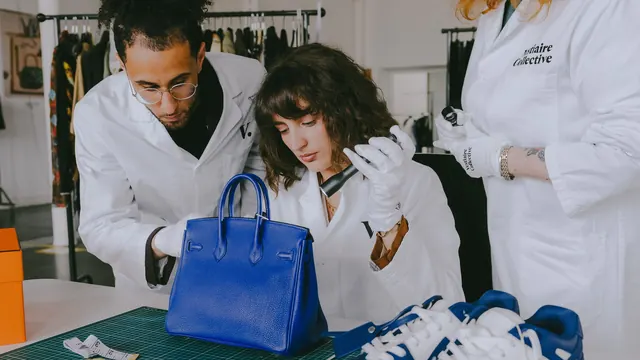
At luxury resale platform Vestiaire Collective’s largest authentication warehouse, situated in an old spinning mill in Torcoing, northern France, security personnel escort guests through the metal gates and into the discreet red brick building where they must place their bags in lockers before proceeding further. The factory floor is bustling with workers in white Vestiaire Collective lab coats, unpacking items as they arrive by conveyor belt, authenticating them, checking their condition and packaging them up again to send to sellers across the world.
Vestiaire Collective has always taken a multi-step approach to authenticating luxury goods to prevent counterfeits and fraud. But now it faces a new challenge.
Shortly after the lootings that took place across France and Italy from October 17, reports emerged of stolen goods appearing on popular resale platforms. Luxury brands including Louis Vuitton, Dior, Celine, and Hermès are some of the most sought-after labels on Vestiaire.
Now, the marketplace is taking measures to avoid reselling stolen goods from Milan and Paris shop floors.
On Monday, October 19, following the weekend’s unrest, the Vestiaire team held an emergency meeting to brief their commercial and legal departments on how to spot suspicious listings. Employees were instructed to look out for new profiles uploading multiple never-before-worn pieces in short succession.
“Following the recent incidents, we’ve held meetings with several brands and authorities,” says Victoire de Coutard, Vestiaire Collective’s senior brand manager and authentication specialist. “Brands are sharing identifying details and product-specific information with our teams to help identify potentially stolen goods.” Vestiaire is also verifying all new members, she adds.
“If you have an account made two days ago with never worn Celine, it’s a bit suspicious.”
The French government has warned that buyers, as well as sellers, could face legal consequences for purchasing goods stolen during the recent looting. For resale platforms, like Vestiaire Collective, that are founded on the principles of buyer and seller trust, the challenge isn’t only to determine whether a luxury good is genuine, but whether it can legally be sold.
With continued unrest across France, the marketplace is keeping a close eye on the situation as it develops, Francisco says. If suspected stolen items are uploaded to the platform, listings will be removed, seller accounts restricted and verified proof of provenance or purchase will be required before the item can proceed.
“Establishing whether a specific item has been stolen requires verified ownership and police records so our operational response relies heavily on our longstanding relationships with brand rights holders, retailers, or e-tailers and public authorities in France and abroad,” he says.
“When anomalies are detected, we take appropriate preventative measures,” Victoire de Coutard, Vestiaire Collective’s senior brand manager and authentication specialist, adds, “including quarantining listings to demand verifiable proof of purchase and systematically complying with official judicial requisitions to support police investigations.”
The platform also maintains direct channels of communication with brands, which can alert respective teams to potentially stolen merchandise. Some luxury products have unique serial numbers or other identifying features that can help with identification. “We work with the French authorities, including the police, on official requests,” de Coutard says. “Brands inform us of suspicious items and prototypes.”
Also on October 19, France’s Minister of the Economy, Roland Lescure, called an emergency meeting to address the issue of suspected looted goods re-emerging on resale sites. Platforms including Vinted, Ebay and Leboncoin were briefed on measures to prevent the resale of these goods, he said, including regular reporting of their enforcement activities to the authorities, with the first report expected within 48 hours of the briefing.
Vestiaire Collective did not attend the meeting itself, but was represented by the Fédération du e-commerce et de la vente à distance (FEVAD), of which it is a member.
The ministerial meeting primarily addressed mass-market, peer-to-peer resale platforms and open classified sites handling massive volumes of uncurated, low-cost goods, de Coutard says. While no platform can be completely immune to stolen goods, she explains that Vestiaire operates a “highly controlled” model, relying on both advanced technology and specialized human expertise to curate and authenticate items. “Consequently, we were not the primary target of these specific governmental discussions,” adds de Coutard.
The authentication process combines human expertise and AI integration to flag any suspicious activity and ensure that listings follow commercial industry standards. Following those standards means not only identifying counterfeit and stolen goods, but also flagging fur, exotic skins and ivory that cannot legally be exported — protecting the anonymity of high-profile sellers and preventing buyers from returning counterfeit items in place of the genuine products they purchased.
Items listed from employee or family and friends sales are sometimes removed, but those sellers will not be banned from the platform. “If there has been a conversation with the brand about a recent employee sale, [for example] we send the product back to the seller,” says authentication site director Henric Hadrien. He did not disclose which brands Vestiaire is in communication with.
Once an item has passed these initial checks, it arrives at the center, where specialist authenticators examine details such as typography, stitching, engraving and materials, using tools including UV lamps and magnifying glasses to spot counterfeits. Finally, quality control inspectors check that the item’s dimensions, color and stated condition match its listing.
How to spot stolen
While specialist authenticators are highly skilled at spotting fakes, identifying stolen goods can be much trickier. During busy periods, such as next month’s Black Friday sale, between 1,500 and 3,000 items are expected to be uploaded to Vestiaire Collective each day of the week-long retail holiday.
When processing such a high volume of product, especially following a mass looting event, it is incredibly difficult to identify whether an item has been stolen or not. “It’s not difficult to create five different accounts and post across them,” says Hadrien.
“Sometimes, it’s impossible to know if you don’t have the serial number.”
Prior to the lootings, the company has received alerts from the Italian and German police that items on the platform may have been stolen, based on “alerts following official complaints or a police report filed by the victim, whether an individual or a brand,” says de Coutard.
“We removed the item from the site and processed it in a discreet way that does not alert the seller right away, and we follow the instructions of the police,” Hadrien adds. “If there is enough reason to believe it has been stolen, we will ship it to the police, coordinating with our legal team and the national police department. If the buyer has already received it, they will be reimbursed.”
Following the looting on October 17, businesses prepared for further unrest ahead of the next protest on October 24. Many luxury brands boarded up their stores and hired private security in anticipation.
But the scale of the damage was markedly reduced. According to a preliminary government report, 24 businesses were looted across France on October 24, compared with 1,522 a week earlier.
While the scale of the looting has decreased, for resale platforms like Vestiaire Collective, the challenge of identifying potentially stolen goods will continue in the weeks and months to come.
“Following the recent incidents in France, we anticipate further alerts as investigations progress,” concludes de Coutard, “and we are already in direct communication with some French authorities, remaining fully mobilized to cooperate with maximum speed and diligence.”