
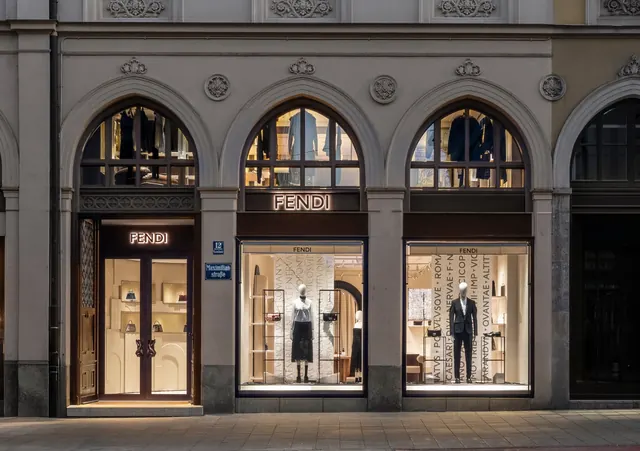
The Fendi Munich boutique by Alessandro Saletta for Fendi.
Shopping for a new Fendi bag in Munich now comes with a side of contemporary art. Earlier this week, the Italian Maison has opened a new boutique on Maximilianstraße , spreading its collections across three floors of a historic building where Roman-inspired architecture, tactile materials and works by local artists share the same address.
The boutique’s opening was celebrated with a launch dinner, bringing together guests from the worlds of fashion and culture. Among those in attendance were Hannah Müller-Hillebrand , Kiala Kanzi and Moritz Hau , joining Fendi to mark the arrival of its new store.
Covering 280 square metres, the space takes its cues from Palazzo Fendi Milano and the house’s Roman heritage, beginning with geometric flooring inspired by ancient Roman homes and handmade bas-relief detailing. The entrance door has been left untouched, preserving its original wooden features and bronze handle, while further inside, ribbed travertine and sculptural Ascoli marble sit alongside an original architectural column. A glass staircase and textured-glass lift introduce a more contemporary counterpoint.
The boutique’s artistic connections become particularly interesting as visitors move upstairs. On the way to the first floor, a work by Israeli-American artist Ronen Azulay gives discarded materials a second life, using leather, textiles and reclaimed denim to build layered compositions.
In the men’s section, cardboard becomes the unlikely star of local artist Florian Baudrexel ’s wall reliefs, whose enlarged grids and architectural shapes recall models pulled from an architect’s studio and scaled up into artworks.
The women’s ready-to-wear collection occupies the second floor, where a grand semi-domed space takes inspiration from Munich’s National Theatre. Neutral travertine flooring and the building’s original parquet set the scene for two salons punctuated by works from German artist Anna Fasshauer . Known for transforming aluminium with industrial paints and vivid colours, Fasshauer creates enlarged, playful forms that appear to soften the material’s industrial character into something almost human.
Elsewhere, the men’s shoe area introduces handmade green tiles in three shades, arranged in an irregular pattern that recalls rippling water. The men’s VIP room, hidden by a perforated nickel-silver door, draws on Piero Portaluppi’s Villa Necchi Campiglio in Milan, while the women’s private salon borrows its palette and design cues from Linderhof Castle, complete with a geometric console by Thierry Lemaitre.
Across the boutique, Fendi’s handbags, ready-to-wear and accessories sit within an interior that gives equal attention to craftsmanship, architectural history and contemporary creativity. Discover more here .
photography. courtesy of Alessandro Saletta for Fendi words. Gennaro Costanzo
Londoners know the Selfridges effect: you walk in for one thing and emerge having discovered an entire new fashion corner of your taste. In Istanbul, COMMUNITÉ is chasing that same pleasure of the unexpected, with a distinctly Turkish identity and a 1970s-inspired interior that makes wandering between fashion, design and beauty part of the appeal.
Developed by Boyner Group , the new 4,300-square-metre retail concept has opened earlier this May its Galataport Istanbul location and is now celebrating its grand opening with the ambitious proposition of creating a store where discovering something new matters as much as buying it.
“We believe an idea born in Türkiye can resonate around the world,” says Cem Boyner , Chairman of the Board of Boyner Group. “With COMMUNITÉ, we wanted to take a fresh look at what we had been doing. We saw an opportunity to go beyond gaining a share of the existing market and develop a new shopping culture.”
Connected across four levels, the space brings together more than 400 brands spanning fashion, beauty, wellness, homeware and design, with international houses sharing the shelves and rails with emerging labels from Türkiye and beyond. Comme des Garçons, JW Anderson, Yohji Yamamoto and Dries Van Noten sit alongside contemporary names such as Paloma Wool, Gimaguas, Wales Bonner and Willy Chavarria, while Turkish labels including Nackiye, Lug von Siga and Faraway add a local perspective.
Elsewhere, Maison Francis Kurkdjian, Creed, Goop, Lalique and Georg Jensen extend the selection into fragrance, skincare and living.
COMMUNITÉ, launch party with Polat Uyal, Sebla Refiğ Devidas, Cem Boyner and Ümit Boyner.
Neslihan Denizer , Head of Creative at COMMUNITÉ, describes the ambition as creating “a Turkish Selfridges”, with the emphasis on browsing, discovery and a sense of belonging. “We want to give the feel of a museum that the customers can explore,” she says.
There is one important distinction: unlike a museum, every piece on display here can be purchased directly from the floor, making the furniture and design objects that shape the interiors part of the offering, too.
From the furnishings and colour palette to the carefully considered atmosphere, each department has its own character. The menswear floor brings together established tailoring and contemporary labels, with names such as Rubinacci, Baracuta and Maison Kitsuné among the selection.
Upstairs, the womenswear offering includes Dries Van Noten, JW Anderson and Simone Rocha, alongside labels taking a more experimental approach to dressing. A dedicated area for shoes and bags features Mach & Mach, Paris Texas, Mansur Gavriel and By Far, while the home and living selection introduces design pieces from Nilufar Gallery, Lalique and Georg Jensen.
Across the store, the arrangement encourages unexpected discoveries between categories: an art book beside a fashion collection, or a design object catching the eye next to a sneaker.
COMMUNITÉ, ceramics floor and CEO Polat Uyal.
COMMUNITÉ, Sebla Refiğ Devidas and menswear floor.
Speaking to Schön!, CEO Polat Uyal explains that the name itself grew out of the idea of bringing people and creative disciplines together. Initially known internally as ‘Project Horizon’, the concept eventually took its name from the community it hopes to build.
Uyal also had a personal hand in shaping the aesthetic, drawing on his affection for 1970s design through the furniture, colours and furnishings. Although the building itself is only two years old, the atmosphere is intended to be warm and lived-in, with the team keen to create somewhere people can spend time without feeling obliged to buy anything.
“We wanted to create a beautiful, comfortable place where you could come and enjoy your coffee, even if you didn’t want to buy anything,” Uyal explains. “It’s like a third place.”
Local talent becomes a forefront attraction across the floors, with Turkish designers and makers brought into conversation with established international names, giving visitors the chance to encounter labels they might not otherwise know. “In Türkiye, we met local makers and a new generation of designers,” says Sebla Refiğ Devidas , Chief Merchandising Officer of COMMUNITÉ.
“We can present an established name and a designer who is just starting out with the same enthusiasm. We love it when someone looking at a familiar label notices a brand they have never heard of before.”
COMMUNITÉ, Oslo Made in Heaven installations.
COMMUNITÉ, Oslo Made in Heaven and Constantin Brancusi-inspired installations.
During the opening celebration, edible installations by Milan-based creative studio Oslo Made in Heaven appeared across the different levels, beginning with rose-shaped Rose Coupe desserts on the beauty floor. On menswear, towering halva structures spelling out COMMUNITÉ drew inspiration from the sculptures of Constantin Brancusi, with miniature versions served for guests to taste.
The womenswear floor featured a winding installation of Turkish delight, where twin performance artists led games, while the home, shoes and bags area was filled with suspended Princess Cakes whose mirrored undersides multiplied the display overhead.
The store’s setting is equally relevant to its ambitions — and one that is bound to achieve all of them as it continues to expand. Galataport occupies the Karaköy waterfront, an area long associated with maritime trade and Istanbul’s connections to the wider world.
Since the redevelopment opened in October 2021, the former port has become a 1.2-kilometre waterfront destination, with a public promenade, an underground cruise terminal, restaurants, shops and cultural venues. The opening of the Renzo Piano-designed Istanbul Modern in 2023 further strengthened the area’s relationship with contemporary art, making COMMUNITÉ’s combination of retail, design and hospitality part of a wider shift in how the waterfront is experienced.
Il Gattopardo, Italian restaurant at COMMUNITÉ.
The hospitality offering comes into focus upstairs at ‘ Il Gattopardo ’, the Italian restaurant making its debut at the top floor. Already established in London’s Mayfair and Dubai’s DIFC, the restaurant brings its interpretation of Italian dining and ‘La Dolce Vita’ to the Bosphorus. Named after Giuseppe Tomasi di Lampedusa’s celebrated novel, it centres on Italian classics and seasonal ingredients, with executive chef Massimo Pasquarelli drawing on the produce Türkiye has to offer.
“Istanbul is a city where cultures, flavours and people come together, and that makes it a wonderful place to cook,” Pasquarelli says. “After London and Dubai, we are bringing our menu to the Bosphorus, rooted in Italian classics and seasonal ingredients, while drawing on the exceptional produce Türkiye has to offer.”
With its first Istanbul location at İstinyePark and a further store planned for Bağdat Caddesi in 2027, COMMUNITÉ is building a retail community that extends beyond the shopping trip. At Galataport, that might mean coming in search of a designer, discovering a new Turkish label along the way and ending the afternoon upstairs over a plate of pasta.
photography. courtesy of COMMUNITÉ words. Gennaro Costanzo
New Balance is taking a trip back to the 2000s, but the running shoe in question has its eyes firmly set on the future. The new 983 , the sportswear label’s latest lifestyle silhouette, revisits the shapes and technical details of its performance-running archive before giving them a more contemporary spin.
The design plays with curves, textures and proportions, pairing rounded overlays with wave-like mouldings across the midsole and outsole. Its signature feature is the elliptical ABZORB SBS cushioning pods, whose chunky forms give the shoe a distinctive profile, while the familiar ‘N’ logo keeps the design in New Balance territory.
Colour-wise, the shoe aims for a futuristic, almost sci-fi approach, arriving in shadow blue, shadow red and field green. Reflective detailing, a dual-density midsole and a stitched collar add further technical touches, keeping the 983 connected to its athletic origins even as it finds a place in everyday wardrobes.
To introduce the model, New Balance has brought together once again tennis champion Coco Gauff and rapper Aminé for a campaign exploring the many sides of personal style. Gauff has previously appeared in their Miu Miu capsule collaboration for the launch of the 530 SL sneakers.
This time, the duo takes different directions with their individual aesthetics, demonstrating how one silhouette can move between contrasting wardrobes, making room for the wearer to experiment without losing its identity.
For Gauff, that freedom was part of the appeal from the start. “The idea for the campaign actually came from a vision meeting I had with the New Balance team.
I thought it would be cool to showcase the different sides of my personality through style,” she says. “It was fun bringing the vision to life with Aminé and getting creative with styling the shoe in different ways.
I love pieces that are fashion-forward but still easy to wear, and the 983 goes with any outfit.”
With its mix of early-millennium running references and more progressive design details, the 983 sits comfortably between sportswear nostalgia and modern street style, offering a new option for those whose wardrobes rarely stick to one mood.
The New Balance 983 is now available globally online and at selected retailers. Discover more here .
photography. courtesy of New Balance words. Gennaro Costanzo
All Louis Vuitton ’s handbags are masterpieces in their own way, so why not celebrate their timeless designs among some of the greatest artists of our time? At this year’s Art Basel Paris , the Maison is offering the Capucines a little art history lesson, bringing seven years of artist-designed bags together at the Grand Palais from 23 to 25 October.
The presentation marks a new chapter for Artycapucines, the project that has invited contemporary artists to turn the House’s signature leather silhouette into a canvas for their own ideas.
Set on the Balcon d’Honneur, the exhibition brings together 14 artists, with their original works displayed alongside the bags they inspired. The setting takes its cues from art shipping and archival storage, with open crates, aluminium plinths and trunk-like structures recalling the journey artworks make between studios, galleries and collectors.
And it shouldn’t come as a surprise its inherent tribute to Louis Vuitton’s origins as a trunk-maker — even as the exhibition looks firmly towards contemporary art.
Since Artycapucines began in 2019, the collection has become a meeting point for wildly different approaches to making art. American artist Alex Israel ’s ‘Cut-Out-Fin (Golden Hour)’ (2019) brings his colourful, cut-out aesthetic into view, while Swiss artist Urs Fischer ’s ‘Fruits’ (2026) sits alongside a bag featuring a suspended banana.
American painter Sam Falls ’ ‘Western Wind’ (2025) echoes the botanical impressions found in his design, while fellow American artist Tschabalala Self ’s ‘Kitten’ (2026), composed of painted and textile elements, reflects the layered treatment of figures that runs through her work.
Elsewhere, German artist Gregor Hildebrandt ’s ‘Ich möchte eiskunstlaufen (Lebanon Hanover)’ (2019), made using cassette tape, offers a contrast of surfaces and graphic patterns. American sculptor Kennedy Yanko brings a different material sensibility with ‘Because of its blues’ (2025), while Malawian-born, South African artist Billie Zangewa ’s embroidered-silk work ‘Soldier of Love’ (2020) highlights the possibilities of textile.
The retrospective also revisits the Maison’s longstanding artistic partnerships, including Japanese artists Takashi Murakami and the late Yayoi Kusama, whose ‘Great Gigantic Pumpkin’ (2023) joins the display, alongside fish-shaped lamps by Canadian-American architect Frank Gehry .
A new Artycapucines collection dedicated to American artist Keith Haring adds another chapter to the project. Comprising 13 limited-edition designs and developed with the Keith Haring Foundation, the collection draws on the artist’s lively figures, dancing silhouettes and running heart which appear across the bags.
Among the standout pieces is the Capucines Nano Running Heart, a silver-toned evening bag covered in more than 12,000 hand-set crystals, while the Capucines East-West Mini Maze takes an intricate route, with thousands of beads and traditional embroidery requiring around 240 hours of work. The Capucines BB Holiday looks beyond New York to a drawing Haring created in Naples in 1983, featuring interconnecting dolphins and human figures.
Perhaps the most poignant connection, however, lies in the Capucines MM Genesis and Valisette Genesis, inspired by a 1930s Louis Vuitton suitcase that Haring customised in 1984 with his signature Radiant Baby figures.
Open to the public at the Grand Palais until 25 October, the retrospective places the Capucines at the intersection of collectible design, contemporary art and the Maison’s leather-working heritage. The Keith Haring Artycapucines collection will be available in Louis Vuitton stores worldwide from 1 January 2027. Discover more here .
photography. courtesy of Ophelie Maurus for Louis Vuitton words. Gennaro Costanzo