
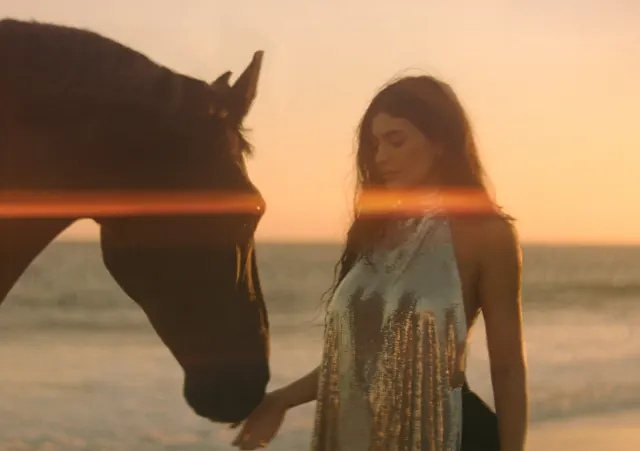
Kylie Jenner by Gia Coppola for Stella McCartney.
Days after making her runway debut as a Victoria’s Secret Angel, Kylie Jenner has found a more unpredictable co-star: a horse. In ‘ Wild Horses ’, Stella McCartney ’s new Winter 2026 campaign film, directed by Gia Coppola , Jenner immerses herself in water alongside a trained horse, sharing the frame with one of the designer’s lifelong passions. Horses have been part of the McCartney family story for decades, long before they became fashion’s latest leading characters.
Conceived by Stella herself, the film celebrates “the power, sensitivity and freedom of the horse”, continuing the house’s long-standing exploration of the relationship between humans and animals. The imagery centres on coexistence, care and mutual respect, while behind-the-scenes footage offers a closer look at the campaign’s making. The American Humane Society monitored the animal action, and no animals were harmed during filming.
“This campaign is born out of a very heartfelt and deep, historical love of horses. I was brought up riding horses, even when I was in my mum’s womb, riding her own Appaloosa stallion across the hills of Scotland,” says McCartney.
“The majesty and magnificence, the strength, the pride, the beauty, the delicacy, the healing and the love that horses give – this collection is deeply inspired by these incredible creatures and our relationship with them as humans.”
McCartney grew up around Appaloosa horses on her family’s farm in East Sussex, including Lucky Spot, her mother Linda McCartney’s treasured stallion. That connection inspired the new Appaloosa bag, a soft, unstructured design handcrafted in Italy from vegan leather alternatives.
For Winter 2026, the bag comes in black, whipstitched red and leopard jacquard, alongside two bucket sizes and a crossbody wristlet style. Its equestrian inspiration carries a personal significance, tying the accessory to the designer’s childhood and enduring affection for horses.
The film also offers a glimpse of colourful charms created in collaboration with ‘My Little Pony’, first seen on the Winter 2026 runway and due to arrive in December. Beyond the fashion, ‘Wild Horses’ draws attention to the vulnerability of America’s wild horse populations, with Stella McCartney set to donate to equine welfare charities around the world.
photography. courtesy of Gia Coppola for Stella McCartney words. Gennaro Costanzo
The Fendi Munich boutique by Alessandro Saletta for Fendi.
Shopping for a new Fendi bag in Munich now comes with a side of contemporary art. Earlier this week, the Italian Maison has opened a new boutique on Maximilianstraße , spreading its collections across three floors of a historic building where Roman-inspired architecture, tactile materials and works by local artists share the same address.
The boutique’s opening was celebrated with a launch dinner, bringing together guests from the worlds of fashion and culture. Among those in attendance were Hannah Müller-Hillebrand , Kiala Kanzi and Moritz Hau , joining Fendi to mark the arrival of its new store.
Covering 280 square metres, the space takes its cues from Palazzo Fendi Milano and the house’s Roman heritage, beginning with geometric flooring inspired by ancient Roman homes and handmade bas-relief detailing. The entrance door has been left untouched, preserving its original wooden features and bronze handle, while further inside, ribbed travertine and sculptural Ascoli marble sit alongside an original architectural column. A glass staircase and textured-glass lift introduce a more contemporary counterpoint.
The boutique’s artistic connections become particularly interesting as visitors move upstairs. On the way to the first floor, a work by Israeli-American artist Ronen Azulay gives discarded materials a second life, using leather, textiles and reclaimed denim to build layered compositions.
In the men’s section, cardboard becomes the unlikely star of local artist Florian Baudrexel ’s wall reliefs, whose enlarged grids and architectural shapes recall models pulled from an architect’s studio and scaled up into artworks.
The women’s ready-to-wear collection occupies the second floor, where a grand semi-domed space takes inspiration from Munich’s National Theatre. Neutral travertine flooring and the building’s original parquet set the scene for two salons punctuated by works from German artist Anna Fasshauer . Known for transforming aluminium with industrial paints and vivid colours, Fasshauer creates enlarged, playful forms that appear to soften the material’s industrial character into something almost human.
Elsewhere, the men’s shoe area introduces handmade green tiles in three shades, arranged in an irregular pattern that recalls rippling water. The men’s VIP room, hidden by a perforated nickel-silver door, draws on Piero Portaluppi’s Villa Necchi Campiglio in Milan, while the women’s private salon borrows its palette and design cues from Linderhof Castle, complete with a geometric console by Thierry Lemaitre.
Across the boutique, Fendi’s handbags, ready-to-wear and accessories sit within an interior that gives equal attention to craftsmanship, architectural history and contemporary creativity. Discover more here .
photography. courtesy of Alessandro Saletta for Fendi words. Gennaro Costanzo
All Louis Vuitton ’s handbags are masterpieces in their own way, so why not celebrate their timeless designs among some of the greatest artists of our time? At this year’s Art Basel Paris , the Maison is offering the Capucines a little art history lesson, bringing seven years of artist-designed bags together at the Grand Palais from 23 to 25 October.
The presentation marks a new chapter for Artycapucines, the project that has invited contemporary artists to turn the House’s signature leather silhouette into a canvas for their own ideas.
Set on the Balcon d’Honneur, the exhibition brings together 14 artists, with their original works displayed alongside the bags they inspired. The setting takes its cues from art shipping and archival storage, with open crates, aluminium plinths and trunk-like structures recalling the journey artworks make between studios, galleries and collectors.
And it shouldn’t come as a surprise its inherent tribute to Louis Vuitton’s origins as a trunk-maker — even as the exhibition looks firmly towards contemporary art.
Since Artycapucines began in 2019, the collection has become a meeting point for wildly different approaches to making art. American artist Alex Israel ’s ‘Cut-Out-Fin (Golden Hour)’ (2019) brings his colourful, cut-out aesthetic into view, while Swiss artist Urs Fischer ’s ‘Fruits’ (2026) sits alongside a bag featuring a suspended banana.
American painter Sam Falls ’ ‘Western Wind’ (2025) echoes the botanical impressions found in his design, while fellow American artist Tschabalala Self ’s ‘Kitten’ (2026), composed of painted and textile elements, reflects the layered treatment of figures that runs through her work.
Elsewhere, German artist Gregor Hildebrandt ’s ‘Ich möchte eiskunstlaufen (Lebanon Hanover)’ (2019), made using cassette tape, offers a contrast of surfaces and graphic patterns. American sculptor Kennedy Yanko brings a different material sensibility with ‘Because of its blues’ (2025), while Malawian-born, South African artist Billie Zangewa ’s embroidered-silk work ‘Soldier of Love’ (2020) highlights the possibilities of textile.
The retrospective also revisits the Maison’s longstanding artistic partnerships, including Japanese artists Takashi Murakami and the late Yayoi Kusama, whose ‘Great Gigantic Pumpkin’ (2023) joins the display, alongside fish-shaped lamps by Canadian-American architect Frank Gehry .
A new Artycapucines collection dedicated to American artist Keith Haring adds another chapter to the project. Comprising 13 limited-edition designs and developed with the Keith Haring Foundation, the collection draws on the artist’s lively figures, dancing silhouettes and running heart which appear across the bags.
Among the standout pieces is the Capucines Nano Running Heart, a silver-toned evening bag covered in more than 12,000 hand-set crystals, while the Capucines East-West Mini Maze takes an intricate route, with thousands of beads and traditional embroidery requiring around 240 hours of work. The Capucines BB Holiday looks beyond New York to a drawing Haring created in Naples in 1983, featuring interconnecting dolphins and human figures.
Perhaps the most poignant connection, however, lies in the Capucines MM Genesis and Valisette Genesis, inspired by a 1930s Louis Vuitton suitcase that Haring customised in 1984 with his signature Radiant Baby figures.
Open to the public at the Grand Palais until 25 October, the retrospective places the Capucines at the intersection of collectible design, contemporary art and the Maison’s leather-working heritage. The Keith Haring Artycapucines collection will be available in Louis Vuitton stores worldwide from 1 January 2027. Discover more here .
photography. courtesy of Ophelie Maurus for Louis Vuitton words. Gennaro Costanzo
It was in 1998 that Puma and Jil Sander first joined forces, bringing the sportswear giant together with the pared-back minimalism long associated with the German designer. Now, almost three decades later, the labels have returned for Autumn/Winter 2026 , extending their renewed partnership into apparel for the first time while revisiting two familiar footwear designs.
Under the creative direction of Simone Bellotti , the latest collection takes three Puma signatures, the T7 tracksuit, Speedcat and Suede, and gives each a new perspective through Jil Sander’s design language.
“With this chapter I wanted to slow everything down,” says Bellotti, with this idea resonating across the collection’s campaign. Photographed by Guen Fiore and filmed by Lisa Rovner , the visuals star Meadow Walker alongside Barry Lawson in a landscape of tall grass and wildflowers.
With the cast dressed in pieces intended for leisure and the outdoors, the imagery places urban sportswear against a more natural setting, capturing what Bellotti describes as a moment “suspended between city and nature”.
The original collaboration began when Jil Sander reimagined Puma’s football lace-ups as luxury leather sneakers, bringing a fashion perspective to familiar sporting designs. After returning in October 2025 with the KING AVANTI in premium leather, the partnership continued with the K-STREET in April of this year, setting the foundations for this latest instalment.
Leading the apparel debut is a reworking of the T7 tracksuit, first introduced in 1968 as Puma’s inaugural apparel line. Named after its seven-centimetre Formstrip, the design takes on a new silhouette through Bellotti’s interpretation, comprising a boxy track jacket and tapered trousers cut from bi-stretch wool developed exclusively for Jil Sander.
Finished in a custom Club Navy, the set features a brushed-silver branded zip puller and co-branded woven label, while a relaxed, boxy long-sleeved top in white, made from cotton and recycled polyester, completes the offering.
Footwear revisits two familiar Puma designs through considered changes to their construction. The motorsport-inspired Speedcat returns as an archive reissue in all-black and all-white leather, finished with an artisanal leather heel detail developed by Bellotti and a full leather lining. The Suede, meanwhile, arrives exclusively in white premium leather, with a revised outsole, concealed lacing and leather lining for a pared-back finish.
The Puma x Jil Sander AW26 collection is now available globally at Jil Sander and Puma stores and online. Discover more here .
photography. courtesy of Guen Fiore for Puma and Jil Sander words. Gennaro Costanzo