
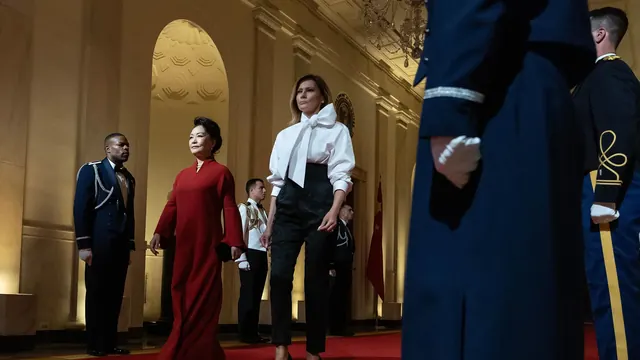
A First Lady’s wardrobe will never be apolitical—Melania Trump is among those that have come to learn this lesson. During state visits especially, clothes enter a new lexicon of diplomacy, where the choice of colors, designers, and silhouettes innately acquire symbolism and signal allegiances.
How a spouse chooses to inhabit a highly visible but largely undefined role is visually articulated through their fashion. This week in Washington, Mrs.
Trump and Madame Peng Liyuan provided a particularly compelling study in contrasts.
The two women have developed markedly different approaches to First Lady style. Trump is grounded in sharply controlled silhouettes, vertiginous heels, and a roster of major European houses, her life before and after FLOTUS-dom having rarely been far from view. Peng (who has served as China’s First Lady since 2012) has made Chinese design central to her public wardrobe, favoring domestic designers and contemporary iterations of traditional silhouettes.
Their reunion came as Chinese President Xi Jinping and Peng arrived in Washington on Wednesday for a three-day state visit. Donald and Melania Trump personally greeted the couple at Joint Base Andrews—a rare departure from presidential protocol, and the first time a president has welcomed a world leader in over 50 years—before Thursday’s elaborate White House arrival ceremony, which involved hundreds of members of the U.S.
Armed Forces and culminated in a military flyover. The visit comes as the two presidents are discussing an extensive list of economic and geopolitical issues, from trade to artificial intelligence.
Peng began communicating her own sartorial vocabulary as she arrived off of the plane, wearing a slate-gray, waist-cinching dress with a Chinese collar and small qipao-style slits cut into the long skirt, paired with a silky, pale pink scarf. It had all the hallmarks of Peng’s diplomatic wardrobe.
The difference between the two First Ladies was made particularly stark on Thursday morning. For the formal White House welcome, Trump wore a severe black Alexander McQueen look: a wool-and-mohair tweed jacket sculpted close to the body, with an asymmetric fastening and high wrapped neckline, paired with a matching knee-length skirt and black Christian Louboutin pumps.
She kept the look on for her subsequent engagement with Peng at the Smithsonian’s National Museum of Asian Art. It was classic Melania Trump in its taut shape and monochromatic palette.
For the museum visit, Peng wore a deep navy velvet dress with long sleeves and a white-piped traditional collar, fastened with a diamond-and-silver brooch. The two women toured James McNeill Whistler’s Peacock Room and viewed works related to centuries of artistic exchange between China and the United States before meeting local students. It was their first public appearance together since 2017.
While Trump’s wardrobe relies upon the recognizable codes of the European fashion establishment that she has long been accustomed to (Dolce & Gabbana and Dior, especially), Peng has spent more than a decade presenting something more stringently national. Long before Xi became president, Peng was a celebrated soprano and folk singer in China—and, for a time, the more famous half of the couple.
Designer Ma Ke began dressing her years before she became First Lady, and Peng’s public wardrobe subsequently helped draw international attention to Chinese fashion through Mandarin collars, qipao references and locally produced tailoring without obvious logos or ever even confirming designer names.
The arrival ceremony suggested that others understood the communicative potential of clothes at such an event, too. Ivanka Trump appeared in a custom pale-blue look by Beijing couturier Guo Pei, whose work has become one of Chinese fashion’s most internationally recognizable exports (and who went viral in 2015 when Rihanna wore his resplendent yellow gown to the Met Gala).
Ivanka’s robin’s-egg-blue dress and matching jacket featured delicate silver embroidery—a direct sartorial acknowledgment of the visiting delegation. Usha Vance, meanwhile, chose a cobalt-blue, high-neck silk dress by Saloni with Manolo Blahnik pumps.
Ivanka and Vance sat prominently near the front of the ceremony alongside Vice President JD Vance.
And it was at Thursday night’s state dinner that Trump and Peng’s different approaches to dressing for the job came into sharpest focus. The East Room itself had been dressed with symbolic red linens, dahlias, and ranunculus.
The White House explicitly cited red’s longstanding significance in Chinese culture; the meal opened with Schramsberg Blanc de Noirs, recalling the American sparkling wine served during Richard Nixon’s 1972 visit to China. (Melania had led preparations for the evening.)
Rather than reach for the traditional First Lady state-dinner gown, Trump once again swerved traditional and wore trousers. Her oversized white Saint Laurent cotton-poplin blouse was tied into an enormous bow—pussybows being something of a longtime signature—at the neck and tucked into black Dolce & Gabbana cigarette trousers woven with a subtle peony brocade; added to that was a wide black silk cummerbund and her favored pointed Louboutin pumps.
It exemplified Melania’s highly controlled articulation of glamour, where precision is prized over any kind of sentimentality or overt messaging.
Beside her, Peng wore a patriotic red gown which featured a rounded neckline, long flared sleeves, and a loose A-line silhouette, a look she finished with a black velvet clutch and double strand of pearls. While stark in shade, it felt softer when cast in the traditionally inflected silhouettes that have defined her public wardrobe.
The state dinner guest list offered still more variations on public engagement style. The dinner drew a substantial contingent from American technology and business, including Jeff Bezos, who attended with his wife Lauren Sánchez Bezos. Sánchez Bezos, never one to suddenly adopt establishment conservatism for the sake of a presidential invitation, remained firmly within her own style codes: a plunging black evening gown accompanied by a major diamond-and-emerald necklace.
Trump and Peng first met in April 2017, when the Trumps hosted Xi and Peng at Mar-a-Lago in Palm Beach. A few months later, they met again when the Trumps traveled to Beijing.
Xi and Peng received them for tea, a tour, and dinner at the Forbidden City, and both couples attended a state dinner. Nine years later, the dance of world leaders and their spouses is a familiar one: the hard business of presidential diplomacy running alongside a softer program of art, education, food and dress.
In the intervening years, it’s become much clearer how differently these two women employ the latter.
Peng’s wardrobe consistently locates her within China, drawing on domestic design and recognizable elements of Chinese dress. Trump, by contrast, approaches the role through the highly international vocabulary that’s just as high-octane as it was when Trump Tower was her permanent address.
McQueen, Saint Laurent, Dolce & Gabbana, and a stiletto heel. While Peng harnesses fashion as a way to foreground national identity, Trump crowbars her intensely polished personal style into the modern image of a First Lady.
Disappearing into the ceremonial role, though, is not for either woman.