
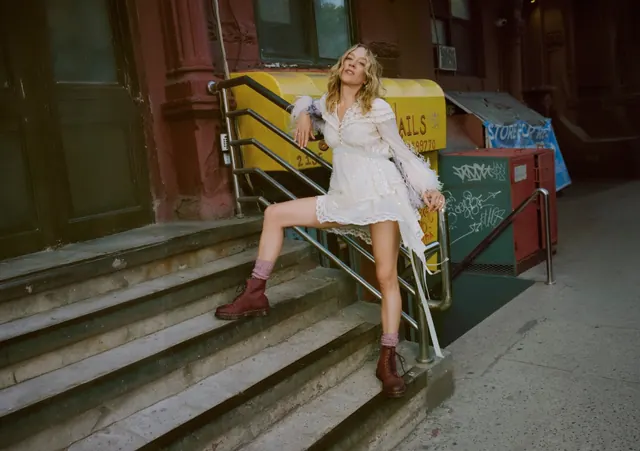
Chloë Sevigny by Brianna Capozzi for Dr. Martens.
The words ‘With Bouncing Soles’ have been sitting on Dr. Martens heel loops since 1960.
Originally a literal tribute to the brand’s air-cushioned soles, the phrase has spent over six decades absorbing the subcultures, grime, and self-expression of the people who laced them up. For Autumn/Winter 2026 , the British heritage label is elevating this archival stamp into a global brand platform, launching a campaign that poses a single question to its community: ‘What Makes Your Sole Bounce?’
The first campaign brings together independent cinema icon Chloë Sevigny , British musician and writer Jordan Stephens and Japanese comedian Naomi Watanabe , each offering their own unvarnished answer to the campaign’s central prompt. “I’ve always been drawn to pieces that become more personal the longer you live in them, and Dr.
Martens has always represented that for me,” says Sevigny. “For me, it’s staying curious – taking on new roles, finding inspiration in unexpected places, and always being open to what’s next.”
The autumn campaign puts the focus back on Dr. Martens’ best-known silhouettes.
The 1460 boot, 1461 shoe, Adrian loafer, 2976 Chelsea boot and 8065 Mary Jane appear in Crazy Horse leather, with a new Cherry Red finish joining the AW26 range. The 1460, 1461 and 8065 also arrive in DM’s Green.
Crazy Horse has been part of the Dr. Martens story since the 1990s and is designed to develop a distinctive patina with wear, making each pair change alongside its owner.
That idea of change is central to the platform. Dr. Martens describes Crazy Horse as a leather in which “no two boots will ever be the same”, with the oils and waxes worked into the material producing its characteristic ageing process. Evolving far past the digital campaign space, ‘With Bouncing Soles’ will continue through real-world creative collaborations, hands-on workshops, cultural programming, retail experiences and community projects designed to support the next generation.
The new Dr. Martens Crazy Horse Icons collection is available to explore online and across select global stockists. Find out more here .
photography. courtesy of Brianna Capozzi for Dr. Martens words. Gennaro Costanzo
Across history, women explorers have unknowingly contributed to some of the modern wardrobe’s most enduring staples. Celebrating those pioneers, Max Mara ’s Spring/Summer 2027 woman appears to have packed for several possible scenarios at once. There are long trenches, oversized trousers, enormous pockets, suede bags and enough fastening belts to suggest that somewhere between Milan and the far horizon, practicality became the main fashion accessory.
Titled ‘Far Horizon’, the collection looks to the travelling women of the 1930s, like Freya Stark, Osa Johnson, Eva Dickson, Amelia Earhart and Beryl Markham. Creative Director Ian Griffiths borrowed from their wardrobes without turning the references into costume: the safari jacket sits at the centre of the collection, appearing in linen and gabardine, but the strongest thread running through the show was tailoring.
Coats dominated the runway. Long trenches arrived in everything from sheer organza to heavier, more substantial fabrics, often pulled in with low-slung belts that wrapped around the body and extended well beyond the waist. Some felt almost architectural; others had the looseness of something borrowed from an explorer’s luggage, particularly when paired with similarly oversized trousers and voluminous chemises.
Belts became a recurring fastening device across the collection, cinching skirts, jackets and trousers while adding another functional layer to the styling. The safari references were most obvious in the abundance of pockets, with cargo and bellows shapes appearing across jackets, vests and coats.
Max Mara even layered cargo vests over matching tailoring, turning what would normally be a functional extra into part of the suit itself. Trousers sat high and came loose through the leg, while shirts and blouses expanded into generous silhouettes.
The clothes carried the authority of traditional tailoring, but the scale and shifting proportions made them much more relaxed.
Suede bags were a particular highlight, arriving in capacious shapes that looked capable of carrying considerably more than a phone and lipstick. The collection’s multi-bags could also shift between crossbody, clutch and rucksack configurations, extending the same utilitarian thinking into the accessories.
The palette stayed close to the landscape that inspired it: white, sand, beige, camel and black, with the occasional richer brown adding depth. There was very little need for colour when texture and proportion were doing so much of the work anyway. As the presentation neared its end, the tough, tactical layers gave way to a series of delicate sheer dresses that closed the runway, softening the utility with an open play on transparency.
Discover the Max Mara Spring/Summer 2027 collection here .
photography. courtesy of Max Mara words. Gennaro Costanzo
Few pieces of clothing attract as much unsolicited commentary as a skirt. Its length can somehow become shorthand for modesty, sexuality, respectability and even character — a subject Italy has found itself debating measurably again this week. Fashion has its own answer, courtesy of Prada who has devoted its entire Spring/Summer 2027 womenswear collection to the skirt.
The timing makes the collection feel particularly pointed, although Prada was already busy with its own argument long before Italy started measuring hemlines. Miuccia Prada and Raf Simons sent 63 looks down the Milan runway, all orbiting the same familiar garment and repeatedly finding ways to make it strange again. Skirts came pleated, wrapped, expanded, layered and sliced into new proportions, with one crystal-covered version becoming an immediate favourite.
The internet has already nicknamed the collection ‘Brada’ thanks to the sheer number of bras involved and the combination was, indeed, hot. Tiny bra tops and bandeaus repeatedly replaced conventional tops, leaving the skirts to do most of the visual work while making the whole collection feel slightly mischievous.
The styling relied on heavy decoration, using contrasting Velcro strips as functional bases for intricate crystal embroideries. The fastening method allows the skirts to adapt dynamically, altering shape through the revealing or concealing of embellishment as they move down the catwalk.
Magnified metal snap fasteners were also jewelled, while crinoline — an internal component — became a decorative outer shell.
The material execution deliberately played with perceptions of weight and utility. Industrial fabrications like matte ciré and Re-Nylon were illogically pressed into delicate plissé pleats, while modest cotton was treated to look like leather or suede.
The collection introduced striking geometric patterns that felt quintessentially Miuccia, running parallel to leather pieces that arrived halfway coated in thick, vibrant splashes of pink, green and white paint. Models navigated the room with heavily frizzled hair, wearing sharp, asymmetrical sunglasses and the archival return of the house’s signature banana-heel shoes.
For a collection built around one garment, there was an impressive amount to look at. And while everyone else is debating how long a skirt should be, Prada is busy demonstrating how many ways it can be.
Discover the Spring/Summer 2027 collection here .
photography. courtesy of Prada words. Gennaro Costanzo
If anyone knew how to weaponise a mirror-ball aesthetic while dramatically rewriting the rules of prime-time television, it was Raffaella Carrà. For Spring/Summer 2027 , Maria Grazia Chiuri channeled that exact Italian pop subversion, transforming the Fendi runway into an expansive, glass-reflected space inspired by Luciano Fabro’s ‘Cubo di specchi’.
Carrà’s legendary 1974 performance of ‘Prisencolinensinainciusol’ alongside Adriano Celentano was the starting point behind this season’s outing. The televised moment was defined by synchronised dancers, independence and a complete refusal to conform — themes that are so dear to Chiuri and the Italian scene overall.
“Raffaella Carrà was certainly, in some way, a mirror for an entire generation,” she says. “In this theatre of mirrors, the audience feels that they are the actors and I believe the fashion show is like a theatre where we all interact with one another.”
Through the glass, the audience was forced into a literal confrontation with the clothes, multiplying the moving bodies across the floor to explore a collection centred mostly on emotional freedom. Using the intimacy of undergarments for both men and women, the collection establishes a lightweight base layer that can conceal or reveal according to the mood of the wearer.
Lace-trimmed bras, bloomers, slips and boxer shorts appeared as visible layers, then disappeared beneath tailoring, coats and dresses. Fishnet socks and tights gave the lingerie story a slightly mischievous edge, particularly underneath the prettier pieces, while unbuttoned shirts and low-cut dresses kept the body firmly in the conversation.
Shearlings also surprisingly returned in the form of plush fur-lined jackets, stoles and shaggy outerwear that landed over everything from delicate lingerie to slouchy denim and slip-on dresses. Chiuri pushed the contrast further with leopard and other animal prints appearing across the look — either as a whole or as understated accents.
There was plenty of tailoring too, although it never stayed particularly respectable for long. Deconstructed tuxedo waistcoats revealed lingerie underneath, jackets were thrown over barely-there layers, and polished suiting sat beside distressed denim and fur. The collection kept jumping between bourgeois and bohemian, masculine and feminine, covered-up and completely exposed.
The bags deserved their own runway. Fendi’s Baguette appeared in an enormous range of treatments, from sequins and fringe to animal patterns and glossy finishes, while reptile textures gave the familiar shape a more exotic attitude. Chiuri also introduced a miniature Baguette designed to fit little more than a phone — a version that will definitely capture the younger audience’s attention.
Fendi’s SS27 was an exploration of fashion that functions without constrictions. Just like the runway is in a loop of endless reflections, Chiuri suggests that what we wear is never just a solitary choice, but a continuous dialogue between who we are and who we see looking back at us.
photography. courtesy of Fendi words. Gennaro Costanzo