
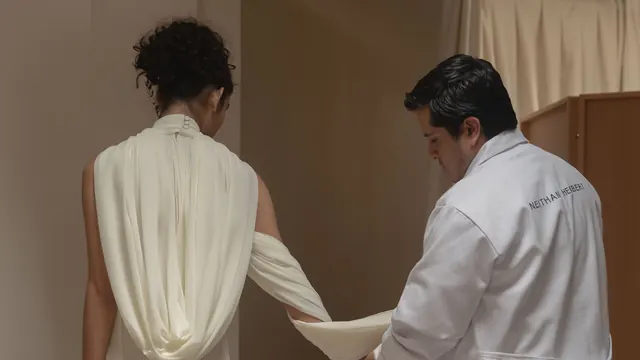
“I have good news, my atelier is coming with me to Milan,” says Mexican Ecuadorian designer Neithan Herbert Ruiz Pillajo, speaking over Zoom from his hometown, San Miguel de Allende. It’s one week out from his eponymous label’s runway debut at Milan Fashion Week on Saturday.
When we last spoke over the summer, Ruiz wasn’t sure he could afford to bring the five Mexican women who weave, cut and sew his garments to Milan to be part of his show.
But when Ruiz’s creative community, many of them artists, jewelers and photographers, heard that Neithan Herbert was headed to fashion week but needed help with funds, they came together, donated their works and organized a fundraiser, so his artisans could join him. “I never expected it, but it was so beautiful,” the designer says. “It feels like the energies are aligning. My community made it happen.”
Ruiz spent his whole life learning how to make clothes. His Inca Ecuadorian mother was an artisan herself, and Ruiz grew up traveling across Ecuador and then Mexico, watching her craft and sell garments using traditional hand techniques at markets and small stores.
At 18, he headed to Italy to study fashion design, fusing his artisanal background with more formal training, and eventually graduated from IED Milano (Istituto Europeo di Design) in 2020. His collections are characterized by hand-pleating, hand-smocking and embroidery, with locally sourced cashmere as a canvas.
Upon graduating, Ruiz was one of five designers selected for the Milano Moda Graduate showcase, hosted by Italian fashion incubator Fondazione Sozzani during Milan Fashion Week. There, he met Michelle Ngomo, founder of the Afro Fashion Association, a non-profit that supports BIPOC designers.
Ruiz soon returned to Mexico to launch his eponymous label in 2021, co-founded with his sister Anga, who manages the operations, but Ngomo remained a mentor, helping secure a slot for Neithan Herbert to show on the official Spring/Summer 2027 calendar. “[At the graduate showcase] everybody was asking where in Italy I produced my collections,” Ruiz recalls.
“I said, ‘Oh my god, this is produced in Mexico!’ People didn’t know designers in Mexico were making this kind of fashion.”
The team working on the show consists of many Mexican talents who believe in what Ruiz is doing. Casting was led by Ignacio Murillo, Vogue’s global casting director, while Carlos Castellanos, founder of agency In The Park management, supported the designer on campaigns and press.
Then, of course, there are the artisans: Gloria Guerrero Sanabria, Emelia Guerrero Sanabria, Daniela Jaramillo Guerrero, Karen Guerrero Sanabria, and Bibiana Crisanto Muñoz. Until Milan, they’d never left Mexico, but the designer intends to make them a part of the show.
“We are planning on a performance, because for me, the brand is all about the people behind it, and I want to pay homage to them,” he says. “I don’t want to say too much, but they will open the show.”
Ruiz has so far built a modest but solid business with small, artisanal collections. “I don’t know how to mass produce.
I don’t know how to maybe get into China and import and export,” he says. “What I know is these communities, so that’s the way I produce and create.” With a Milan show on the horizon, the designer is ready to enter the next phase of his brand, towing that fine line between hand-crafted, artisanal goods, and dipping his toe into the larger production demands of luxury wholesale.
Roots in resort
Neithan Herbert has historically focused on small collections sold in hotel boutiques rather than traditional wholesalers. “I was raised in a resort city, so I think my eye for fashion has always been resort,” he says.
The opportunity arrived after a pop-up he held with other designers back in 2021, where a representative of Rosewood Hotels spotted Ruiz’s designs and asked to sell the pieces at one of the hotels’ boutiques. “We sold 300 pieces at that pop-up in a few days.”
A pop-up customer also recommended Neithan Herbert to a buyer for the boutique at Four Seasons Punta Mita, where Ruiz later held a pop-up of his own. The brand’s Four Seasons capsule sold out in almost a matter of weeks.
Now, Neithan Herbert can be found across several hotels and boutiques across Mexico and the US. “Texas is a big market for me, Austin [in particular], a lot of retail stores there have consignment and emerging brands,” he says.
“So that’s another way for us to grow.”
Following the Milan show, Ruiz is ready to enter more wholesale doors, but with a handful of retailers like those in Austin, who align with his small-batch production. “Everybody wants to do thousands of [units],” he says, “people aren’t thinking about small, unique and more personalized things.”
Already, he’s feeling boosted brand awareness from the Milan debut, with plenty of requests from press and buyers to attend the show. Ngomo is helping Ruiz on that front.
“We didn’t know how to deal with buyers in Italy, because no one we know has ever entered Milan Fashion Week or has even done a showroom,” Ruiz says. “For the moment, I don’t believe in mass production.
So what I’m trying to offer to all the buyers is to find a way to make made-to-measure, small drops, five of a kind, 10 of a kind, and continue with that exclusive way of selling.”
Learning how to scale, slowly
With a strong foundation in resort sales, two years ago, Ruiz began to consider how he could make slightly bigger collections, without losing the quality of his pieces and the techniques behind them. So he went to Puglia to see the factories that produce for brands like Dior and Giambattista Valli. It was there that he met Paulillo Francesco.
“I asked Francesco, I said: I know I’m emerging, so I know you work for all of these big maisons, but how can I enter?” Francesco started mentoring him, and in exchange, Ruiz invited him to San Miguel to train his people in Italian manufacturing, while Francesco learned local techniques like gathering with hand needles. They’ve worked together for two years, and when Ruiz confirmed the Milan debut, Francesco helped him produce half of the collection in Italy, so it could be sold wholesale if buyers do buy in (still in small batches).
The collection includes showpieces, handmade pleats, embroidery, belts and accessories made in Mexico, but the rest of the base garments are made in Italy and can be reproduced. “You cannot believe how magical it is,” Ruiz says.
“I’m so happy to say that half of the collection is made in Italy, and half is made in Mexico. It means a lot to me that I’m also showing in Italy — I have a lot of respect for that industry.”
While there’s much commercial ambition for the collection, Ruiz tried to remain focused on the creativity when designing. “As a creative, you need to think about numbers, economy, business, making this a business, retail, and it can be really stressful,” he says. “But fashion is a dream, I can’t lose that. So my intention for this show is to enter the dream world.”
The collection is loosely based on this idea, playing with shadows and light, and with emphasis on white, which references the sling Ruiz’s mother carried him in when she was a nomad selling her wares at markets across Mexico. The runway will feature fans, Ruiz says, to show the lightness of the fabrics and emphasize the breezy silhouettes.
The whole experience has shown him what’s truly possible when he leans on others. “For me, just to know that I have a community that has my back, and they want this show to succeed, that has been the biggest surprise,” Ruiz says. “We had a budget, but it has increased and increased and increased. So having the support of my community has been a beautiful thing.”
Ruiz Pariello references documentaries based on fashion designers like Lee ‘Alexander’ McQueen and John Galliano, who also wouldn’t have got their starts without support from those around them. “I think I’m in a telenovela sometimes,” he says with a smile. After the fashion show, the next step is opening the brand’s San Miguel de Allende flagship, a small store where he can bring his community together.