
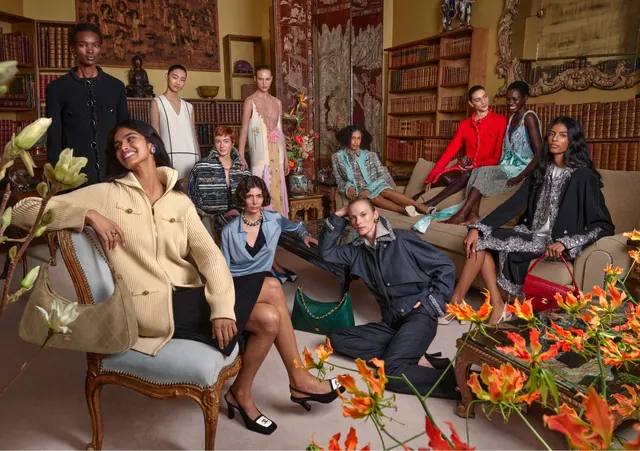
Gabrielle Chanel once imagined the Chanel woman somewhere between a caterpillar and a butterfly, practical by day and transformed by night. Matthieu Blazy has taken that idea seriously for Autumn/Winter 2026 , building a collection around the movement between opposing states and giving familiar Chanel codes new proportions, materials and textures.
Presented at the Grand Palais in March, Blazy’s second ready-to-wear collection for Chanel developed around the house’s capacity to hold contradictions at once. With the change of setting, its story shifts considerably from the cranes and coloured scaffolding that surrounded the collection at the Grand Palais.
The latest campaign, photographed by Julien Martinez Leclerc inside Gabrielle Chanel’s apartment at 31 Rue Cambon, imagines a full house gathering at the legendary Paris address. Models Awar Odhiang , Bhavitha Mandava , Noor Khan , Trinidad Castaño , Xiuli Jiang , Imane Benkaddour , Julia Morais , Adeng Marial , Lais Hames , Stephanie Cavalli and Anne Vyalitsyna linger among the furniture, mirrors, screens and decorative objects that have become part of the mythology of the Maison.
Stuart Winecoff directs the accompanying film, extending the idea of a ‘full house’ at 31 Rue Cambon.
Blazy looked to Chanel’s 1920s silhouettes, including the elongated dropped-waist proportions that appeared throughout the show, while the jacket became one of the season’s most adaptable pieces. Wide-shouldered tailoring, cropped bombers, ribbed knit jackets, tweed and suede were all used to reshape the familiar Chanel silhouette, giving the wardrobe a more fluid relationship with menswear and everyday clothing.
Textiles remain among the collection’s most interesting details. Blazy and the house’s ateliers worked tweed into unfamiliar forms, introduced lurex and gauze, embroidered sequins onto fluid fabrics and experimented with silicone and knitted constructions. Flowers appear throughout that vocabulary, blooming across dresses and accessories while pastel and iridescent tones take the palette towards something lighter and more atmospheric. Against the apartment’s richly layered interior, those colours and textures become even more pronounced.
The bags move between classic Chanel territory and more sculptural forms, including the Hobo Handbag in lambskin and the Lantern Minaudière, a small brown-and-orange case made from lacquered metal, strass and silver-tone metal.
Discover the Chanel Autumn/Winter 2026 campaign here .
photography. courtesy of Julien Martinez Leclerc for Chanel words. Gennaro Costanzo
Nothing about London Fashion Week ever behaves the way you expect it to, and Spring/Summer 2027 carried on that tradition with real enthusiasm. Alongside the big returns, Mulberry’s Christopher Kane debut, McQueen back on home soil and Marks & Spencer finally joining the official schedule, the week’s real energy sat with a run of independent designers using the runway as something closer to a personal manifesto.
Politics turned up uninvited more than once, grief got stitched into fabric and at least one designer spent six months hand embroidering lace as an act of patience. Churches, warehouses and hospital wings all stood in for conventional runway space, and craftsmanship, in Labrum’s case, became the entire subject rather than a footnote.
Schön! went backstage to capture the highlights of London Fashion Week, through the magical lenses of Holly Lavelle , Morgan Layla Williams and Lee Scullion .
Mithridate opened the season with a collection built on London’s ‘New Romantic’ scene, drawing on the Blitz Club era and figures like Steve Strange for a mash-up of Victorian military tailoring and theatrical excess. Feather-covered bodices, tulle-trimmed gowns and candyfloss-pink tutus sat alongside oversized studded denim, shrunken cable knits and broad-shouldered jackets, while Bicorn hats by milliner Noel Stewart and cummerbunds worn over silk shirts rounded out the styling.
Creative director Daniel Fletcher pushed proportion throughout, pairing micro shorts with billowing trenches, and leaned into an unconventional palette of hot pink, scarlet, cornflower blue and acid tones rarely seen together. Fletcher has spoken about wanting the collection to reflect Mithridate’s own growing ambitions, and on this evidence, self-expression without much restraint seems to be exactly where the brand is heading next.
Agro Studio returned to London Fashion Week for its third season on the official schedule with ‘Glass Body’, a collection built around transparency and distorted surfaces. Thousands of antique and discarded buttons were embroidered into garments to mimic shattered glass, while corsetry pulled tight against featherlight tulle and Chantilly lace, marking the first season the London duo’s ready-to-wear has actually been available to buy.
If Madonna’s ‘Confessions II’ has been the summer’s unofficial soundtrack, lilac made a solid case for being its visual equivalent here, turning up across the palette with enough conviction to claim the unofficial title of colour of the season. George Oxby and Angus Cockram , the pair behind the brand, continue to lean on the couture techniques that first made their name dressing Lady Gaga and Madonna, proving those skills translate just as convincingly into ready-to-wear as they ever did into a red carpet showstopper.
Dusty purple and muted blue rounded out the palette, giving the whole collection a slightly worn, lived-in quality instead of expected prettiness.
Bora Aksu took his Spring/Summer 2027 collection inside St Cyprian’s Church in Marylebone, building an entire show around the life of Mary Beale, one of the first women to establish herself as a professional artist in 17th century England, whose own husband gave up his career to manage her studio. Structured menswear tailoring, waistcoats and masculine closures were softened through lace, embroidery and delicate fabrics, with Antep embroidery from Gaziantep, Turkey, some pieces taking up to six months to complete, adding intricate texture throughout.
Veils lent the collection a ceremonial quality, whites and powder blues sitting against black and deep oxblood red, while the show closed with the full cast standing together, a tribute to Beale’s own defiance of the constraints placed on women in her time.
Susan Fang took over the Barbican Centre with ‘Air-Illusion’, a collection unfurling a narrative of fantasy and seduction through pearls, petals and porcelain-inspired detailing. A white mini dress arrived covered in delicate cobalt-blue flowers, while an organza gown carried layers of pale blue and white three-dimensional blooms, and broken porcelain was reworked into jewellery alongside jade repaired with gold in the Japanese kintsugi tradition, worked with a Beijing-based jade master into petal-shaped earrings.
Fang pushed further into 3D printing this season too, rendering lace patterns drawn from porcelain motifs in neon filaments layered over transparent blouses and shorts. The collection’s headline collaboration came via Crocs, introducing the ‘Echo Blume’, the first design built on Crocs’ new Echo Lume silhouette, its surface smothered in metallic 3D-printed wildflower clusters ahead of a global release next spring.
Elsewhere, 3D-printed flip-flops looked like a simple thong from the front and revealed a pixelated, geometric sweep from the side.
Dreaming Eli presented ‘Dreamers in Exile’ at St Bartholomew’s Hospital’s North Wing, with designer Elisa Trombatore reworking memories of a Sicilian childhood and the experience of building a new life in London. Distressed silks, hand-painted surfaces and screen printing referencing Baroque Sicilian churches and tattoo imagery gave the collection real narrative weight, while denim, lace and vinyl were combined to fake a leather-like finish.
Ruffles and pearls were layered to resemble fragments of old photographs, and the returning Wild Hearts Bleed platform heels came back in new blush and rose satin colourways, tying the collection’s romantic distress back to something wearable.
Keburia brought its first ever menswear showcase to a warehouse space at Truman Brewery, opening with a look that had nothing to do with equestrian tailoring at all. The first model walked out with a guitar strapped to his back, painted in red with the words ‘Hope you burn, Putin,’ a blunt political statement from Georgian designer George Keburia that set the tone before a single Western reference even appeared.
From there, exaggerated shoulders, architectural collars and oversized pockets ran through the collection under a loud techno soundtrack, while camouflage and metallic tweed added a utilitarian edge. Rhinestone saxophones and French horns brought unexpected humour, alongside a pig insignia stamped onto belts, all set against a base palette of black, cream, khaki and tobacco lifted occasionally by flashes of red and turquoise.
Keburia has never shied away from politics on the runway, and this season proved no exception.
LABRUM closed its ‘Osmosis’ trilogy with a Spring/Summer 2027 collection staged once again in the grand hall at One Great George Street, this time turning attention to craft itself and the knowledge carried in people’s hands. Handcrafted raffia trousers drew on Mende masquerade traditions, while woven headwear made with British milliner Lucy Barlow and sculptural leather bags connected techniques from West Africa, India and Britain.
One of the collection’s most personal moments came through embroidery depicting Foday Dumbuya ’s grandmother, who worked as a produce seller in Sierra Leone, her story stitched directly onto the garments. A geometric motif referencing Olokun, the Yoruba deity of the sea, ran across white fil coupé, while the label’s signature passport jacquard motif returned once more, built from the dates and destinations stamped across Dumbuya’s own family passports, mapping migration in fabric.
Grete Henriette closed the week with ‘Mourn’, the latest presentation from a designer best known for turning chainmail and gemstones into wearable armour. Having built a cult following through pieces worn by Tems, Tyla and Lil Nas X, Henriette continues to explore ritual, protection and the body as a surface for storytelling, this season leaning into a more elegiac mood than the mythic, divine femininity that shaped her earlier collections, swapping celebration for something closer to reckoning.
photography. courtesy of Holly Lavelle , Hyunji Kim, Morgan Layla Williams and Lee Scullion words. Gennaro Costanzo
Ten years ago, the Apple Watch was still trying to establish itself as something people might wear beyond the gym, while Hermès was synonymous with objects whose appeal came from handwork, materials and fine details. The two companies met in the middle and, a decade later, Apple Watch Hermès has become one of the technology world’s longest-running luxury collaborations.
Its tenth anniversary marked a collection that pushed the relationship further into the territory of illustration, fashion accessories and watchmaking codes, with those ideas continuing into the current Series 12 generation.
First introduced in September 2015, the partnership paired Apple’s tech with Hermès leather bands in Single Tour, Double Tour and Cuff styles. From the beginning, the collaboration treated the strap as part of the identity of the watch, giving the technology a distinctly Hermès point of view without altering the underlying Apple hardware.
The anniversary collection marked a particularly playful chapter for Apple Watch Hermès. The current Apple Watch Hermès Series 12 is available in 42mm and 46mm titanium cases, with the latest generation introducing radiant gold titanium alongside the exclusive silver finish.
The gold model comes with a Noir satin Clou de Selle band, complete with matching gold-finish hardware, while the collection also introduces Rocabar Club, a knitted band inspired by horse-jumping competitions through an elongated H motif rendered in a three-dimensional graphic pattern. The more practical Apple Watch Hermès Ultra has also moved on to Ultra 4, available in a 49mm natural titanium case with its own expanding range of Hermès bands.
The most celebratory addition from the anniversary collection was Faubourg Party, a jacquard-knit band created around an illustration of Hermès’ historic flagship store in Paris. Designed by artist Tibor Kárpáti , the pixel-like drawing translates 24 Rue du Faubourg Saint-Honoré into a miniature architectural world of windows, terraces and rooftop gardens.
The accompanying watch face takes the idea further, featuring 24 animations that change according to the time, weather or date. It gives the familiar interface a building that appears to come alive throughout the day, turning a recognisable physical location into a shifting digital canvas.
Grand H Fin takes the opposite route. Instead of adding more imagery, the bracelet pares the Grand H metal design back to slimmer, more slender proportions. Made from brushed stainless steel in Switzerland, the band features two understated H links framing the wrist, giving the device a jewellery-like presence while retaining classic Hermès watchmaking architecture. The design remains part of the current collection and is available with Series 12 in 42mm.
Animaux Bandana returns to one of the Maison’s most enduring forms of printed storytelling. A lively zoo of horses, toucans, monkeys, parrots and sloths from Shinsuke Kawahara’s eponymous silk scarf is screen-printed onto Swift calfskin. The design brings a casual bandana spirit to the wrist in several seasonal colour combinations, pairing seamlessly with the Double Tour Attelage format to add another layer of equestrian vocabulary to the collaboration.
For the sturdier Apple Watch Hermès Ultra 4, the mood changes completely. Scub’H Diving is made from high-performance fluoroelastomer rubber and features circular, porthole-like perforations, giving the strap a highly technical appearance suited to the larger case. Finished with a secure titanium buckle, the band is lightweight and water-resistant, while the Ultra 4 itself is rated for recreational scuba diving to 40 metres.
The current Ultra 4 range also includes the Grand H Titane band, which brings Hermès’ signature H motif into a titanium construction. Alongside Scub’H Diving, En Mer and other technical designs, it gives the Ultra a distinct vocabulary from the leather and metal straps associated with the smaller Series 12 cases.
The Series 12 collection also expands the partnership’s material vocabulary beyond the designs introduced for the tenth anniversary. Alongside leather, knitted nylon and rubber, Hermès now works with titanium in both cases and bracelets, with the new Grand H titanium band for Ultra 4 offering a different interpretation of the Maison’s signature H motif through a fully technical construction.
Apple Watch itself has also moved considerably since the original Hermès collaboration launched. Series 12 introduces Apple’s new Health Sensing System, with higher-frequency heart-rate and heart-rate variability measurements, alongside a new readiness feature and the S11 chip. Ultra 4 adds the same health-sensing architecture to a more adventure-focused format, alongside up to 50 hours of normal battery life and faster charging.
Over the years, the partnership has steadily accumulated references that sit somewhere between traditional watchmaking and the possibilities of a digital display, ranging from early leather straps and Hermès-inspired dials to Series 4’s colour-blocked designs, the anchor-chain references of Series 7 and the animated Faubourg Party dial.
The new Apple Watch Hermès collection is available to explore online. Discover the full lineup here .
photography. courtesy of Apple Watch Hermès words. Gennaro Costanzo
H&M decided to kick off its latest London Fashion Week show by handing the lights over to a ballerina. Before any of the latest pieces even made an appearance in Kensington, Brazilian dancer Ingrid Silva took to the 40 metre runway, her movement physically triggering the lighting grids to wake up the space — a dreamy opening that felt far more like experimental theatre than a fashion presentation.
Titled ‘ H&M&YOU&I ’, the event marked the retail label’s second consecutive year on the London Fashion Week schedule, once again designed in partnership with British image-maker Nick Knight CBE and his digital platform, SHOWstudio. The production tracked across three separate apparel drops, connecting cinematic atmospheres spanning 1990s Japanese film, Italian noir and historical Sicilian romance.
“This show is a celebration of creativity and of human relationships,” Knight explains. “I wanted to create something that felt romantic, emotional, human and painterly, all while experimenting with new technologies. My mission throughout my career has been to push the boundaries of fashion and stay curious about the next thing. I’m excited that H&M shares that vision.”
Alex Consani opened the runway in a cropped ivory jacquard jacket layered over a sheer lace blouse, paired with slim white trousers and cream jacquard heels, launching the collection’s romantic first chapter, an ode to historical opulence built on soft fabrications and old-world silhouettes. The second drop swung hard in the opposite direction, all sculptural minimalism and sharp tailoring, its models carrying their own lighting rigs down the runway so the garments themselves seemed to glow from within.
Angelina Kendall , Paloma Elsesser , Karen Elson and Lila Moss carried the collection’s third act, an ode to the collector’s spirit, alongside elevated pieces from the H&M Atelier menswear line.
The garments translate this multi-act presentation into tactile items, anchors for the collection’s gothic-romantic and minimalist visual threads. The tailoring uses heavy, structured fabrics to carve out defined shapes, highlighted by sharp masculine overcoats, boxy double-breasted blazers, and strong-shouldered suit jackets from the premium H&M Atelier menswear line.
In direct contrast to these crisp edges, the lace pieces introduce an old-world softness, reminiscent of the ‘Wuthering Heights’. Sheer white blouses with high Victorian ruffles, delicate cream lace tops and spiderweb-thin dresses sit layered beneath the substantial outer coats.
The leather adds a final, protective layer to the seasonal uniform, showcasing heavy, oversized distressed aviator jackets, panelled calfskin maxi skirts with deep slits and structured black trenches that ground the more delicate, ethereal elements of the runway line-up.
Knight’s interactive design work sat right at the centre of the evening. Using footage shot with Consani and actor Archie Renaux earlier in the year, SHOWstudio built a real-time fashion interactive that blurred physical and digital imagery as the show unfolded, flanked on one side by curved mirrors and on the other by a video installation from Tokyo-born artist and engineer Karyn Nakamura .
During the H&M Studio segment, the same technology pulled illustrations by artist Cliff Warner into motion, with models choreographing their own poses against the moving artwork behind them, turning the runway into something closer to a live collaboration than a straightforward parade of clothes.
Music came courtesy of Labrinth , working in his home city for the occasion, building towards an unexpected live performance of ‘I Want to Know What Love Is.’ Before the song began, Consani and Renaux delivered a spoken word piece built from the track’s own lyrics, an epilogue on connection that closed the night’s central theme. Consani wore a ruffled cream gown for the moment, Renaux a full look pulled from the Atelier collection.
“The A/W 26 collections are all about eclecticism,” says Ann-Sofie Johansson, H&M’s Creative Advisor and Head of Design Womenswear. “Each drop brings a vision of fashion that is bold, and dedicated to self-expression, freedom and rule-breaking. Nick Knight is always daring, he never accepts the status quo, and that is an ethos that chimes with all of us at H&M.”
Among the 700 guests, the front row saw a plethora of artists including Audrey Nuna, Kim Petras, Cruz Beckham, Manu Ríos and more. With an Elie Saab collaboration already generating plenty of chatter for later this year, H&M’s fashion week ambitions show little sign of slowing down.
The first drop of the Autumn/Winter 2026 womenswear collection and the Atelier menswear line are available across H&M’s online channels. Discover more here .
photography. courtesy of H&M words. Gennaro Costanzo