
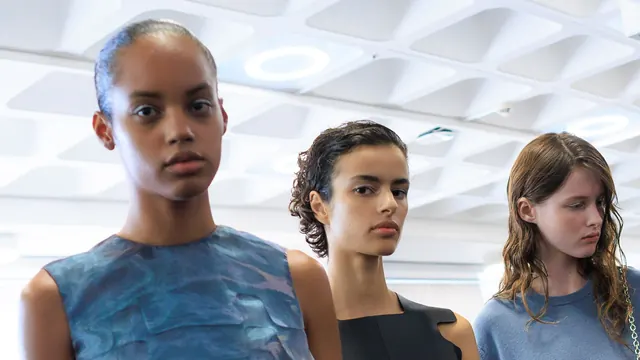
London Fashion Week (LFW) Spring/Summer 2027 was a season of milestones and renewed optimism in a city that has struggled to maintain industry pull the past few years. Headlined by a “rather marvelous” Mulberry debut” from Christpher Kane — following the protracted closure of his own label in 2023 — and a more divisive homecoming show from Seán McGirr’s McQueen, the schedule offered strong propositions, with emerging and household names generating buzz among editors, buyers and content creators.
(McQueen will remain in London for the foreseeable, per CEO Gianfranco D’Attis.)
Burberry bookended the week with a show that was both parts kooky — featuring offbeat prints and badged designs — and commercially minded, primed with easygoing tailoring, track jackets, and hefty denim. A surprise cameo from rapper Central Cee gave the show a quintessentially British star factor, while the front row was curated to match this Made in Britain sensibility: Jason Statham, Stephen Graham, Kano, and Tems.
Elsewhere on the ground, insiders were energized, reflecting a broader stabilization in the luxury market and a renewed momentum unique to London. In a breakfast conference at the beginning of the week, the British Fashion Council’s (BFC) chair David Pemsel — who will leave his role on September 30 after a decade on the board — gave his swansong speech for the non-profit organization, welcoming in his successor Pavita Cooper and noting fashion’s £67 billion contribution to UK economy.
“British fashion travels. It has huge cultural currency, both economically but also on the wider scene,” he said, celebrating the distinct ecosystem that helps young designers thrive.
“There are moments where we worry about the economic climate, but creativity is a superpower. Where creativity thrives, I know economics always follows.”
The BFC’s CEO, Laura Weir, also gave a notably upbeat speech, highlighting a shift in tactics she and her team have ushered in with the 2030 strategy, which focuses on clarifying the significance of British fashion on a global scale — giving the BFC and designer communities leverage with the UK government, partners, and international investment. The UK government’s Department for Culture, Media and Sport (DCMS) has pledged £3 million for the next three rounds of NewGen — a support program for emerging design talent in London.
Nonetheless, the DCMS does not plan to introduce a tax-free shopping scheme in the UK, despite industry calls for it. “The UK’s fashion industry is a vital part of our creative economy, from textile mills in the Scottish Highlands to independent retailers on the Cornwall coast,” a DCMS spokesperson shared with Vogue Business.
“The government is committed to working hand in hand with designers, manufacturers, and retailers to support growth and creativity across the sector.”
Weir’s developing four-year plan could help reposition London as an unmissable pit stop in the global fashion week circuit. And this season, that was already felt. Vogue Business noted a marked presence of international brands and retail powerhouses engaging with the week, not to mention high-profile audiences at the shows. Stars like Alexa Chung, rapper Skepta, actor Joe Locke, and singer Tems were spotted across front rows throughout the week.
Conservative MP Kemi Badenoch sat front row at the M&S show — a collection half of which is priced under £50. London’s mayor Sadiq Khan sat frow at McQueen.
Victoria Starmer, former prime minister Keir Starmer’s wife, actually starred in Edeline Lee’s show. This signaled a move toward ingratiating fashion with policymakers, allowing the British industry and brands to thrive.
Meanwhile, Dover Street Market’s global vice president Dickon Bowden and CEO Adrian Joffe both joined Sir Paul Smith backstage in personally congratulating Pauline Dujancourt on her debut show.
As for activations, LA-born luxe streetwear label Amiri hosted a cocktail event and afterparty, bringing founder Mike Amiri to town; Skims co-founders Kim Kardashian and Jens Grede opened the brand’s first European flagship, inviting the likes of Troye Sivan and Kim Petras to the soirée; and international buyers tapped in for a tight schedule of shows.
“One of the reasons we support the British Fashion Council is we see it as an investment,” Khan said during the BFC breakfast, where he reiterated the industry’s role in creating jobs and supporting businesses. “London Fashion Week is a showcase of our city.
It’s about our culture, our creativity, our values, [and] innovation. You’ve had a tough few years, so thank you for persevering.
Thank you, Laura [Weir], for supporting the next generation, for bringing McQueen back, but also for supporting those who stayed through thick and thin.”
London grows up
Editors noted a commercially led shift among emerging and more established designers. “A strong pant silhouette — low-slung, tight, slight flare — and a doubling down on denim at the likes of Aaron Esh, Petra Fagerström, Talia Byre, and Francesca Lake, shows brands are putting wearability at the forefront of their collections,” says Chioma Nnadi, British Vogue’s head of editorial content.
She also noted “a growing up — coupled with a coming undone” at Simone Rocha, Knwls, Emilia Wickstead, and Erdem, where brands took an unraveled approach, offering approachable looks that played with the push and pull of femininity.
This adaption to more commercial offerings will please buyers. Brigitte Chartrand, Net-a-Porter’s chief buying and merchandising officer, points to a penchant for nightgown dressing, which previously picked up in New York. “We’ve seen that aesthetic continue into London, with many collections embracing lingerie-inspired dressing,” she says. “It’s a really prominent trend that we’re loving, and we think our customers will love it too.”
“We are excited to buy into tailoring as well as dresses this season,” says Bosse Myhr, Selfridges’s buying director, noting that separates and a day-to-night wardrobe will be key looking ahead. “Dress wise, we are looking into adding more red carpet and occasionwear to our overall designer offer.” Fittingly, the season brought a surge in cocktail dresses and easygoing suiting, with Ahluwalia, Alexander McQueen, and Erdem each tapping in.
This commercial nous is important, particularly as London restores its global standing.
“Fashion operates on a global scale and London-based designers are highly regarded everywhere,” says Myhr, advising that close relationships with stores is crucial to cracking different markets and customers.
Simon Longland, Harrods’s director of fashion buying, was also impressed. “What was encouraging this season was seeing designers sharpen their point of view without compromising their creativity,” he says. “The strongest collections combined a very clear identity with exceptional product and craftsmanship.”
Even the Fashion East talent incubator program — renowned for wildly avant-garde designers — offered collections attuned to market standards. Unfolding in Palace and Nike’s Manor Place community hub, Traiceline Pratt’s Goyagoma collection offered an easygoing vision of Bahamian elegance, giving workwear and ball gowns subtle but deliberate idiosyncrasies — be it an oddly placed welt pocket or a trailing, beaded belt.
Pratt, a Central Saint Martins graduate, cut his teeth in visual display and merchandising. “Both my parents do window displays for luxury boutiques — Cartier, Rolex, [etc] — so I already knew that things have to go on a hanger and sell,” he said backstage.
In practice, that meant creating “wearable” goods that push the boundaries just enough to make people double take on the street.
Typically, Fashion East designers get three runway shows as part of the initiative. Jacek Gleba — who showed his third collection — addressed his next steps backstage.
He, again, hosted showroom appointments with the BFC this season. Currently, he has global stockists from the US to South Korea, but wants to expand.
Stockist conversations take time, Gleba points out. “I’m thinking now that we’ve spoken with them for a couple of seasons, the third season may be a good time to start that.”
Mé Mé Yin showed off its scrappy handiwork, presenting what looked like runway one-offs, but are potentially commercial designs. “It was an interesting process discovering how to make a couture technique into something sellable,” the designer, who pattern-cuts everything themself, explained backstage. Enquiries from stockists have already picked up.
Other notable highlights included Geordie Campbell’s presentation, which riffed on the queer tradition of cruising, George Trochopoulos’s sculptural woollens, and Oscar Ouyang’s fluid, silk-laden country house chic. Petra Fagerström’s runway debut stood out for its blend of trompe- l’oeil pleats and hand-crafted reversionings of AI design mishaps.
“This collection felt like something that needed to be seen in this world,” said Fagerström post-show. “I think about the kind of woman I’m designing for [and] her needs, which then probably results in garments that are able to be merchandized.”
Shouting about sponsors
Designers celebrated — rather than hid — their corporate partners this season. Ahluwalia’s show notes dedicated four pages to sponsors, including Puma, Calico (a wallpaper company), Rosewood London (the hotel chain), and Poppi (a prebiotic soda), among others.
Elsewhere, Maximilian Raynor teamed up with drinks company Belvoir Farm, Bentley — a stately motor stood in the centre of the grass courtyard where the designer staged his show — plus, supporting sponsors Bimba Y Lola, hair salon group Blue Tit, footwear brand Gola, and prop hire company Granger Hertzog. “I’d like to think transparency is the best policy,” Raynor explains over email, noting that every call he takes with a sponsor in his studio happens on loudspeaker, demystifying where his financial backing comes from for the interns that work alongside him.
Indeed, sponsors are his biggest source of backing, beating custom, rental, and ready-to-wear sales. “It’s a volatile model, which relies on the ability to cold pitch, again and again — but it’s working.”
Taking a more playful approach, Chopova Lowena proved that even the most off-brand sponsorships — Lloyds Bank, for example — can work. The punky label took out Lloyds’s pet insurance for two dogs that walked its runway.
Labrum’s Foday Dumbuya presented his collection with two major brands, Adidas and Dr. Martens.
For the former partner, Dumbuya incorporated the innovative running line Adizero into gowns, technical knit sneakers, lycra shorts, and a runner’s vest. For the latter, appliquéd classic Docs boots, shoes, and loafers all featured.
Mowalola also collaborated with Jordan brand, Aaron Esh with On, Talia Byre with Topshop, and Masha Popova with Reebok. There were “so many resourceful shoe collaborations to bolster emerging brands’ bottom lines”, notes Nnadi.
As part of this cross-category investment, there was a noted uptick in drinks brand sponsorships, too, with Blank Street coffee — a returning contender — kitting out the 180 Studios venue with a matcha and cold brew bar. Indie and smaller beverage brands were everywhere: Ghost Labs provided drinks for Fashion East’s show and Jawara Alleyne’s activation at concept store LN-CC; Woodford Reserve and Herradura liquors featured at Saul Nash’s “Masquerade in Residence” pop-up .
Another subplot was the rise in sex-positive brands tapping in on designers with sensual aesthetics. British sex toy retailer Ann Summers partnered with party girl designer Sinead Gorey, inviting guests to a strip club in East London where waiters served vibrators, fluffy handcuffs, pheromone perfumes, and lube on silver trays.
R&M Leathers joined forces with Pornhub, even featuring credentialed adult performers in the show. And Natasha Zinko, whose show was walked by legendary pin-up Katie Price, delivered an OnlyFans capsule.
Bringing back the glamour
In keeping with this increasing visibility around corporate partnerships, the season was characterized by high-production moments from household name retailers.
Topman and Topshop threw a flashy party on the Thames in partnership with Uber, calling on fashion stalwart, DJ Fat Tony, to soundtrack the evening. This was rivaled by H&M’s show — a three-drop, “see now, buy now” collection — walked by Lila Moss and Alex Consani, and visually orchestrated by image-maker Nick Knight and creative director Calum Knight.
The show opened with a ballet performance by Ingrid Silva and closed with a Foreigner rendition by Labrinth, interspersed with flickering AI visuals.
“There was visual spectacle, but ultimately, it was about celebrating human creativity and exploring the relationships between the models, designers, musicians, dancers, technologists, and the audience that make fashion possible,” says Calum. “We also felt strongly that we wanted to take everyone in the room on an emotional journey, just like any great film would do,” Nick adds.
For H&M, it was the logical conclusion to recent momentum in the London fashion ecosystem. “We are a global brand.
We have worked on events and activations in so many special cities. London is one of those amazing cities to us — a place rich in talent, creativity, and a heritage of rule-breaking fashion,” says Jörgen Andersson, H&M’s chief creative officer.
Last season, H&M showed on-schedule, leaving a big impression on the city’s critics and customers alike, he explains. “Our motivation this season was to build on that success and excitement [and] to show our commitment to interesting ideas and collaborations.”
The high-production show followed with a major party, headlined by Kim Petras. It seems that big money wants a piece of the London pie.
Spotlighting behind-the-scenes talent
Across the board, designers put more time and energy into revealing what goes on behind the scenes and seams. Rising star Dujancourt took a handful of editors backstage to showcase the painstaking process that goes into her featherweight looms. Her shoppers appreciate this craft-led approach, because it helps them build a personal relationship with the pieces, the designer explained.
“We’ve had the brand growing a lot,” Dujancourt said, revealing that she will join Dover Street Market Paris’s brand development showroom this year in support of her wholesale network. Nonetheless, her highly personal approach to design is building her a market for occasion dressing and bridal commissions, alongside direct-to-consumer and wholesale.
A representative for the brand later confirmed that turnover has grown by around four to fivefold in the past year. “For us, the question is how a designer can grow without losing what made us fall in love with their work in the first place,” says Joffe.
“With Pauline, it’s the time and patience involved in the handwork and the fragile beauty that it results in. Our work is to protect that while building the structure around it.”
Fittingly, buyers are taking note of this craft-led approach. On the penultimate day of LFW, Net-a-Porter’s Chartrand said her top three collections were Simone Rocha, Erdem, and Pauline Dujancourt — all highly wrought and artisanally developed.
Chartrand noted the common denominators. “What they all have is a strong sense of craft, elevated fabrications, and intricate animations,” she says.
“With socializing and events trending so strongly, the Net-a-Porter customer is constantly looking for something new to wear, and these three designers have approached occasion dressing particularly well this season.”
Also keen to showcase the craft and labor involved in a collection, Maximilian Raynor named, pictured and shared the Instagram handles for every single intern and studio member that worked on his collection in the show notes. He explains that without young budding students, he wouldn’t be able to put on such ambitious shows, estimating that 90% of his time is dedicated to pitching for sponsorships, answering emails, and orchestrating operations from behind a laptop screen.
The remaining 10%, he says, is spent directing young people — some freelancers, some unpaid volunteers — to execute his vision.
Raynor is “deeply uncomfortable” with unpaid internships, but concedes that is the industry standard, and he doesn’t want to deny students an opportunity to learn and build their CVs. “It’s very difficult to sustain a personal salary.
I live off my tutoring money — not off the brand — so employing someone else full-time is simply not an option yet,” he says. “Because of this, visibility and education become the most crucial compensation for the time invested by the students, graduates, and freelancers.”
Reformatting fashion week
For this season, designers showing in “more flexible formats” were up 100%, Weir noted. Screenings, appointments, and shows were reimagined in fresh ways, and, according to the CEO, the BFC focused closely on curating the schedule this season. To her point, the line-up spanned everything from Ebay’s Endless Runway format — a live-streamed shoppable collection of pre-loved goods, which Weir indeed shopped herself — through to Steve O Smith’s articulated salon-style collection walkthrough.
Designers rethought the runway. Geordie Campbell’s collection could be viewed through gloryholes, and Chopova Lowena took over a bowling alley in Bloomsbury, seating guests in the lanes. Lucila Safdie filled a pokey gallery with mannequins, while models pottered through the set as a seasonal lookbook was shot. And even some of those that did show explained they were content with it becoming more occasional.
“I don’t think [a show is] essential for us every season,” Ashley Williams said post-show, which she funded not through sponsorship but her own personal “piggy bank”. She contends that shows can be crucial for world-building beyond sharing a lookbook and campaign, but there’s more to this than just catwalks and presentations.
“I’d like to [run] more pop-ups,” she said, noting the Chopova Lowena clubhouse earlier this month — a cutesy permanent retail space that will host everything from book clubs to dating nights. “Eventually, we’re going to do something like that and build a world so that people can engage with it in real life as well.
It’s a big investment, but it’s quite fundamental, I think.”