
The Ouze, Toby Vernon’s jewelry studio, has quickly become known for its singular, contemporary approach to silver, with designs that appear somewhere between well-loved antiques and Jurassic landscapes glimmering with gemstone fossils. Hang around certain pockets of East London, and you’ll see the flash of one of its textured hair clips on someone knocking back a martini outside Dalston’s Ellie’s Bar, or a gnarled ruby ring trilling a bell as its wearer speeds past on a Lime Bike.
Similar scenes are proliferating on the Lower East Side and in Sarugakuchō. A scroll through Instagram will also reveal the furore around The Ouze’s custom modern engagement rings.
Or you could just visit Dover Street Market.
On the third day of London Fashion Week, The Ouze staged its third Newgen presentation at 180 Studios. Previous seasons saw Vernon curate the subterranean room into messy domestic tableaux, with pieces nestled among scenes of dinner parties and unfinished musical manuscripts—the detritus of a chaotic creative process. For spring 2027, he brought visitors into another part of jewelry making that is rarely seen.
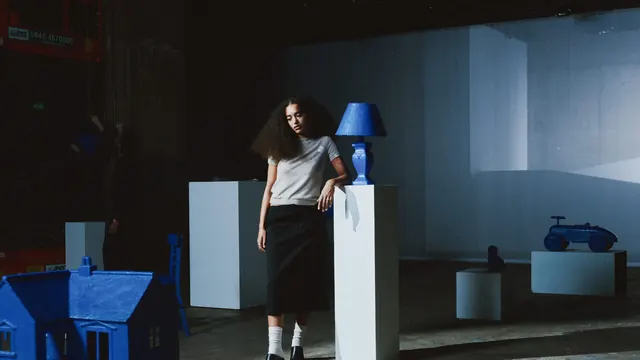
The dominant color of the room was not sterling silver, ruby, or emerald, but Yves Klein blue. Jewelry sat on and among a sink, chair, cabinet, artist easel, and smaller domestic objects coated in the blue carving wax Vernon uses in the workshop.
Every piece from The Ouze begins this way, hand-carved in wax before being translated into precious metal. There are many grades and colors used in jewelry making, but this particular striking blue was the first Vernon worked with.
“It’s not too brittle, it’s not too weak, and it’s an amazing color,” he says. “It’s just very important to the brand and the way the jewelry’s made.”
The idea was to give what is normally a temporary and invisible stage of the process as much presence as the finished precious object. Found items collected around London had been repeatedly coated in wax and displayed on white plinths. The larger forms also acted as propositions for where The Ouze might go next, extending the same sculptural language beyond jewelry and into furniture, fashion, and the home.
“From the first presentation, I wanted to subvert what people expected a jeweler could do—it was never going to be clear cases or mannequin hands,” Vernon says as the show receives its finishing touches around us.
Spring 2027 also brought a greater focus on homeware, carrying The Ouze’s distinctive signatures into more everyday objects: sterling-silver corkscrews, valve caps, and candlesticks, alongside vases embedded with raw sapphires. Like the jewelry, they preserve traces that might ordinarily be polished away—fingerprints, folds, and marks left by the hand.
There were silver jugs with buckled rims and scarred, almost battered surfaces; a tiny padlock criss-crossed with tool marks; dappled candlesticks that looked as though they had already survived a few centuries; chess pieces; a corkscrew; even a scalpel, Vernon’s most-used tool.
That relationship to process is fundamental to The Ouze. Vernon works directly into wax with scalpels and other implements, allowing scratches, fingerprints, and cuts to survive their translation into metal. “To me, it’s almost more valuable than the finished piece,” he says of the wax model. “It’s still this very fragile thing that’s not yet finished. It’s like the final form before it gets made this permanent thing in silver or gold.”
The mise-en-scène was also a blueprint for what comes next. “I’d love to make a chair,” Vernon says. “I think the next show—probably January or February—I actually want to make a chair.”
More leather goods and collaborative projects are on the horizon too. Midway through our conversation, Vernon produces a doctor’s-style bag in buffed oxblood leather with sculptural aluminum handles, created with Dutch bag maker Joost Pasman, which he uses to present jewelry to buyers.
The handles, naturally, began as wax models before being remade in metal by artisans. “It really got me initially thinking about how we choose to build and present the world.
What does the jewelry also interact with?” Vernon asks in our conversation. If the object carrying the jewelry can become part of The Ouze’s visual universe too, why stop at the jewelry box?
Vernon studied fashion design at Westminster University before becoming a self-taught jeweler. One of his earliest experiments at university was an ordinary clothes peg recreated in sterling silver.
“I guess it’s subverting this thing that’s not valuable,” he says. The process has remained much the same whether the resulting object is destined for a finger or a mantelpiece.
“Texture is just what we love,” Vernon says, “showing the hand and the craft.” His lack of formal jewelry training has proved useful. “I’d speak to other jewelers, and they’d be like, ‘Why would you even do that?’” he recalls.
“They’d tell me my process was really risky. I didn’t know what you couldn’t do, and that was actually liberating.”
One such experiment became a signature: burying stones directly into wax before casting them. Raw, lab-grown gemstones appear partly swallowed by silver rather than perched neatly atop.
It is a precarious way to work. “It’s just a very organic, risky process,” he says.
“We make the wax and then bury them in the wax so that you have this effect.” A stone might shift, a casting might fail, and hours of work and material can disappear with it. The resulting pieces possess the same quality Vernon has always sought in antique jewelry.
He gravitates toward things beaten up by previous wear, pieces that arrive with some evidence of a life already lived. New jewelry often seemed too uniform.
“I want to wear sapphires and diamonds that aren’t super sparkly,” he says. “So it’s much more muted.”
At the same time that The Ouze is pushing outward into the home, its jewelry is moving toward gold. Silver made natural sense for a young brand, because it is considerably less expensive to sample and experiment with, but bespoke commissions have increasingly taken The Ouze into the more precious metal, particularly for wedding and engagement pieces.
And Vernon wants to bring more of it into the ready-to-wear offer. “I found it’s almost like people have to see it,” he says.
“They don’t know that they want it until they see it.” One engagement ring can prompt a dozen emails to request their own tweaked version. “I think people want it and I want to make it,” he says.
“Platinum too. It’s fun material to work with.”
The Ouze is now a six-person London studio, working with recycled precious metals and stones selected as much for their irregularity as their perfection. Next, the brand will return to New York for another pop-up at Colbo—a city where Vernon has quickly learned customers expect, and shop for, higher carats.
He is also considering opening the studio more regularly to customers: perhaps a Saturday shop and, eventually, a more formal retail space. It makes sense for jewelry this tactile.
And more compelling still is imagining what the space around it might eventually look like and contain.
There is a satisfying push and pull between Vernon’s two ambitions. At one end, The Ouze is embracing a conventionally more precious material; at the other, it is applying precious-metal thinking to things that are resolutely ordinary. Jewelry becomes object; object becomes artifact; a domestic tool becomes something to keep. “It really is my dream that there can be a whole house of just things I’ve made,” Vernon says.