
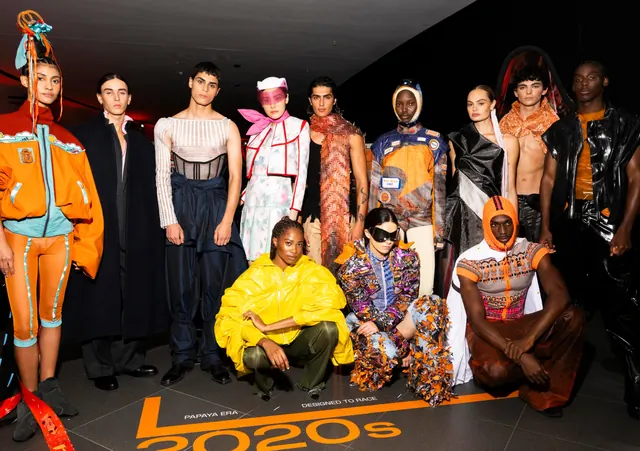
The Norman Foster-designed McLaren Technology Centre in Woking spent an evening exchanging its familiar world of engineering drawings, race cars and computer screens for something more fashion-minded. Staged on the eve of London Fashion Week, the facility became the setting for ‘Designed to Race: Front Row’, McLaren’s first fashion show and the culmination of a nine-month creative collaboration with Central Saint Martins, UAL, bringing 46 MA Fashion students into the team’s archive to reinterpret six decades of racing history through 12 original looks.
The brief gave the students plenty of room to get creative, with 12 groups each asked to take one of McLaren’s five historical chapters, spanning the 1970s through to the current Papaya era, and decide what that period meant in fashion terms. Drivers and famous cars offered one route in, but so did engineering, racewear, fan culture, the people working behind the scenes and the materials used around the team.
The 1970s became ‘Grit x Glamour’, followed by ‘Precision and Power’ in the 1980s, ‘Global Icon’ in the 1990s, ‘Engineered Athlete’ across the 2000s and 2010s, and ‘Papaya Era’ for the 2020s.
“Formula 1 is influencing culture in ways we’ve never seen before,” says Louise McEwen, Chief Marketing Officer at McLaren Racing. “Designed to Race explores that cultural influence through the eyes of the next generation of creative talent.”
The fashion world has hardly been waiting for permission to get interested in motorsport, with driver wardrobes, racing-inspired footwear and an endless calendar of collaborations already making the paddock a regular source of fashion reference. McLaren’s approach was to hand that history to students and see what they could make of it, without asking them to reproduce a McLaren uniform or turn the archive into another merchandising exercise.
Engineering blueprints became starting points for patterns, aerodynamic shapes informed silhouettes and racing equipment was repurposed throughout the collection, with carbon fibre, fabric offcuts, second-hand materials and used McLaren seatbelts finding their way into the garments. Johannes Warnke and Stephanie Corbyn weaved literal pieces of racing equipment directly into the tailoring, constructing structured blazers from cured carbon fibre and draping loose skirts with frayed, upcycled racing seatbelts.
A particularly striking cape was built from a racing seat, with its shape designed to billow like a visual interpretation of speed, while blurred photographs of the McLaren team spread across the fabric brought the people behind the machinery into the design.
The references became wonderfully particular as the looks moved through the decades. One Ayrton Senna-inspired outfit translated his reputation for precision in wet conditions into lightweight performance-wear, a tyre-derived digital pattern and flashes of canary yellow recalling his famous helmet.
Another look took inspiration from a female fire marshal, shifting attention away from the drivers and towards one of the many people whose work has always formed part of racing life. Somewhere else, the Monaco hairpin was stitched inside a pair of trousers.
The contemporary chapter became even more playful, with papaya racewear mixed with denim and knitwear, toy cars and childlike drawings reflecting the younger fan culture around McLaren today. Used racing boots from previous eras were incorporated into one look, topped with a headpiece inspired by Daniel Ricciardo’s famous ‘Shoey’ celebration, giving the archive a new life without treating it with too much reverence.
Dell Technologies supported the project as its technology partner, with each student working on an XPS laptop for research, digital pattern development and design before translating those ideas into physical garments. That digital-to-physical process feels particularly fitting for a project rooted in McLaren, where engineering, technology and design have always shared the same workspace.
“My background in econometrics has taught me to look at systems through patterns, relationships and connections,” says Enzo Keuning, one of the Central Saint Martins students involved. “Presenting our work at the McLaren Technology Centre felt like completing that journey.”
The setting gave the show a slightly surreal quality of its own, with the new designs presented alongside historic racewear and championship-winning cars from the McLaren archive, while Lando Norris and Oscar Piastri joined F1 Academy drivers Ella Lloyd and Ella Stevens among the guests. McLaren also used the evening to give attendees the first look at Puma’s ‘Without Limits’ collection honouring James Hunt, with the range set to launch globally on 19 October.
photography. courtesy of McLaren words. Gennaro Costanzo
Ten years ago, the Apple Watch was still trying to establish itself as something people might wear beyond the gym, while Hermès was synonymous with objects whose appeal came from handwork, materials and fine details. The two companies met in the middle and, a decade later, Apple Watch Hermès has become one of the technology world’s longest-running luxury collaborations.
Its tenth anniversary marked a collection that pushed the relationship further into the territory of illustration, fashion accessories and watchmaking codes, with those ideas continuing into the current Series 12 generation.
First introduced in September 2015, the partnership paired Apple’s tech with Hermès leather bands in Single Tour, Double Tour and Cuff styles. From the beginning, the collaboration treated the strap as part of the identity of the watch, giving the technology a distinctly Hermès point of view without altering the underlying Apple hardware.
The anniversary collection marked a particularly playful chapter for Apple Watch Hermès. The current Apple Watch Hermès Series 12 is available in 42mm and 46mm titanium cases, with the latest generation introducing radiant gold titanium alongside the exclusive silver finish.
The gold model comes with a Noir satin Clou de Selle band, complete with matching gold-finish hardware, while the collection also introduces Rocabar Club, a knitted band inspired by horse-jumping competitions through an elongated H motif rendered in a three-dimensional graphic pattern. The more practical Apple Watch Hermès Ultra has also moved on to Ultra 4, available in a 49mm natural titanium case with its own expanding range of Hermès bands.
The most celebratory addition from the anniversary collection was Faubourg Party, a jacquard-knit band created around an illustration of Hermès’ historic flagship store in Paris. Designed by artist Tibor Kárpáti , the pixel-like drawing translates 24 Rue du Faubourg Saint-Honoré into a miniature architectural world of windows, terraces and rooftop gardens.
The accompanying watch face takes the idea further, featuring 24 animations that change according to the time, weather or date. It gives the familiar interface a building that appears to come alive throughout the day, turning a recognisable physical location into a shifting digital canvas.
Grand H Fin takes the opposite route. Instead of adding more imagery, the bracelet pares the Grand H metal design back to slimmer, more slender proportions. Made from brushed stainless steel in Switzerland, the band features two understated H links framing the wrist, giving the device a jewellery-like presence while retaining classic Hermès watchmaking architecture. The design remains part of the current collection and is available with Series 12 in 42mm.
Animaux Bandana returns to one of the Maison’s most enduring forms of printed storytelling. A lively zoo of horses, toucans, monkeys, parrots and sloths from Shinsuke Kawahara’s eponymous silk scarf is screen-printed onto Swift calfskin. The design brings a casual bandana spirit to the wrist in several seasonal colour combinations, pairing seamlessly with the Double Tour Attelage format to add another layer of equestrian vocabulary to the collaboration.
For the sturdier Apple Watch Hermès Ultra 4, the mood changes completely. Scub’H Diving is made from high-performance fluoroelastomer rubber and features circular, porthole-like perforations, giving the strap a highly technical appearance suited to the larger case. Finished with a secure titanium buckle, the band is lightweight and water-resistant, while the Ultra 4 itself is rated for recreational scuba diving to 40 metres.
The current Ultra 4 range also includes the Grand H Titane band, which brings Hermès’ signature H motif into a titanium construction. Alongside Scub’H Diving, En Mer and other technical designs, it gives the Ultra a distinct vocabulary from the leather and metal straps associated with the smaller Series 12 cases.
The Series 12 collection also expands the partnership’s material vocabulary beyond the designs introduced for the tenth anniversary. Alongside leather, knitted nylon and rubber, Hermès now works with titanium in both cases and bracelets, with the new Grand H titanium band for Ultra 4 offering a different interpretation of the Maison’s signature H motif through a fully technical construction.
Apple Watch itself has also moved considerably since the original Hermès collaboration launched. Series 12 introduces Apple’s new Health Sensing System, with higher-frequency heart-rate and heart-rate variability measurements, alongside a new readiness feature and the S11 chip. Ultra 4 adds the same health-sensing architecture to a more adventure-focused format, alongside up to 50 hours of normal battery life and faster charging.
Over the years, the partnership has steadily accumulated references that sit somewhere between traditional watchmaking and the possibilities of a digital display, ranging from early leather straps and Hermès-inspired dials to Series 4’s colour-blocked designs, the anchor-chain references of Series 7 and the animated Faubourg Party dial.
The new Apple Watch Hermès collection is available to explore online. Discover the full lineup here .
photography. courtesy of Apple Watch Hermès words. Gennaro Costanzo
H&M decided to kick off its latest London Fashion Week show by handing the lights over to a ballerina. Before any of the latest pieces even made an appearance in Kensington, Brazilian dancer Ingrid Silva took to the 40 metre runway, her movement physically triggering the lighting grids to wake up the space — a dreamy opening that felt far more like experimental theatre than a fashion presentation.
Titled ‘ H&M&YOU&I ’, the event marked the retail label’s second consecutive year on the London Fashion Week schedule, once again designed in partnership with British image-maker Nick Knight CBE and his digital platform, SHOWstudio. The production tracked across three separate apparel drops, connecting cinematic atmospheres spanning 1990s Japanese film, Italian noir and historical Sicilian romance.
“This show is a celebration of creativity and of human relationships,” Knight explains. “I wanted to create something that felt romantic, emotional, human and painterly, all while experimenting with new technologies. My mission throughout my career has been to push the boundaries of fashion and stay curious about the next thing. I’m excited that H&M shares that vision.”
Alex Consani opened the runway in a cropped ivory jacquard jacket layered over a sheer lace blouse, paired with slim white trousers and cream jacquard heels, launching the collection’s romantic first chapter, an ode to historical opulence built on soft fabrications and old-world silhouettes. The second drop swung hard in the opposite direction, all sculptural minimalism and sharp tailoring, its models carrying their own lighting rigs down the runway so the garments themselves seemed to glow from within.
Angelina Kendall , Paloma Elsesser , Karen Elson and Lila Moss carried the collection’s third act, an ode to the collector’s spirit, alongside elevated pieces from the H&M Atelier menswear line.
The garments translate this multi-act presentation into tactile items, anchors for the collection’s gothic-romantic and minimalist visual threads. The tailoring uses heavy, structured fabrics to carve out defined shapes, highlighted by sharp masculine overcoats, boxy double-breasted blazers, and strong-shouldered suit jackets from the premium H&M Atelier menswear line.
In direct contrast to these crisp edges, the lace pieces introduce an old-world softness, reminiscent of the ‘Wuthering Heights’. Sheer white blouses with high Victorian ruffles, delicate cream lace tops and spiderweb-thin dresses sit layered beneath the substantial outer coats.
The leather adds a final, protective layer to the seasonal uniform, showcasing heavy, oversized distressed aviator jackets, panelled calfskin maxi skirts with deep slits and structured black trenches that ground the more delicate, ethereal elements of the runway line-up.
Knight’s interactive design work sat right at the centre of the evening. Using footage shot with Consani and actor Archie Renaux earlier in the year, SHOWstudio built a real-time fashion interactive that blurred physical and digital imagery as the show unfolded, flanked on one side by curved mirrors and on the other by a video installation from Tokyo-born artist and engineer Karyn Nakamura .
During the H&M Studio segment, the same technology pulled illustrations by artist Cliff Warner into motion, with models choreographing their own poses against the moving artwork behind them, turning the runway into something closer to a live collaboration than a straightforward parade of clothes.
Music came courtesy of Labrinth , working in his home city for the occasion, building towards an unexpected live performance of ‘I Want to Know What Love Is.’ Before the song began, Consani and Renaux delivered a spoken word piece built from the track’s own lyrics, an epilogue on connection that closed the night’s central theme. Consani wore a ruffled cream gown for the moment, Renaux a full look pulled from the Atelier collection.
“The A/W 26 collections are all about eclecticism,” says Ann-Sofie Johansson, H&M’s Creative Advisor and Head of Design Womenswear. “Each drop brings a vision of fashion that is bold, and dedicated to self-expression, freedom and rule-breaking. Nick Knight is always daring, he never accepts the status quo, and that is an ethos that chimes with all of us at H&M.”
Among the 700 guests, the front row saw a plethora of artists including Audrey Nuna, Kim Petras, Cruz Beckham, Manu Ríos and more. With an Elie Saab collaboration already generating plenty of chatter for later this year, H&M’s fashion week ambitions show little sign of slowing down.
The first drop of the Autumn/Winter 2026 womenswear collection and the Atelier menswear line are available across H&M’s online channels. Discover more here .
photography. courtesy of H&M words. Gennaro Costanzo
What happens to a wardrobe during the suspended space when one state shifts into another? That is the central question Weekday addresses for Autumn/Winter 2026, introducing a campaign and collection titled ‘Hybrid Hour’. Taking its narrative cues from the ‘hour of the wolf’ — the quiet, unsettling time just before dawn — the collection explores the exact moment when the mood of a room changes and clothing follows.
The wardrobe functions around transition, coordinating a dialogue between heavy, structured outerwear and softer, more fluid layers designed to move naturally between different parts of the day. Across the collection, wolf imagery becomes one of the clearest visual markers. Prints appear alongside oversized proportions and layers that can be added, removed or reinterpreted throughout the day.
Womenswear pushes that contrast through strong shoulders, Victorian-inspired collars, cropped jackets and long skirts, with fur details and jersey softening the more constructed shapes. Washed-out purple runs through the palette, while the styling places tailored elements alongside pieces that feel closer to everyday dressing. Current pieces from the collection include a belted wool-blend coat, an asymmetric midi wrap skirt, a cropped bomber with a faux-fur hood and low-rise bootcut denim.
Menswear takes a more utilitarian route, with workwear-inspired jackets, expressive knitwear, flannel shirts, new suiting, and distorted prints appearing in shades of green, khaki, camel and nut brown. The current online offering extends that vocabulary through transitional drawstring jackets, relaxed bombers, wide cargo trousers, bootcut jeans and oversized graphic layers.
To mark the launch, Weekday partnered with Boukan Records and its founder Bamao Yendé for a private event in Paris, soundtracked by electronic bass music, Afro-diasporic rhythms and R&B.
The Weekday Hybrid Hour Autumn/Winter 2026 collection is available now in stores and online. Find out more here .
photography. courtesy of Weekday words. Gennaro Costanzo