
On Sunday night, celebrities, financiers, industry leaders and climate activists gathered in New York for the second annual Nat Gala. It was a starry affair supporting a decidedly un-starry subject: closing the approximately $700 billion nature finance gap.
Among the honorees was Dee Jay Two Bears, a filmmaker, artist and activist from the Standing Rock Sioux Tribe, who was heavily involved in the Dakota Access Pipeline protests from 2016 to 2017. While introducing Two Bears, and marking the 10th anniversary of Standing Rock, fashion designer Gabriela Hearst announced that the Nat Gala will head to Paris for the first time in April 2027, for an additional special event focused on the role of Indigenous matriarchs in galvanizing climate action and spearheading nature conservation.
While the main New York gala benefits the Blue Marine Foundation, Conservation International and Open Planet, the Paris event will specifically open up funding to Indigenous-led organizations, to be decided in due course.
Fashion is expected to play a central role. “Luxury fashion does not simply reflect what people value; it possesses an extraordinary power to actively shape it,” says The Nat co-founder Gail Gallie.
“By bringing The Nat to the cultural capital of the world, we are making a deliberate statement: environmental stewardship is not a secondary, clinical policy debate; it is the defining cultural imperative of our era. If we want to fundamentally shift how humanity values nature, we must embed that value into the very heart of global culture, fashion, and expression.”
The Paris gala will be a chance to dig into the nuances in nature finance, which channels funding into promoting biodiversity and protecting the natural ecosystems we rely so heavily on. Crucially, says Gallie, it’s about making sure that funding is distributed fairly, to the places it will make the biggest impact.
“Indigenous Peoples make up just 6% of the global population, yet they care for more than a quarter of the Earth’s lands and waters, and sustain at least 40% of its remaining intact ecosystems. Meanwhile, they receive less than 1% of global climate funding,” she explains.
“Within many Indigenous communities, women and matriarchs play an incredibly important role as custodians of ecological knowledge, food systems and natural resources. So often, they carry the responsibility of passing that knowledge between generations and helping shape how land and biodiversity are protected.”
Hearst was a natural choice to make the announcement, and to support the Indigenous matriarchs initiative – dubbed Wonder Women – says Gallie. For Spring/Summer 2022, Gabriela Hearst collaborated with Navajo weavers Naiomi Glasses and TahNibaa Naataanii, using botanically dyed wool from Navajo-Churro sheep.
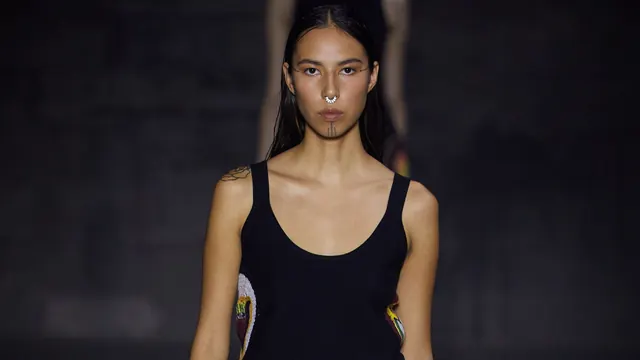
It was the first fashion show that Indigenous model Quannah Chasinghorse opened and closed. Hearst later partnered with Chasinghorse for the Council of Fashion Designers of America (CFDA) and Vogue United Flags of Fashion project, marking 250 years of the US by honoring Chasinghorse’s Lakota heritage.
Then, in 2024, Hearst dressed Indigenous actor Lily Gladstone for the Met Gala, working with Indigenous jeweler and metalsmith artist Keri Ataumbi on a hand-crafted dress and cape covered in stars. “Inspired by Kiowa beliefs that ancestors return to the stars, the piece represents Lily Gladstone being supported and embraced by her ancestors,” explains Hearst.
“We have worked with Indigenous leaders and artisans on many different occasions. It’s always with the utmost respect for the hidden intelligence and archaic knowledge that they have, as this has been their land.
We are just guests.”
To advise on the Paris gala and its ongoing Wonder Women initiative supporting Indigenous matriarchs, The Nat has put together a circle of leaders in the nature space, spanning the Global North and South. They include marine biologist Dr Sylvia Earle; Mexican-Chilean and Otomi-Toltec climate organizer Xiye Bastida; climate venture capitalist Tenzin Seldon, who is the only Indigenous woman currently managing more than a billion dollars in capital; Indigenous rights and climate activist Helena Gualinga; 'Aulani Wilhelm, former head of the global oceans program at The Nat beneficiary Conservation International and the first Indigenous CEO of non-profit Nia Tero; and Lynda Carter, the American actress who originally played Wonder Woman.
They face an uphill battle: the global financial system has historically been stacked against Indigenous communities. “To effectively support Indigenous communities and nature-positive practices, the financial system must move away from rigid investment models that overstate risk, and fail to comprehend local ecological contexts,” says The Nat co-founder and global investments specialist Hari Balasubramanian.
“Allocators need specialized training and refined due diligence processes with metrics that accurately capture the value of nature uplift and Indigenous guardianship.”
The Nat sees itself as a facilitator in this process, adds Balasubramanian. “We want to bring the two worlds closer together, to enable a better mutual understanding and promote more collaboration.”