
“Animal Magnetism,” by Hamish Bowles, was originally published in the May 2000 issue of Vogue.
For more of the best from Vogue’s archive, sign up for our Nostalgia newsletter here.
As their glamorous new Milanese penthouse bears witness, designers Domenico Dolce and Stefano Gabbana are as much mix-masters at home as they are on the runways.
For their production this season, the sweeping chords of Pietro Mascagni’s Cavalleria Rusticana (“sweet and strong and romantic”) opened the show, as they have done for thirteen years, only to segue symbolically into poundingly high-voltage disco. In the designers’ new aerie, centuries also collide, and gilded eighteenth- and nineteenth-century furnishings sit comfortably beneath Basquiats and Warhols.
The visual mix begins with the couple themselves. Tall, lithe, and urbane, Stefano Gabbana, 37, is a figure out of Lampedusa (the grand seignorial Sicilian author whose masterwork The Leopard is a touchstone for them both), while jolly Domenico Dolce, 41, might have been a character in a bawdy Boccaccio tale.
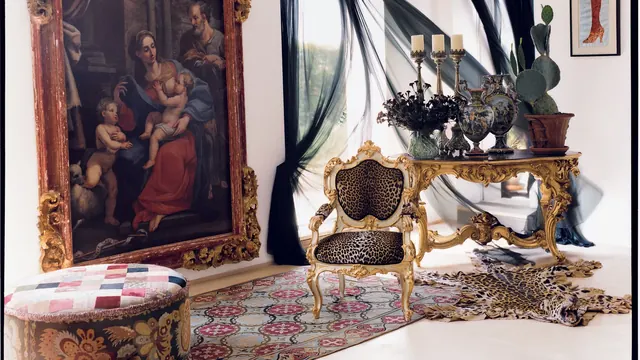
Cathy Horyn, the New York Times fashion critic, once playfully referred to them as “fashion’s Laurel and Hardy.” They are also stars of Milan’s fashion-mad nightclub scene—they even own Post Garage, a disco glamorously decorated like a New Age El Morocco in those animal prints that they just can’t get enough of, at work or at home. And this home is no exception—the place is a riot of zebra and leopard prints; there is even a shag carpet that proves to be sheared Persian lamb.
Their new apartment was the result of a two-and-a-half-year search through central Milan, followed by a renovation that took almost as long. “You instinctively know when you feel good in a place.
You feel a connection,” says Gabbana of the couple’s seemingly endless quest. “I don’t think the real estate agent thought we were serious,” he remembers.
“But, finally, we came here and felt that connection.” Ironically enough, that special place was catercorner to their corporate headquarters, a magnificent eighteenth-century palazzo fitted out with the kind of extravagance Italy expects of its fashion czars (especially those who control an empire estimated at more than $300 million). In their offices, the sweeping staircase is hung with padded crimson velvet, and a colorful Venetian glass chandelier refracts rainbow light in a dining room lined and curtained in dazzling Cruella DeVil zebra stripes.
A huge marquee set up in the garden serves as a setting for their exuberant fashion shows.
Nonetheless, the new apartment presented a challenge. “It was very seventies—orange peel walls, brown carpet on the floor,” says Gabbana.
Two months after they bought the apartment, half of the fifth floor of a substantial building, they realized it was too small. So they negotiated with the owners of the penthouse upstairs and acquired that as well.
Then they were offered the remainder of the fifth floor, too. “So we ended up with three apartments—it was like a patchwork!”
With this vast tract, they could seriously indulge themselves. “Basically, we wanted a feeling of life,” says Gabbana of their modus operandi.
“I don’t know if we have good taste or bad taste—but we have a taste! We didn’t want an apartment that looked done by an architect but something that represented our lives—past, present, and future.
We had collected things on our world travels, and we wanted somewhere we could put everything together.”
“For me, the kitchen is the heart of the house,” says Dolce. “It’s a very Italian thing,” agrees Gabbana.
“For me, too, the kitchen is where everything happened in my childhood—where I would do my homework, where I’d play with friends, discuss problems with my family. That’s the feeling that we wanted to capture.” And on each level, the rooms are designed to flow through, rather than around, the two kitchens and dining rooms.
Dolce, who studied architecture for a little while in Palermo before he became involved in fashion, worked with architect Claudio Nardi on the framework while Rodolpho Dordoni helped the duo find antiques and artworks—thirties and contemporary pieces as well as the “baroque Sicilian” look they love.
In fact, Dolce is hands-on with the design of all the properties in their ever-growing portfolio, which now includes a seaside villa in Roquebrune, on the French Riviera (a short drive from Milan), and a house on Stromboli, the volcanic island off Sicily immortalized in director Roberto Rossellini’s powerful 1949 film. These houses reflect their twin aesthetics.
Roquebrune, where “all is black and white, and linear,” bears Dolce’s signature. Stromboli reflects Gabbana’s spirited taste, which, as he describes it, is “more chaotic, more ‘Italian folk.’ It’s really, really, really colorful.
A mix of cheap and chic, the worst and the most beautiful things mixed together!”
In the Milan apartment, these two aesthetics have melded as potently as they do in the duo’s fashion work. Dolce’s cool, reductive architectural sense, with its airy vistas and great open spaces inside and out (perfect for their energetic Labradors, Lola and her son, Dali), is cluttered with the eclectic bounty that Gabbana has assembled over the years.
“I like to step into the past—but then to put that together with the Warhols,” says Gabbana, who has quite a collection of his works.
In spite of the apartment’s cool urbanity, there is something indefinably Sicilian about it, too—and little to suggest that it is right in the middle of Milan. “Sicilian style for me is about a passion for life,” says Gabbana.
“It’s about one color—black—that then absorbs all the other strong colors. Domenico has that passion for life inside him.
He was born in a small mountain village in the middle of Sicily.” The more intimate spaces in the apartment are paneled in the same heavy black raw silk that was once used for a Dolce & Gabbana opera coat; even the windows are curtained in billowing drifts of black silk chiffon. Outside, the terraces have been landscaped with an exotic but rustic mix of palm trees, roses, geraniums, and an abundance of herbs, which are plucked fresh for the earthy Sicilian dishes Dolce delights in preparing for the close-knit circle of friends whom they entertain nearly every night for dinner.
The pool on the roof is an optimistic addition in the face of Milan’s often gray climate. “We wanted it to feel like a beach in Stromboli,” explains Gabbana, and so they had it laid with tiny black volcanic pebbles from the island.
The terraces surrounding it have been landscaped by Giorgio Fornari, the visual mastermind who also creates the elaborate and evocative sets for the designers’ fashion shows. “For Domenico and me, he is like an artist with a beautiful point of view,” says Gabbana.
“And he understands us very well.” This season, they wanted to give their public a more intimate view of their private world, so they re-created something of the spirit of their new apartment in the set of their fashion show. They even moved in some furniture and paintings, like the dramatic 1926 Tamara de Lempicka portrait in the entrance hall that Gabbana gave to Dolce as a Christmas present three years ago.
For both of them this portrait, and the spirit of the fabulous de Lempicka (“a ‘future woman’—very independent, very glamorous, very disciplined, and not too sweet”), became the starting point for their fall collection. “Our job is our life, our life our job,” says Gabbana.
“And we love our house like we love our clothes.”