
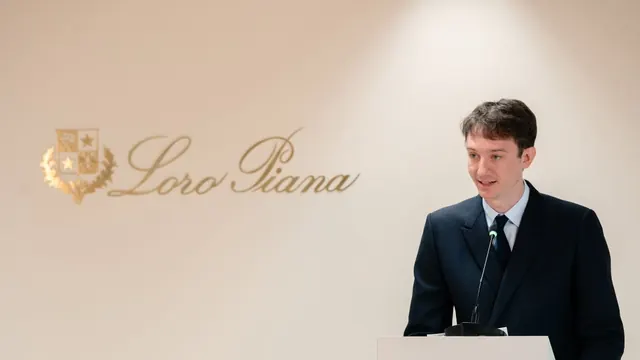
With the luxury sector yet to stage a meaningful recovery, Loro Piana appears largely unfazed. On Friday, the Italian luxury brand inaugurated an 8,000-square-meter facility dedicated to knitwear, which has historically been at the heart of its business, representing an investment of several tens of millions of euros, the largest in Loro Piana’s history.
About a hundred guests, including journalists and representatives of local institutions, attended the inauguration of the Ghemme facility, located in Italy’s Piedmont region. Following a tour of the manufacturing plant, Loro Piana CEO Frédéric Arnault; Pier Luigi Loro Piana, deputy chairman of the house and sixth-generation family member; and Adolfo Urso, Italian minister of enterprises and Made in Italy, delivered speeches, followed by a ribbon-cutting ceremony.
Among other attendees were Toni Belloni, president of LVMH Italy; Maria Luisa Loro Piana, the wife of the late Sergio Loro Piana, Pier Luigi’s brother, and Alberto Cirio, president of the Piedmont region.
“The Ghemme plant is not simply a new factory. It is a strategic milestone for the maison: a place that redefines manufacturing excellence while supporting our long-term growth and ambitions,” said Arnault, who gave part of his speech in Italian.
This opening, three years in the making, fits with Arnault’s broader strategy. He became CEO in June 2025, and he is committed to protecting the brand’s exclusivity.
“I have a strategic priority around controlling know-how, industrial development and vertical integration,” Arnault told a handful of journalists at the inauguration. “We’ve also identified which capabilities are strategic for us, particularly those that are relatively rare, such as double cashmere, and we’re gradually bringing them in-house.” The 31-year-old executive is fresh from a trip to Mongolia, timed to coincide with COP17, where Loro Piana operates a manufacturing plant processing the country’s prized cashmere fibers.
The opening of this Ghemme factory marks an important moment for the Piedmont region, a historic wool-producing center that’s home notably to Ermenegildo Zegna and Fratelli Cerruti wool mills.
Loro Piana’s new knitwear center will have 300 employees within the next three years. It will also have students: the Knitwear Métiers School of Accademia dei Mestieri, the brand’s training center established in 2015, has also relocated to a dedicated building within the new Ghemme site.
It’s an important moment for Loro Piana, whose heritage as a fabric manufacturer — still a significant part of its business — has enabled it to build an exceptionally vertically integrated upstream value chain. “We have a high level of vertical integration. Where we still need to continue integrating is further downstream, and today is an important step in that direction,” Belloni said.
It’s also a timely step. Verticalization gives brands greater control across the value chain — a particularly relevant consideration for Loro Piana and several other Italian luxury brands that faced scrutiny over alleged labor abuses in their supply chain.
In Loro Piana’s case involving one subcontractor, the judicial administration measure, initially scheduled for 12 months until July 2026, was lifted early in April 2026. In a statement in April, Loro Piana welcomed the early conclusion of the measure, calling it “the virtuous path undertaken and swiftly completed by Loro Piana,” and citing the Court of Milan.
Loro Piana said it has conducted 2,400 audits since 2024. It also said that, from the outset of the proceedings, it had strengthened its internal functions dedicated to supplier oversight and introduced enhanced procedures for supplier onboarding and monitoring, including systematic assessments of production capacity.
“The steps we have taken in recent months reflect a rigorous and disciplined approach to strengthening governance and oversight across our value chain. We are firmly committed to the highest level of compliance and ethical conduct across our supply chain,” Frédéric Arnault stated at the time.
The fourth child of Bernard Arnault, who has also served as CEO of Tag Heuer and CEO of LVMH Watches and has been on the LVMH board since 2024, faces a challenge that may seem counterintuitive in the current economic context: controlling growth.
“At Loro Piana, we have only one problem: we want to slow down growth,” LVMH chair and CEO Bernard Arnault said during the group’s full-year 2025 earnings conference. “We don’t want to move too fast because we need to maintain the quality of our products.
So whenever things start to get a little out of hand, we put the brakes on.” Bernard Arnault went on to announce that LVMH has strengthened its position in Loro Piana by raising its stake from 85% to 94% by acquiring an additional 9% of shares for €1 billion. Arnault noted that Loro Piana’s valuation was around €2 billion when LVMH bought it in 2013, and it’s now worth around €11 billion.
LVMH CFO Cécile Cabanis said during the Q1 earnings call: “You have Loro Piana still growing double digits.” Loro Piana “turned in another excellent performance” in the second quarter of 2026, per the earnings release. According to analyst estimates, Loro Piana generates just under €3 billion in annual sales, making it — or putting it on track to become — the third-largest brand in LVMH’s fashion and leather goods division, after Louis Vuitton and Dior.
It’s also counterintuitive that, despite its rapid growth, Loro Piana is reducing its store count this year on a net basis — currently 179 stores and concessions globally. Frédéric Arnault’s plan to keep Loro Piana at the pinnacle of the luxury pyramid is equally reflected in its distribution strategy, with a focus on the most prestigious locations. Loro Piana is set to open a new Tokyo flagship located on Omotesandō Avenue in October.
“Loro Piana is making the most of strong demand in the top-end consumer cohorts. The pressure in luxury is coming from the middle class, to which Loro Piana is little if not exposed,” Bernstein analyst Luca Solca says.
“The challenge is making a great business even greater, and growing it while maintaining its exclusive high-end allure,” Solca says. Loro Piana is renowned for rare and noble fabrics such as vicuña fiber, which comes from a small member of the camel family that lives wild in the Andes, or Gift of Kings, a very fine wool from selected flocks of merino sheep in Australia and New Zealand.
(On the Loro Piana French website, the Tov parka featuring vicuña priced at €27,500 is sold out in almost all sizes, and so are many other pieces featuring vicuña at staggering prices.) The brand is also known for its bestselling sailing shoes with distinctive white soles, all of which are favored by an ultra-high-net-worth clientele. (Many versions of the coveted loafers are also unavailable on the website, including styles crafted from Gift of Kings or elk leather.)
So how can Arnault balance strong growth and brand equity?
“There’s an important factor, which is supply and the availability of raw materials. And often, that’s what constrains growth,” Frédéric Arnault explained.
“In footwear, for example, we use a type of leather that is already exceptionally fine and can only be produced by a handful of tanneries around the world. So we can’t scale up quickly; we have to plan for long-term growth.
The same applies to exceptional raw materials such as Gift of Kings. They are limited, and we want to maintain the highest level of quality, so growth has to be carefully planned ahead.
Obviously, the goal is to grow because we are a company. But we want to do so in a healthy, sustainable way while maintaining a high level of desirability.
We also want to ensure that no single product takes up too much space relative to the rest of the business, and that all of our categories are properly represented. We are a global brand, covering men’s and women’s ready-to-wear, shoes and bags.”
Unlike most luxury brands, Loro Piana derives the lion’s share of its business from ready-to-wear. Leather goods, however, still offer significant room for growth, with the category currently led by the Extra Pocket and Extra Softy bags.
The brand has recently acquired a leather goods factory in Tuscany, with the inauguration slated for summer 2027. “We’re going to develop expertise in leather goods, which is relatively new for Loro Piana.
Every year, [we open a factory].”