
Since the Spring/Summer 2027 shows kicked off last Thursday, Peta protestors have crashed the runway twice. At Cos in New York and H&M in London, animal rights activists interrupted with demonstrations, holding banners saying, “Wool is bloody cruel” and “Sheep beaten and bloodied for wool, don’t buy it”.
While Peta protests at fashion week are nothing new, many were perplexed by the idea that wool should be removed from the supply chain. After all, it is a natural fiber that humans have worn for centuries and — unlike fur — does not necessarily involve the death of an animal.
As material literacy continues to ramp up and consumers seek natural alternatives to polyester-based fabrics, wool may seem like a lasting, sustainable alternative. It has many helpful properties, including regulating body temperature, moisture, and odor. However, some experts take issue with the ethics surrounding its production, which can often entail cruel practices like mulesing.
While a vocal minority advocate for a complete ban on wool, others suggest more regulations and transparency in the supply chain. In short, it’s complex, so we put together a list of five informative documentaries worth watching to learn more about fashion’s knotty relationship with wool, following designers and activists on their journeys to forge a more ethical and sustainable path into the future.
Farm to Fashion
In Farm to Fashion, New York-based designers Donna Karan and Mimi Prober visit Isabella Rossellini’s farm in Long Island to learn more about sustainable fiber production. The documentary highlights the journey wool goes on from farms in upstate New York to the fashion week runways in Manhattan. On her farm, Rossellini raises heritage sheep breeds, offering blankets, ponchos and clothing crafted from their yarn.
Farm to Fashion represents wool as a renewable natural resource that can be produced through ethical farming practices while creating jobs, supporting local economies and encouraging biodiversity. Although the film acknowledges that wool is not entirely impact-free, it is positioned as a regenerative alternative to synthetic fabrics derived from fossil fuels. Sustainability is not about perfection, but transparency.
The Value of British Wool
The Value of British Wool follows knitwear designer and researcher Nicci James on a year-long research project where she explores the properties of different rare, UK-native wool yarns, including Shetland, Welsh Mule and Lincoln Longwool. The short film documents the process from sourcing the fleece through to final garment development, featuring farmers, wool processors, spinning mills, and manufacturers.
“Wool has a very rich cultural history, everyone I meet has a story to tell me about wool,” says James. “The real joys have been in working directly with farmers and the UK wool network and developing garments and textiles, which celebrate the properties of the breed they are made from.” For James, questions about the ethics and sustainability of wool come back to traceability in the supply chain.
“Each piece I make brings an opportunity to learn about the landscape wool comes from,” she says, “the skilled hands that transform fiber to yarn and how design brings all these elements together through making.”
Slay: The Film That Gets Under Fashion’s Skin
Slay is a global investigation into how animal skins become fashion products, created by the producers of acclaimed documentaries Cowspiracy and What the Health. It follows investigative filmmaker and self-professed fashion fan Rebecca Loviconi as she visits factories across the world where animal skins are produced. The investigation spans India, Italy, Brazil, China, the US, France and Australia, examining the production of leather, fur and wool.
“Animals are exploited for wool in a system that requires mutilation,” says Loviconi, reflecting on her findings. “Even for merino wool, practices such as tail docking and mulesing can be performed without pain relief.” Rather than continuing to produce wool using these practices, she suggests that we already have enough and should instead “use and upcycle existing wool, rather than producing more animal-derived fibers”.
Willow and Claude
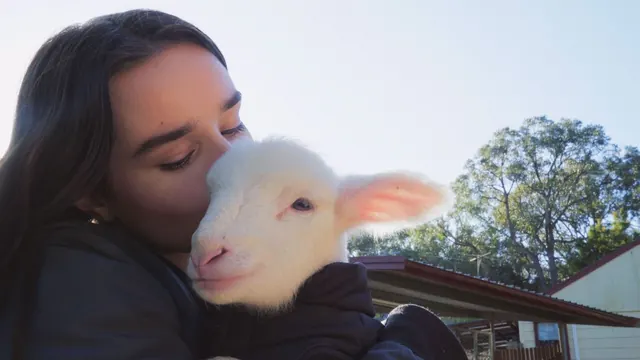
Willow and Claude are the names of two lambs that Emma Håkansson rescued from near death in Australia in 2021. The short documentary film from Collective Fashion Justice uses their stories to highlight why we shouldn’t treat animals as commodities.
However, the alternative isn’t manmade fibers either. “We cannot replace one problem with another, such as by switching out wool for synthetic fibres,” says Håkansson.
“We must look at plant-based, recycled and other bio-fibers, which are made with people, animals and the planet in mind, and these must be made into knit and other garments through totally traceable supply chains where everyone involved is paid a living wage.”
The film was accompanied by a proof of concept knitwear collection created using raw, sustainably grown cotton that was spun into high-quality yarn to make sweaters and scarves. Håkansson engaged with plant-based farmers throughout the process, “growing cotton through rotational cropping and other holistic land management practices, which reduce water usage while benefitting biodiversity and not harming our fellow animals.”
Fashion Reimagined
Raised in rural England by activist parents, Akyn and formerly Mother of Pearl’s Amy Powney had a complicated relationship with her role in the fashion industry and its impact on the environment. In 2017, after she won the BFC/Vogue Designer Fashion Fund, she decided to use the money to launch a transparent, sustainable sub-label called No Frills.
The 2022 documentary, Fashion Reimagined, directed by filmmaker Becky Hutner, documents her quest to create a sustainable collection, from field to finished garment. Sourcing ethical wool was a key component.
During her research, Powney found that South American sheep don’t suffer from fly strike and therefore mulesing is not practiced by wool farmers there, so she met with wool supplier Pedro Otegui, to source wool that is soft enough for skin contact but doesn’t involve treatments that are cruel to animals. Overall, Powney suggests that a balanced view toward wool production is what is needed, adding that, “Lots of sheep need shearing no matter what.
If we give wool a bad name without context, this may give terrible fabrics like polyester a good name and we have to be careful to promote true information and balance.”