
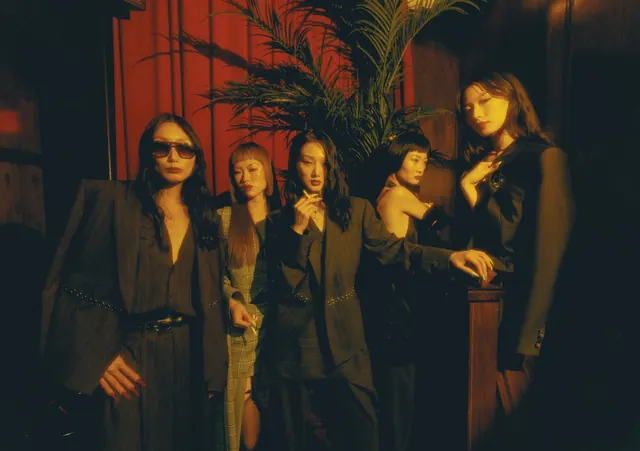
Over dim sum and tea in Chinatown’s Chinese Tuxedo, Shao debuted a follow-up collection to her ‘Underworld Royale, Part 1: Darkness Under Neon Lights’ show she premiered at Shanghai Fashion Week last March. The 2026–2027 CFDA Genesis House AAPI Design and Innovation Grant recipient allowed guests to participate in the next chapter of her cinematic, 90’s-inspired universe.
A sit-down where models doubled as stylised gangsters. The kind of characters found in the Hong Kong movies Yang grew up watching in New York.
A tailor by trade, Shao Yang’s sartorial choices were equally important. “The structure has not left; it has gone underneath, because softness here is not the absence of danger; it is the danger sitting down with nowhere left to be,” Yang said.
“Leather that used to armour a man falls open across his back, denim drifts instead of holding its line, and wool pools where it once stood at attention,” she said. These kinds of details were evident every time a new character was introduced in a choreographed leisurely stroll, the phones of every guest following them as they zig-zagged their way across the room, playing to the cameras.
However, the clothing here was secondary, more like a supporting cast member than a main character, a bargaining chip caught in the emotion of the moment. “You are sitting with everything these characters carry once the action stops: their loneliness, their betrayal, their love, grief, death, sadness, loss, and the forlorn silence sitting underneath all of it,” Yang said.
While not every aspect of the storytelling was clear, soon, the spotlight would drop one last time, the models would parade across the room, a singer would howl, and the cast would gather behind Yang. It was time to take a bow.
photography. courtesy of Kevin Tachman for Shao words. Malcolm Thomas
The Norman Foster-designed McLaren Technology Centre in Woking spent an evening exchanging its familiar world of engineering drawings, race cars and computer screens for something more fashion-minded. Staged on the eve of London Fashion Week, the facility became the setting for ‘Designed to Race: Front Row’, McLaren’s first fashion show and the culmination of a nine-month creative collaboration with Central Saint Martins, UAL, bringing 46 MA Fashion students into the team’s archive to reinterpret six decades of racing history through 12 original looks.
The brief gave the students plenty of room to get creative, with 12 groups each asked to take one of McLaren’s five historical chapters, spanning the 1970s through to the current Papaya era, and decide what that period meant in fashion terms. Drivers and famous cars offered one route in, but so did engineering, racewear, fan culture, the people working behind the scenes and the materials used around the team.
The 1970s became ‘Grit x Glamour’, followed by ‘Precision and Power’ in the 1980s, ‘Global Icon’ in the 1990s, ‘Engineered Athlete’ across the 2000s and 2010s, and ‘Papaya Era’ for the 2020s.
“Formula 1 is influencing culture in ways we’ve never seen before,” says Louise McEwen, Chief Marketing Officer at McLaren Racing. “Designed to Race explores that cultural influence through the eyes of the next generation of creative talent.”
The fashion world has hardly been waiting for permission to get interested in motorsport, with driver wardrobes, racing-inspired footwear and an endless calendar of collaborations already making the paddock a regular source of fashion reference. McLaren’s approach was to hand that history to students and see what they could make of it, without asking them to reproduce a McLaren uniform or turn the archive into another merchandising exercise.
Engineering blueprints became starting points for patterns, aerodynamic shapes informed silhouettes and racing equipment was repurposed throughout the collection, with carbon fibre, fabric offcuts, second-hand materials and used McLaren seatbelts finding their way into the garments. Johannes Warnke and Stephanie Corbyn weaved literal pieces of racing equipment directly into the tailoring, constructing structured blazers from cured carbon fibre and draping loose skirts with frayed, upcycled racing seatbelts.
A particularly striking cape was built from a racing seat, with its shape designed to billow like a visual interpretation of speed, while blurred photographs of the McLaren team spread across the fabric brought the people behind the machinery into the design.
The references became wonderfully particular as the looks moved through the decades. One Ayrton Senna-inspired outfit translated his reputation for precision in wet conditions into lightweight performance-wear, a tyre-derived digital pattern and flashes of canary yellow recalling his famous helmet.
Another look took inspiration from a female fire marshal, shifting attention away from the drivers and towards one of the many people whose work has always formed part of racing life. Somewhere else, the Monaco hairpin was stitched inside a pair of trousers.
The contemporary chapter became even more playful, with papaya racewear mixed with denim and knitwear, toy cars and childlike drawings reflecting the younger fan culture around McLaren today. Used racing boots from previous eras were incorporated into one look, topped with a headpiece inspired by Daniel Ricciardo’s famous ‘Shoey’ celebration, giving the archive a new life without treating it with too much reverence.
Dell Technologies supported the project as its technology partner, with each student working on an XPS laptop for research, digital pattern development and design before translating those ideas into physical garments. That digital-to-physical process feels particularly fitting for a project rooted in McLaren, where engineering, technology and design have always shared the same workspace.
“My background in econometrics has taught me to look at systems through patterns, relationships and connections,” says Enzo Keuning, one of the Central Saint Martins students involved. “Presenting our work at the McLaren Technology Centre felt like completing that journey.”
The setting gave the show a slightly surreal quality of its own, with the new designs presented alongside historic racewear and championship-winning cars from the McLaren archive, while Lando Norris and Oscar Piastri joined F1 Academy drivers Ella Lloyd and Ella Stevens among the guests. McLaren also used the evening to give attendees the first look at Puma’s ‘Without Limits’ collection honouring James Hunt, with the range set to launch globally on 19 October.
photography. courtesy of McLaren words. Gennaro Costanzo
Cara Delevingne has entered the lab, and thankfully she has brought jeans. For Autumn/Winter 2026, Cologne-based label ARMEDANGELS drops the British model, actress and musician into a fictional DETOXDENIM laboratory for ‘Never the Expected’, a campaign built around the idea that denim can and will evolve throughout time.
“The DETOXDENIM Lab is a symbol of our approach to innovation and our belief in challenging the way things have always been done,” says Creative Director Christiane Bördner. “Cara embodies the mindset behind it: staying curious, questioning the familiar and forging your own path.”
Delevingne feels indeed like the perfect face for the campaign, especially with her debut album ‘Not Normal’ arriving later this month and A24’s ‘Club Kid’ following in November. Her own relationship with the material is unvarnished.
“I don’t know if it’s unexpected, I just love denim,” she confesses. “I can never get enough of it.
I know that sounds bad, but it’s my favourite thing, so you can never have too much. Where’s the denim underwear?
Double-denim underwear would be so uncomfortable, but it’s a fashion thing!”
There is also a reason she fits ARMEDANGELS’ approach beyond the obvious wardrobe connection. “ARMEDANGELS does things in a way most brands simply don’t. And that matters, because you actually know what you’re wearing and how it was made,” she says, pointing towards a philosophy that has been at the heart of the label’s DETOXDENIM project since 2018.
The idea is to rethink denim production from the material itself through to the way jeans are washed and finished. Organic and recycled fibres are used alongside ozone and laser technologies designed to reduce water consumption and chemical use, while the collection also offers three levels of stretch, from non-stretch styles through to X-stretch options.
For Autumn/Winter 2026, the collection pushes this circular approach further with SaXcell Lyocell, an ultra-soft fibre made from recycled cotton waste and responsibly sourced wood pulp. ARMEDANGELS was an early adopter of the material, bringing it to market in spring 2025, and it now appears across the denim line alongside organic and recycled cotton.
“For the brand, I heard about why they were different: transparency, traceability, circularity, pieces that are made to last,” Delevingne says. “So no, it didn’t surprise me, that was already the reputation.”
The season also introduces selvedge denim, woven on traditional looms with a distinctive finished edge. Instead of the classic red selvedge thread, ARMEDANGELS opts for yellow this time, giving the detail a subtle house signature to match its corporate identity. The line leans heavily into bold washes, showcasing deep indigos and distinctive vintage finishes.
Fit remains central to the collection, with the women’s line moving across several key silhouettes. The Baarly high-waist barrel jeans and the workwear-minded Aalthea lead the statement shapes, sitting alongside the wide-leg Enijaa and Aastraeaas fits and the straight Aikaala.
The current lineup also integrates the low-waist baggy Haayi, slim Lejaani and classic skinny options, making the collection considerably broader. Men get their own rotation of shapes, including the relaxed-tapered Maakxy, the loose Jaameo baggy pantand the new straight-leg Maadox, running parallel to existing tapered and slim styles.
These coordinate with a fresh line of staples, including the striped Fietaa long-sleeve, the garment-dyed Maarkos t-shirt and the Alizaa sweatshirt.
“‘Never the Expected’ captures how we see ARMEDANGELS. We challenge the rules of the fashion industry and explore how they can be evolved through innovation,” says Martin Höfeler, CEO at ARMEDANGELS. “The new collection shows what becomes possible when materials, craftsmanship and design are considered as one.”
Delevingne also knows a thing or two about keeping clothes around. Asked about the oldest thing she still wears, she recalls a pair of childhood shoes she loved so much that, when her feet outgrew them, “we just cut the toes out instead of getting rid of them.”
The ARMEDANGELS DETOXDENIM collection is available now in stores and online. Find out more here .
photography. courtesy of ARMEDANGELS words. Gennaro Costanzo
Damson Madder is stepping into new territory for Autumn/Winter 2026, joining forces with Clarks Originals for its first-ever footwear collaboration. Bringing together Damson Madder’s playful, feminine-meets-utilitarian aesthetic with Clarks’ rich shoemaking heritage, the capsule reimagines two of the brand’s most recognisable silhouettes through a distinctly Damson lens.
Leading the collection is the iconic Wallabee, transformed in striking pillar-box red. The classic crepe rubber sole is paired with hiking-inspired lacing and eyelets, tonal red decorative lacing across the vamp, and a custom heel motif featuring the Damson Girl — a playful reinterpretation of Clarks’ original Trekman character from the 1970s.
The second style, the Nomad Damson Mule, takes inspiration from Clarks’ Nomad silhouette. Arriving in a rich “chocolate plum” colourway, the open-back Mary Jane-inspired design features a bespoke double strap finished with silver “D” and “M” branded buckles.
“We were often styling our collections and campaigns using Clark’s classic Wallabee shoes, and felt there was a natural affinity between the ‘Damson Girl’ and the Clarks customer,” Fontaine Anderson, Creative Director at Damson Madder, says. “The styles sit so effortlessly with our apparel collections that it felt like a natural fit to extend our design handwriting onto two of Clarks’ most iconic silhouettes.
I spent a lot of time delving into Clarks’ extensive archive of over 200 years, and reimagined some of their signature motifs and design details through a Damson lens.”
Adding further customisation, both styles are finished with polka-dot footbeds bearing Damson Madder branding and two bespoke fobs that can be mixed and matched to personalise the shoes. The collaboration grew from an existing affinity between the two brands.
“What we love about Damson Madder is that they maintain a specific and distinctive point of view in their collection while still completely understanding what a contemporary woman wants from their clothing,” Matteo Bellentani, Creative Director Clarks Originals, notes. “These are the types of brands we love to work with.
A brand that understands context and history while adding just enough distinctive perspective to make a classic their own.”
The Damson Madder x Clarks Originals collection launches 17 September 2026 via Damson Madder and selected retailers globally.