
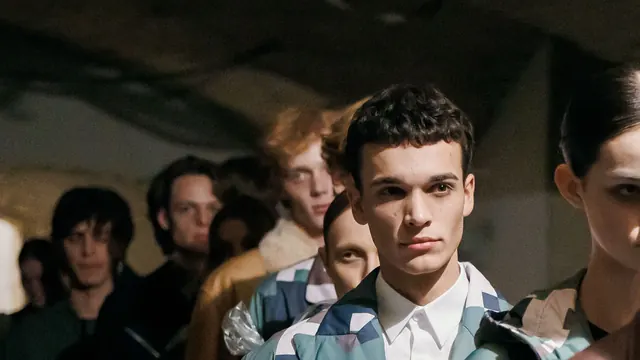
Just days before Ukrainian Fashion Week Spring/Summer 2027 began, Russian air strikes intensified on the city of Kyiv. The schedule, which ran from September 2-6, continued with strict safety protocols.
Any time an air raid alert sounded, events were suspended immediately as guests, designers, and teams took shelter. Three shows — Viktor Anisimov, Darja Donezz, and Vorozhbyt & Zemskova — took place inside allocated bomb shelters near their venues.
Five alerts sounded during a business conference, with guests and speakers leaving and returning after the all-clear, each time. Heroically, 50 brands managed to show against the odds.
“We all live and work within the same reality, and there is a strong shared understanding of the context,” says Iryna Danylevska, founder of Ukrainian Fashion Week. “Nevertheless, of the five wartime seasons we’ve held in Ukraine, this 59th season was by far the most demanding, while also becoming truly historic — both for the Ukrainian fashion industry and in the broader context of the global fashion week experience.”
Since 1997, Ukrainian Fashion Week has been a platform for the development and international visibility of Ukrainian fashion, says CEO Yelyzaveta Ushcheka. “For us, it’s essential to [maintain] that platform despite every challenge.”
It’s a brave and risky move, but Ushcheka is not alone. From Georgia to Dubai, designers, business owners, and founders are clubbing together to produce or engage in fashion weeks outside the big four, amid conflict or hostility. Meanwhile, some pioneers have developed satellite events, such as the UA in UK fashion show, to showcase Ukrainian fashion on a global stage.
The ripple effect
The Russian invasion has impacted other fashion cities, too. Back in May, 11 shows, three exhibitions, and a tight program of concerts, dinners and a drag ball took place as part of Mercedes-Benz Fashion Week (MBFW) Tbilisi FW26 — all within an increasingly volatile and socially conservative climate that threw the Georgian fashion industry into disarray.
Following Russia’s invasion of Ukraine, pro-Russia populist party, Georgian Dream, has ruled Georgia, making international headlines in 2024 for its anti-LGBTQ+ legislation prohibiting gender transition and queer “propaganda”. As Vogue Business reported, this has impacted the fashion sector creatively and financially, culminating in a mass exodus of design talent.
“Lots of queer designers left Georgia because of the danger. So many Georgian designers are [now] refugees or have chosen a different career,” says Matt Shally, the stylist behind God Era’s FW26 show and one of the drag ball’s original organizers.
“There was a level of uncertainty that you simply cannot separate from the reality of working in Georgia today,” says MBFW Tbilisi founder Sofia Tchkonia, who reinstated the fashion week last May for the first time since May 2023. Logistics, planning, international travel, and the willingness of business partners to invest were all affected by the region’s hostile conditions, but the show went on.
“I felt very strongly that this was exactly why the fashion week needed to happen. When a country is going through political and social instability, culture can easily become secondary, but for me, stopping was not the answer,” adds Tchkonia, explaining that after years of building Georgian fashion’s international profile (MBFW Tbilisi launched in 2015), it was essential the city remained a pit stop on the global calendar.
Creating momentum in difficult conditions
Of course, since hostility intensified between the US, Israel and Iran in February this year, the Middle East, one of fashion’s most important territories, has also become a conflict zone. The Arab Fashion Council (AFC) and Dubai Design District intend to go ahead with the SS27 edition of Dubai Fashion Week this October, in spite of recent drone strikes attributed to the Iran-US conflict.
“Designers are not waiting for perfect conditions to create momentum,” said newly announced chair Amina Taher in a recent interview with Vogue Business. “For many, showing is about far more than a commercial decision; it is a statement of identity, ambition, and belief in the region.”
Indeed, the event has become a link to the Middle East for many designers, including New York-based British Iraqi talent Tara Babylon. She showed at both seasons of Dubai Fashion Week in 2025.
“It feels like a bridge between my life and career in the West and my Middle Eastern heritage,” she says. “Of course, the current geopolitical situation makes operating and engaging with any market in the region something that requires awareness and sensitivity.”
Challenges beyond the runway
As tensions in Dubai and the broader Middle East fluctuate, designers will need to remain vigilant as they plan their shows. More broadly, businesses working in and around geopolitical instability must be flexible, ready to shift their go-market approaches as well as their distribution, retail and production.
Taking part in a fashion week is just the tip of the iceberg. The strategic rewiring of brands and their connections with global markets is the real feat that will help them scale.
Aleksandra Volkova, who founded UA in UK — a platform showcasing Ukrainian fashion designers during London Fashion Week — worked in PR, events and model management in Ukraine for 14 years before Russia’s invasion led her to relocate to London in 2022. “I subsequently founded the UA in UK Community, and one of my priorities has been creating a bridge between Ukrainian talent and the international market,” she says.
For Volkova, however, the biggest impact of global instability is on the ground. The fashion week presence is an attempt to lessen the impact.
“The war affects practically every stage of running a fashion business,” she adds.
Volkova notes that production in Ukraine has become less predictable and more expensive, with importation costs for materials, fabrics and trims rising. Meanwhile, Ukrainian manufacturers must grapple with power disruptions, security risks, and a severe workforce shortage caused by the mobilization and displacement of millions of Ukrainian people. The nation’s airspace remains closed to civilian aviation, delaying shipments, and products get lost in freight due to attacks.
Within that framework, it’s hard for Ukrainian designers to compete internationally on price, quality and delivery, let alone produce a show or attract investment. It’s here that Volkova argues the importance of showing on the runway. “It can give a designer access to buyers, press, influencers, potential partners, and customers that may be very difficult to reach from Ukraine under current circumstances,” she explains.
For those trying to orchestrate shows in their home country, it can be harder. Organizers must contend with reluctant guests and sources of investment.
“Bringing people to Tbilisi under the current circumstances required much more work, communication, and reassurance than it once did,” says Tchkonia. Investment was challenging as companies became cautious over budget allocation.
“Conversations with partners required a very clear understanding of why supporting fashion and creative culture matters,” adds Tchkonia, who secured investment from Coca-Cola and returning partner Mercedes-Benz. “Long-term partners are particularly important, because they understand that MBFW Tbilisi is an ecosystem that has helped Georgian designers gain international visibility.” Keburia, which is showing at London Fashion Week SS27, is a case in point.
Keburia’s decision to show internationally was driven primarily by the natural growth of the brand rather than Georgia’s geopolitical climate. “This was never about leaving Georgia behind,” says George Keburia, who had to close his Tbilisi store to ensure the safety of his employees during police dispersals and more intense political demonstrations.
“Keburia remains based in Tbilisi, and our work is still shaped by the social and political reality around us. Showing abroad allows us to develop the business while keeping Georgian creativity visible internationally.”
Scaling in a crisis
Ukrainian designer Valeriia Semchuk’s womenswear label, Selera — founded in 2020 — has and will again show during the UA in UK show. “In 2022 and 2023, there was incredible support for Ukraine, and simply being a Ukrainian brand carried a lot of meaning,” remembers Semchuk.
“But as that support naturally declined, we had to prove that we were more than a Ukrainian brand — that we had a strong identity, a clear face, and values of our own.”
The label is growing steadily, not exponentially, Semchuk affirms, with annual turnover up 30% between 2023 and 2024. More recent growth has leveled between 10-15% year-on-year, while the customer base is growing organically via the brand’s website and word of mouth. Wholesale now accounts for half of the brand’s overall sales. Geographically, Selera continues to grow across Europe, the UK, and Ukraine.
These days, Semchuk largely works from the UK, but made a recent return home to hone her upcoming Selera Atelier line, a more experimental side of the brand that will launch at London Fashion Week. During its development, some of the samples and fabrics were lost in transit.
“We are really hoping they will make it to our upcoming show in Britain,” she says. “We are constantly learning how to adapt to these new realities, because logistics is an essential part of how our brand operates.”
Also showing in the UA in UK show is the 2014-founded Paskal label. (Paskal also showed during Ukrainian Fashion Week SS27.) Before the Russian invasion, founder Julie Paskal relied predominantly on wholesale.
“The crisis gave us an unexpected opportunity to rebuild the business from the inside: to develop our e-commerce, understand our customer directly, and create a stronger foundation for the brand,” says Paskal, who spends most of her time in Ukraine, where her team and family are based. This turn toward direct-to-consumer (DTC) and e-commerce channels, plus an increased focus on the Ukrainian market, has helped the brand build a closer relationship with its customer.
Revenues grew approximately 111% year-on-year in 2025. This year, Paskal revenues are approximately 62% higher than at the close of 2025, with three months still remaining. Overall, revenue has more than tripled since 2024 on a year-to-date basis, despite the ongoing war. Locally, the brand’s key markets are Kyiv, Odessa, and Lviv, as well as some less-disrupted regions. Internationally, key markets include the UK, the US, France, Spain, Qatar, and Japan.
Moving forward, Paskal will strengthen brand presence in the UK, the US, Europe, Japan, and the Middle East. “We diversified our production facilities within Ukraine and adapted our logistics and operational processes to the new reality,” she says. “The next stage is about combining the strength of our direct customer relationship with a strong international wholesale network — and building Paskal into a more scalable global business.”
This could pay off. Danylevska and her peers conducted research into the state of the Ukrainian fashion industry between 2022 and 2024.
By the summer of 2024, the data was already showing signs of recovery in the domestic market alongside growing international sales as brands adapted. “We conducted new research in August 2026 among the brands participating this season, and the results confirmed that this growth has continued,” says Danylevska.
On average, brands reported a 30% increase in domestic wholesale sales and even stronger growth when considering wholesale and DTC as one, she says. “We can now see Ukrainian Fashion Week’s presence in Kyiv as one of the important factors contributing to stronger demand for Ukrainian brands in the domestic market.”