
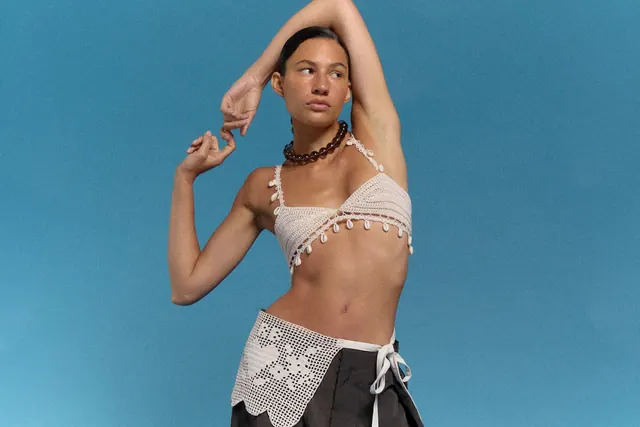
Renata Brenha can turn just about anything into something worthy of the runway. In the Brazilian designer’s London-based studio, football shirts are pulled apart and pieced back together, bamboo curtains become jewellery, and vintage placemats are reimagined as crochet angels playing football.
It’s a way of creating that has followed her since childhood. Growing up in Sorocaba, a city in São Paulo state, Brenha would cut jewellery from her mum’s catalogues and sell the paper pieces from an imaginary shop called Papique .
While Papique is no more, Brenha later enrolled in fashion school in São Paulo, before switching to advertising, unsure whether fashion could offer her a sustainable career. It was only after moving to London that she returned to fashion, studying at Central Saint Martins and later at The Royal College of Art.
It was here, while researching ancestral craft for her MA, that Brenha began drawing connections between football and ritual. Visiting Indigenous communities across Latin America, she repeatedly encountered football jerseys worn alongside pieces crafted from feathers and woven fibres.
“It made the relationship between the mundane and the spiritual worlds very clear to me,” she says. “I feel this is something that deeply marks Latin American culture, and it remains an endless source of inspiration for me and for the work we do in the studio.”
Now, as she unveils the latest collection for her eponymous womenswear label, SS27’s Sport & Spirit , Brenha is looking more closely at the relationship between football and ritual. Below, she talks to Dazed about reworking Brazil’s “ultimate cliché” and what’s on the cards for the rest of 2026.
How would you describe the brand to a stranger you met on a night out?
Renata Brenha: I’d say it’s a womenswear brand by a Brazilian designer based in London. We reinvent everyday and overlooked materials through craft, with a distinctly Latin American sensibility. Basically, we take things that aren’t meant to be precious and make them impossible to ignore.
Football jerseys have appeared in your work since 2022. What keeps bringing you back to them?
Renata Brenha: They are such strong symbols of popular culture and of the many stereotypes surrounding it. I feel they represent the ultimate Brazilian cliché, which makes them such rich territory for commentary, distortion and reinvention. And to be fair, they also really turned the volume up on the brand. These pieces have so much appeal that they pull you in like a magnet.
There is also the fact that they are all second-hand, so they already come in with some sort of energy/heritage behind; and that there is so much waste within this category of clothing. They allow us to constantly play with contradictions: old and new, masculine and feminine, every day and elevated, disposable and precious.
I also find it funny that I approached them with a complete lack of reverence or knowledge of the sport. I was a terrible player as a child, a very skinny little girl who was afraid of the ball and knew nothing about football, so the whole process began with a sense of irony. It is quite hilarious that these jerseys have become such a persistent language in my work.
If you could dress anyone, who would it be ?
Renata Brenha: Sônia Braga. She has always been a forever muse. There is something about her presence, and strength that feels completely timeless to me.
Renata Brenha: I’m currently working on a collaboration that will be released a little over a year from now. There isn’t much I can say yet, but it is in the world of accessories.
What’s something you’re trying to do differently in your work right now?
Renata Brenha: I want to communicate the work we do more effectively, while strengthening and expanding our community. I think this is essential, how the work moves through the world and impacts culture is just as important as the work itself.
I also want to create more space for research and the development of ideas, which can be difficult within the daily reality of managing and building a brand while juggling a million different things.
You wake up tomorrow and the fashion industry has disappeared. What are you retraining as?
Renata Brenha: I already have a food project called Cocina Studio with my co-director, Hernan De Majo, who happens to be a chef. We organise supper clubs and all kinds of creative endeavours that consider food their main material, while exploring culture, provocation and moments of togetherness.
Perhaps I would immerse myself more deeply in this world. I’m so intrigued by the different mediums we can use to communicate an idea or tell a story.
What does the rest of 2026 look like for you?
Renata Brenha: We’ll be doing some very exciting pop-ups that bring food and fashion together. We also have supper clubs happening in October, and we are working on special projects and collaborations for next year, which will be a remarkable moment, with the first Women’s World Cup taking place in Brazil.
Get must-see stories direct to your inbox every weekday.
From Paul Thomas Anderson’s Cameron Winter concert film to a sitcom featuring Andrew Scott as a kinky therapist, here’s our round-up of what to see at this year’s London Film Festival