
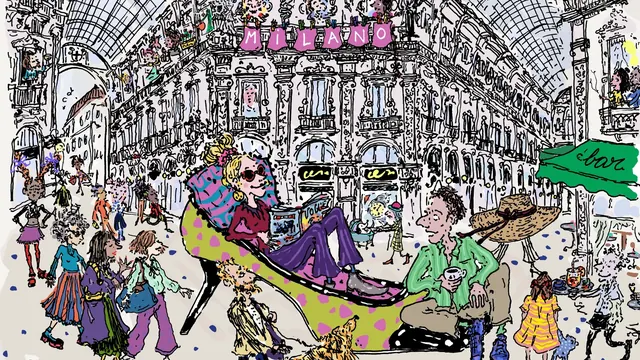
Conceived as a prototype for what would eventually evolve into the modern shopping arcade—and later the mall—the Galleria Vittorio Emanuele II has shaped Milan’s cultural identity for nearly a century and a half. Architect Giuseppe Mengoni completed the landmark in 1877, though its soaring iron-and-glass cruciform vault had already begun connecting the Piazza del Duomo to Piazza della Scala a decade earlier.
Over the decades, the salotto di Milano (“Milan’s drawing room”) welcomed figures like Maria Callas, Giuseppe Verdi, and Giuseppe Garibaldi into a vibrant meeting ground where music, art, and civic life converged.
When the arcade first opened, Europe was navigating industrialization, the rise of the urban bourgeoisie, and the emergence of modern ready-to-wear fashion. The Galleria bore witness to early political protests, the advent of electric street lighting, the devastating aerial bombings of the Second World War, and the founding of the Italian Republic.
Long serving as both a chronicler and custodian of Milanese history, it stands as the ideal backdrop for an event dedicated to human craftsmanship and visionary design.
As Vogue World arrives in Milan, the arcade’s storied central promenade transforms into an open-air runway. Exploring the dialogue between Italy’s artisanal heritage and emerging technologies like artificial intelligence, the event considers how the handmade endures in an era of rapid innovation. To mark the occasion, here is our definitive guide to the historic workshops, venerable dining rooms, and fashion houses that give the Galleria its life.
Algani
Operating for nearly a century, Algani began in 1927 as a modest seller of newspapers, periodicals, and postcards before evolving into one of the city’s first international newsstands. Located steps from Teatro alla Scala, its counter became a regular haunt for political heavyweights like Bettino Craxi and Giovanni Spadolini, as well as musical titans like Riccardo Muti, Claudio Abbado, and Luciano Pavarotti.
In the 1970s, founders Bruno and Elena Algani expanded the inventory to include curated souvenirs, transforming the newsstand into a beloved stop for international visitors looking to take home a tangible piece of Milan.
Borsalino
While Humphrey Bogart immortalized the Borsalino on the silver screen in Casablanca, the storied Piedmontese hatter has long been an essential fixture of Milanese style. Since the late 19th century, its boutique near the entrance to Piazza della Scala has dressed cultural luminaries—including Giuseppe Verdi, who regularly walked over from the nearby Grand Hotel et de Milan to purchase his signature rabbit-fur top hats.
With more than 160 years of heritage, the label remains an enduring benchmark of Italian millinery.
Cadè
In 1926, the same year New York inventor Jesse Langsdorf patented the modern three-piece necktie cut on the bias, husband-and-wife team Canziani and Denari combined their surnames to establish Cadè. Now in its fourth generation, the bespoke shirt-and-tie purveyor remains an emblem of classic Milanese haberdashery.
Inside the boutique, you can still spot artifacts of its wartime survival, including a vintage brass tape measure, an original municipal licensing stamp machine, and the carbide boat lamp the owners used to illuminate the fitting room during wartime blackouts.
Noli
Founded in 1973 by Leonardo Noli and now run by his children Luca and Simona, this tobacconist just steps from Palazzo Marino has served as a discreet gathering place for Milan’s political and cultural establishment. During Italy’s turbulent Years of Lead, ministers and mayors frequented the shop; Bettino Craxi regularly dispatched aides for mint cigarettes, while Mayor Carlo Tognoli purchased pipes here for President Sandro Pertini.
Beyond politicians, the shop has welcomed everyone from conductor Daniel Barenboim to Arnold Schwarzenegger.
Bar Motta
Opened in 1928 by baker Angelo Motta, this café helped establish the modern Milanese ritual of weekend leisure. Designed by Melchiorre Bega with clean lines that bridged Neoclassical balance and the dynamism of Futurism, Bar Motta became famous for the Sunday tradition of stopping for a paper-wrapped tray of fresh pastries after mass at the Duomo.
Today, having evolved through decades of architectural updates, the café forms the anchor of Autogrill’s Il Mercato del Duomo, sharing its sprawling footprint with contemporary bakeries, dining concepts, and a listening bar.
Biffi
Biffi predates the Galleria itself. In 1852, Paolo Biffi—a master confectioner to the royal House of Savoy—opened a café in the historic center, making a name for himself with his artisanal panettone.
When Mengoni’s arcade took shape, Biffi moved into the central Octagon, where it remains today. Over the years, it welcomed Arturo Toscanini, Ernest Hemingway (who referenced it in A Farewell to Arms), and Giuseppe Garibaldi, who was fond of a layered chocolate-and-cherry cake that still bears his name.
In 1882, it was also among the very first commercial establishments in Milan to install electric lights. Today, the café is steered by Tarcisio, an entrepreneur of Italian descent who began his career in the capital’s restaurant kitchens after arriving from Brazil.
Camparino
Founded in 1915 by Davide Campari, this iconic watering hole is the spiritual home of the Milanese aperitivo. Positioned directly at the Duomo entrance, it quickly became an intellectual and artistic salon; painter Umberto Boccioni immortalized its buzzing exterior in his 1910 canvas Rissa in Galleria (Riot in the Gallery). An aperitivo at the sleek counter or an outside table remains one of the city’s signature rituals.
Cracco in the Galleria
Spanning several levels within the Galleria, chef Carlo Cracco’s Michelin-starred outpost balances minimalist, sculptural cuisine with sweeping neoclassical interiors. At the entrance, artist Patrick Tuttofuoco’s neon installation, Heterochromic, captures the gaze of Cracco and his wife, Rosa Fanti.
Inside, slate-blue paneling opens onto three elegant dining salons and two private suites, leading finally to the Fumoir—an intimate lounge wrapped in moss-green metallic textiles and Art Deco finishes, centered on an ambitious cocktail and spirits program.
La Locanda del Gatto Rosso
Run by brothers Andrea and Stefano Loiacono, Il Gatto Rosso has championed classic Milanese fare for more than three decades. Backed by executive chef Claudio Covella, the kitchen balances northern standards like saffron risotto with subtle Mediterranean influences that pay tribute to the owners’ Calabrian roots. A sister venue, Caffè & Bistrot del Gatto Rosso, offers an airy breakfast and aperitivo alternative just around the corner in Piazza Filippo Meda.
Marchesi
While the Marchesi family’s confectionery history traces back to 1824 on Via Santa Maria alla Porta, its pastel-hued outpost on the mezzanine of the Galleria has quickly become an essential stop. Arched windows framed in mint-green marmorino plaster overlook the floor mosaics below, complemented by floral jacquard silk wallcoverings and dark cherry vitrines.
Beyond its heritage panettone and morning espresso service, the salon offers afternoon tea and light lunch menus developed by Chef Emanuele Ruiu and Pastry Director Diego Crosara—with delicate puff-pastry palmiers remaining a well-known favorite of Miuccia Prada.
Galleria Restaurant
Long the official headquarters of Il Salotto di Milano—the association representing the arcade’s businesses—this dining room has been run by the Galli family since 1983. Renowned for its late kitchen hours, it has long served as a post-performance sanctuary for La Scala artists, welcoming tenors Piero Pretti and Giuseppe Di Stefano alongside conductors Daniele Gatti and Ion Marin.
Under chef Pietro Carriero, the kitchen focuses on northern Italian comfort classics, most notably its crisp, bone-in cotoletta alla Milanese.
Il Salotto Restaurant
Retaining the wood-paneled warmth of its 1970s design, Il Salotto offers a classic, unhurried dining room overlooking the main thoroughfare. The kitchen remains devoted to quintessential regional fare—anchored by saffron risotto paired with slow-braised veal ossobuco—serving as a relaxed vantage point for people-watching.
Savini Milano 1867
Established in 1867 during the Belle Époque, Savini quickly became the cultural epicentre of the Galleria, hosting Verdi, Puccini, Gabriele D’Annunzio, and Charlie Chaplin. Its first-floor dining room—specifically Table 7—is legendary: it was Maria Callas’s preferred retreat throughout the 1950s, where she dined between rehearsals and held court after opening nights alongside Luchino Visconti, Franco Zeffirelli, and Aristotle Onassis.
Steered today by the Gatto family, the kitchen serves refined interpretations of Milanese gastronomy inside historic settings like the Sala Toscanini.
Balenciaga
Balenciaga’s Galleria outpost emphasizes architectural reduction and structural precision. The boutique pairs the historic volume of the arcade with minimalist interiors, placing full focus on volume, silhouette, and the craft of garment construction.
Bottega Veneta
Echoing the design language of its Avenue Montaigne flagship, Bottega Veneta’s 2024 boutique pairs local Italian walnut paneling with green Saint Denis marble. Sweeping curved glass elements mirror the soaring barrel vaults outside, while modular wool rugs and grid-patterned terrazzo floors subtly evoke the house’s signature intrecciato leather weave.
Bric’s
Founded on the shores of Lake Como in 1952 by Mario Briccola, this family-owned luggage brand joined the Galleria in 2022. Balancing heritage travel trunk aesthetics with contemporary technical materials, its understated designs—including the vintage-inspired Bellagio collection—bridge old-world travel romance with modern durability.
Chanel
Rather than reproducing its Parisian flagship, Chanel dedicated this boutique primarily to footwear and fine beauty. The collection showcases seasonal iterations of the house’s iconic two-tone slingback alongside an intimate beauty salon highlighting Chanel’s skincare and fragrance lines.
Church’s
Founded in Northampton, England, in 1873, Church’s has maintained its Roberto Baciocchi-designed Galleria boutique since 2001. The brand holds a unique place in industrial history: it was the first shoemaker to introduce left- and right-footed lasts—an innovation dubbed the “Adaptable” that fundamentally shaped the modern footwear industry.
Dior
Occupying a prime position on the central Octagon since 2021, Dior’s boutique presents an airy, pastel-inflected interior framed by Mengoni’s soaring stone pilasters, offering ready-to-wear and leather goods within an ornate setting.
Fendi
Set over multiple levels, Fendi’s boutique pays homage to early 20th-century Milanese residential architecture. The ground floor pairs polychrome marble floors with hand-troweled ivory stucco featuring Karl Lagerfeld’s archival FF motifs, while the upper level is arranged like an intimate private apartment, furnished with rust-colored velvet armchairs by Gio Ponti, blown-glass consoles, and contemporary art commissions.
Fratelli Rossetti
Established in Parabiago just outside Milan in 1953, Fratelli Rossetti helped pioneer post-war Italian casual luxury. In the 1960s, the house made footwear history by popularizing tassel details on classic loafers and debuting the "Yacht"—the first luxury moccasin engineered to be worn comfortably barefoot. Its presence in the Galleria sits as a natural extension of its Lombard craftsmanship.
Giorgio Armani
Giorgio Armani personally oversaw both the 2013 opening and the extensive 2022 conservative restoration of this boutique. The original floor mosaics of the Galleria flow uninterrupted directly through the threshold, meeting neutral walls finished in 19th-century Brenta lime wash rendered in the designer's signature greige, platinum, and ivory palette.
Gucci
Though born in Florence, Gucci’s connection to Milan runs decades deep. Spanning 900 square meters across multiple levels of the central arcade, the flagship showcases the house’s ready-to-wear, leather goods, and high jewelry collections, balancing opulent finishes with contemporary design details.
Longchamp
Conceived as a Parisian pied-à-terre, Longchamp’s concept boutique relies on Haussmann-style moldings, vintage mid-century furniture, and antique market curios. Display walls are structured like library bookshelves, lending the intimate interior the casual warmth of an apartment salon.
Loro Piana
While Loro Piana celebrates a century of textile excellence, its boutique facade boasts even deeper historic pedigree. Supervised by the Italian Archaeological and Heritage Superintendency, the exterior features original stone moldings, pediments, and neoclassical friezes that open into a quiet, minimalist interior lined in warm cashmere, wool, and polished timber.
Louis Vuitton
Occupying an expansive footprint that once housed an early-century ballroom, Louis Vuitton’s boutique is laid out as a classical French enfilade—a continuous axis of connecting salons finished in parchment, bronze, and pale timber. The store balances contemporary design commissions with travel-trunk heritage, celebrating the historic dialogue between French savoir-faire and Milanese decorative craft.
Luisa Spagnoli
Before revolutionizing Italian women’s knitwear, Luisa Spagnoli achieved fame as an entrepreneur in Perugia, where she co-founded the Perugina confectionery and invented the iconic hazelnut Bacio chocolate. Her fashion house opened in the Galleria in 1968 under the direction of her son Mario, and the boutique still preserves an original, patented Murano glass chandelier custom-blown for the space.
Moncler
In the 1980s, Milan’s Piazza San Babila became the staging ground for the Paninari—a youth subculture that mixed Americana with luxury streetwear, anchored by Timberland boots, rolled-up denim, and brightly colored, down-filled Moncler puffer vests. Moncler’s split-level Galleria boutique pays tribute to this distinct Milanese subculture through sleek alpine wood finishes, oversized visual archives, and technical outerwear collections.
Montblanc
Anchored by a sculptural spiral staircase designed by Noé Duchaufour-Lawrance—its dark wood contours echoing the flowing stroke of an ink nib—Montblanc’s boutique celebrates the written word. Overhead hangs The Tree of Writing, an installation of suspended white characters that captures the tactile heritage of calligraphy and high-precision penmaking.
Pinko
Dubbed Pinko Galleria, this boutique features an interior concept designed specifically for the landmark. Founded in Fidenza in 1986 by Pietro Negra and Cristina Rubini, the brand highlights exclusive limited editions here, including archival releases of its Love Bag produced in vivid magenta and bubblegum pink.
Prada
Prada’s presence in the Galleria represents the fashion house’s point of origin. In 1913, Mario Prada opened his leather goods and luxury travel boutique, Fratelli Prada, in the central arcade, outfitting the space with imported crystal vitrines, custom brass umbrella stands, and hand-painted wall panels by La Scala set designer Nicola Benois.
That original checkerboard marble floor and Art Deco mahogany cabinetry remain fully preserved today, serving as the cultural heart of the global brand.
Rocca
A premier horological destination, Rocca operates as part of the Damiani Group, which has specialized in fine jewelry since 1924. Its boutique offers curated high-jewelry collections alongside museum-grade watchmaking from Switzerland’s top manufacturers.
Rolex
Operated in partnership with the Damiani Group, the Rolex boutique features an engineered “Moving Room”—a bespoke vertical platform that transports clients between levels, turning a visit into an architectural journey.
Panerai
Blending its Florentine nautical watchmaking heritage with Milan’s classic architectural proportions, Panerai’s boutique incorporates marine-grade brass, dark oak, and a dramatic custom chandelier assembled from 1,400 hand-blown Murano glass elements by Venini.
Saint Laurent
Situated along the eastern arm of the central Octagon, Anthony Vaccarello’s Saint Laurent boutique features clean, reflective black marble, polished chrome, and minimal display plinths dedicated to runway accessories, leather goods, and footwear.
Santoni
Designed by Patricia Urquiola, Santoni’s store brings the shoemaking traditions of the Marche region to Milan through geometric, tangram-inspired architectural lines. The boutique incorporates local terracotta, sustainable brass accents, and an interactive “One Live” bespoke studio where clients can commission custom hand-painted patinas and monogramming.
Tiffany & Co.
Positioned beside the Galleria’s mosaic depicting the Americas, Tiffany & Co. integrates its Fifth Avenue visual heritage with classic Italian craftsmanship. The interior features cast-glass displays fabricated on Murano by Venini, a geometric coffered ceiling engineered by Hugh Dutton & Associés, and a dedicated salon highlighting the jewelry designs of Elsa Peretti framed by Gio Ponti-inspired furnishings.
The Bridge
To celebrate its Galleria opening, the Florentine leather house debuted the Milano Galleria—a limited-run half-moon shoulder bag restricted to just 100 numbered pieces. Crafted from Tuscan vegetable-tanned leather with woven handle detailing, the silhouette honors the brand’s 1970s archive.
Tod’s
Tracing its roots to a modest cobbler’s bench in Sant’Elpidio a Mare founded by Filippo Della Valle, Tod’s has grown into a titan of casual luxury. Opened in 2023, its Galleria flagship focuses on the artisanal construction of its signature pebbled-sole Gommino driving shoe, presented alongside bespoke tailoring and handcrafted leather goods.
La Feltrinelli
Established within the arcade in 1999, Feltrinelli operates an expansive, multi-room literary hub on Level -1 beneath the Piazza del Duomo entrance. Beyond its shelves of foreign-language titles and art books, the underground space hosts a busy calendar of author readings, debates, and cultural lectures.
Libreria Bocca
Founded in Turin in 1775 by the Bocca brothers—printers who published groundbreaking texts by Silvio Pellico, Giovanni Segantini, Friedrich Nietzsche, and Søren Kierkegaard—Libreria Bocca is Italy’s oldest surviving independent bookshop. Steered by the Lodetti family since the early 1980s, the compact boutique doubles as an art gallery, mounting regular micro-exhibitions and artist monograph debuts among ceiling-high stacks of rare publications.
Libreria Rizzoli
A Galleria fixture since 1949, Rizzoli’s multi-floor flagship was reimagined by Studio Lucchetta+Retail Design in 2014 as a celebration of Italian industrial design. The bookstore showcases iconic post-war furnishings, including Franco Albini’s Infinito modular shelving, Vico Magistretti’s Nuvola Rossa bookcase for Cassina, and Poltrona Frau armchairs, creating an inviting reading room with international design titles and curated fiction.
The Good-Luck Bull
Restored after decades of wear, the mosaic bull set into the central Octagon’s floor remains one of Milan’s most visited rituals. Installed in 1867, the motif is part of a heraldic series honoring the four historical capitals of the Kingdom of Italy: Milan, Florence, Rome, and Turin—with the charging bull representing Turin.
Although legend claims the tradition originated as a cheeky slight by the Milanese toward their Piedmontese rivals, spinning backward three times on your right heel over the bull’s testicles is now an essential good-luck ritual for locals and travelers alike.
Highline Galleria
Tucked away just past the Moncler boutique along the arcade’s Scala wing is a discreet doorway leading to the building’s original access stairs. Long closed off, the route now allows visitors up to the Highline Galleria—a 250-meter elevated walkway winding along the iron-framed glass barrel roof. Reconstructed following the Second World War, the path offers panoramic views across the city skyline toward the spires of the Duomo.
The Golden Regulations
To preserve the visual harmony of Mengoni’s neoclassical design, an official municipal ordinance enacted in the mid-20th century dictates that every commercial storefront in the Galleria must adhere to a strict aesthetic code: every sign must feature uniform gold lettering set against a matte black ground, mounted flush between the arched windows.
The “Ratin,” or How the Galleria Was Lit
Before electric arc lamps arrived in 1883, the Galleria was illuminated each twilight by rows of individual gas lanterns. To ignite them, maintenance crews used a tiny, automated clockwork-driven miniature locomotive called the Ratin (“little mouse” in the Milanese dialect). Running along a track fixed near the cornice molding, it carried a spark down the length of the nave, automatically lighting each gas jet in sequence as evening fell.