
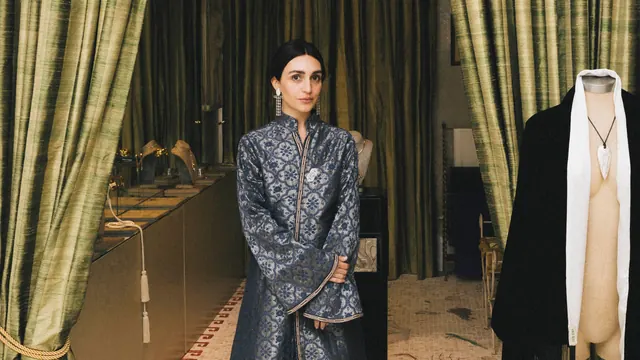
Two jewelry designers are among this year’s 10 CFDA/Vogue Fashion Fund Finalists, and both hosted New York Fashion Week presentations—Milamore, by designer George Inaki, at a traditional Japanese tea house, and Juju Ferentinos’s label Juju Vera at her brand-new studio.
On Friday, Inaki gathered the fashion set for ceremonial matcha at Sorate. Inaki, who is of Spanish-Filipino and Japanese heritage, wanted to show visitors a bit of his culture, while also showing off his new collection. Milamore is based around kintsugi, the Japanese practice of repairing broken pottery by filling the cracks with gold lacquer—with many of the pieces sculpted to look like the gilded seams that hold the pottery together.
“It all started with the idea of wanting to mend myself. When I moved from Japan I didn’t have friends, I didn’t have a job, I came to this big city of dreams to become someone, but I really struggled,” Inaki said.
Tea masters don’t typically wear jewelry, but Sorate’s made an exception. She wore the brand’s signature kintsugi necklace, a gold squiggle that sits at the collarbone, as well as one of Inaki’s newer creations—kimonos upcycled into shirts with pearl and diamond buttons. Inaki also showed off a heart pendant and his silver puzzle chain necklace, its interlocking hooks made to be completely broken apart and then put back together at the wearer’s whim.
Inaki himself was wearing a divorce ring, which he made by melting his engagement ring and adding a line of diamonds to it—a process in keeping with the kintsugi ethos.
Then, on Saturday morning, Ferentinos officially opened the doors to Juju Vera’s studio—a downtown Manhattan respite adorned with satin curtains and art she has collected on travels.
The most exciting part of the space was the alcove where she displayed a mix of her Penelope dangle earrings, a Valentina belt, Olympia armbands, and the Carolyn Pendant, based on a top Carolyn Bessette-Kennedy wore in the ’90s. Another highlight: she’d commissioned artist Joseph Kester to paint the floor in the style of an asarotos oikos mosaic—designed to look as if a great feast had taken place, and some food and dishware had fallen on the floor—a popular motif in ancient Greek dining rooms.
Though the feature was meant to symbolize how all of life is temporary and everything decays, it became a major status symbol among the ancient elites due to its high cost. (Think of it as the de Gournay wallpaper of antiquity, Ferentinos suggested.)
But Juju Vera’s high jewelry launch quickly drew attention away from Ferentinos’s mock-triklinion floor. The collection included three pieces made to resemble a fishing net—an ear cuff, anklet, and necklace—all in gold, with a big diamond drop. The ear cuff alone took Ferentinos over a year to engineer, and the anklet falls so that the diamond rests atop the wearer’s metatarsals.
Ferentinos also showed off a silk and velvet shawl, representative of where the brand is going next. “We’re going to be introducing new product categories in the future, all in the same vein of just elegant accessories for the modern woman,” she said.
“The modern Maria Agnelli, Maria Callas, Jacqueline de Ribes,” Ferentinos continued. “They traveled around the world and distilled all of their exposure down to their own style, that’s what made it so special.”