
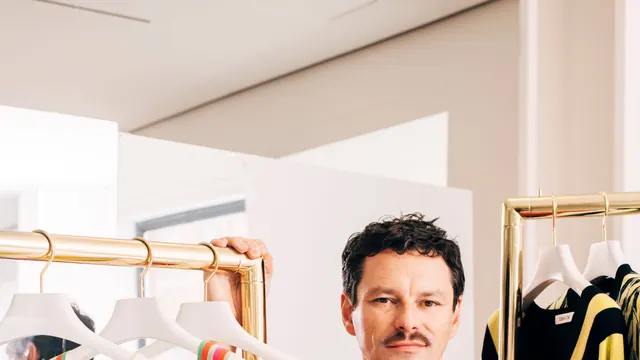
On September 9, the Diane von Furstenberg (DVF) store in the heart of the Meatpacking District is closed. “The boutique will be closed in preparation for our Spring/Summer 2027 runway show,” a sign taped to the door reads.
Upstairs, newly minted DVF artistic director Henry Zankov is busy prepping. But today, he’s not focused on the DVF show, preparations for which are near complete.
Instead, he’s in the midst of previews for his eponymous label, Zankov. He moved operations into the DVF HQ for ease when he took on the role of artistic director earlier this year, and so the office is split in two: DVF on the right, Zankov on the left.
As we chat while looking at the Zankov boards, the designer runs across to the DVF side of the floor (it’s not far) to look at a model walk back and forth in a sheer yellow, pink and purple chiffon gown with the team. The DVF show is the next day, but everything is in hand, Zankov says, allowing him to shift focus.
Satisfied, he strolls back over. “I go from one desk to another on a daily basis,” he laughs.
The back and forth has crystallized Zankov’s vision for his own brand, which he founded in 2020. To start, he focused on colorful knitwear (the embrace of color, in part, inspired by his time working at DVF under Jonathan Saunders), but in recent seasons, he’s expanded into fuller wardrobing, from chiffon eveningwear to embellished shirting.
Zankov is part of New York’s new guard, and came up under designers like Christopher John Rogers, and alongside the likes of Diotima’s Rachel Scott (with whom he’s co-hosted sample sales in the past). The Zankov aesthetic stood out from the brand’s early days against New York fashion’s more muted palette for its bright stripes and zany prints.
Prices sit in the mid-hundreds for sweaters, and in the thousands for dresses and skirts.
“Working on [DVF] made me realize how wacky this needs to be,” Zankov says, nodding to the left side of the office, where racks of brightly colored SS27 Zankov are sitting. Fittings will kick off the next day. “As I’m working on it, I realize even more so how different the brands are.”
While we’re talking, an employee comes by with a pot of ginger tea, which she pours on a table with a platter of croissants, bowls of pins and some static guard (of course), before heading back up to Diane von Furstenberg’s office, where the founder is working. (She usually resides in Venice these days, but is in town for the show.)
DVF may be in town, but the design direction was all Zankov. Throughout the process, he says, he managed to keep the two brands very separate, including the source material that inspired each collection.
This season’s Zankov collection, the designer says, was informed by the word ‘analog’. “Because of working so much on both brands, I wanted to slow down.
I wanted to listen to quieter music, chill out more, and be away from my phone,” Zankov says. “I barely go on Instagram right now — for the brand, someone helps me with that, but I really wanted to move away from all this extra stuff, because I have so much going on.”
Through this stepping back, Zankov found himself deep in ’60s music and architecture, thinking about his Russian heritage. (Zankov moved with his family from Russia to New Jersey as a child.) While his mother was in her 20s, she moved to Saint Petersburg, Russians went to the moon, things were changing.
When Zankov was in his 20s, the internet came about. “So I was thinking about this idea of analog and the future,” he says.
The subsequent collection is a product of this juxtaposition between past and future. “The collection feels almost retro.
It feels like the first iPhone that ever came out — because you saw the future then, and now you look at it and it feels old.”
The design process this season really elucidated what Zankov (the brand) can be for Zankov (the designer). “Working on this made me realize how much more I can lean into the eccentricity of Zankov, because I always think about, ‘Oh, how are we going to do a black dress, or how are we going to do something that maybe is more approachable to others?’ But now I’m like, ‘Maybe I don’t need to.
Maybe I do it here,’” he says, nodding to DVF, where his colleague is photographing a fit model. (There is one black Zankov number for SS27, he notes, but it’s replete with feathers.) The dual-gig setup means that Zankov now has more financial freedom to take more creative risks on his own brand, leaning into the off-kilter pieces he has such a knack for.
This is Zankov’s third time putting on a runway show. Monday’s show is at one of NYFW’s mainstay buildings, 180 Maiden Lane in FiDi, supported by a partnership with the NYFW Collections.
Though he’s still not sure about doing shows “all the time”, he feels less anxious in the lead-up now that he has a couple seasons under his belt. “I do like this whole thing of the music coming together, the clothes, the casting, the space,” he says.
“That whole thing feels really exciting to me.”
Beyond knits
Zankov may have started with knitwear, but the brand’s ready-to-wear offering is now far more expansive. Zankov is continuing to branch out, with the goal of opening up the brand to a wider customer base.
“I want to grow product offerings that are more accessible to a wider audience,” the designer says. “Things like T-shirts, things like jersey.
I really would love, maybe if you don’t wear colors so much, if you can wear a tank top from us; really offering more accessible product.”
It’s also a moment of reconciliation for Zankov, who is looking to integrate more approachable pieces while doubling down on the eccentricity and whackiness for which the brand has become known and loved. Though this goal of approachability may seem at odds with Zankov’s realization that he wants to lean further into the esoteric, the designer is confident that there is space for both in the Zankov world.
“We have cardigans in there that have wacky drawings [by artist Philippine de Richemont] on them — but then why can’t we sell that in yellow and cashmere, too?” Offering multiple versions of garments he’s designing, with small changes, could make all the difference for a customer toying with buying in, Zankov believes.
“Not everything needs to be novelty, and I think that’s what we do so well,” he says. “But now I would like to offer things that people can go back to all the time.”
His time designing for DVF has informed this thinking. “DVF is established.
It has fabrics that have been established in the collection for years; there are silhouettes that are on the essential line.” (The signature wrap dress, for instance, which Zankov reinterpreted on Thursday.) “But with Zankov, we don’t have essentials. We have things that we go back to, whether it’s a material or a silhouette.
But that’s the next step for me: to establish a real wardrobe.” In essence, he’s figuring out what Zankov’s wrap dress equivalent might be.
To do so, he’s listening to the customer. Taking me through the collection, he pulls out a bright yellow mesh tank with a pink and green lining. “José [Criales-Unzueta, Vanity Fair’s style correspondent] has this from two seasons ago,” Zankov says. “Everyone keeps asking for them, so I’m bringing it back.”
This season, Zankov is also showing shoes for the first time, following a whirlwind 36-hour trip to Porto with Apiccaps to develop three styles for the show. (Apiccaps works with New York designers each season with the view of drawing attention to the Portuguese footwear industry.)
“With Zankov, knitwear is my expertise, but doing silk now and beading, embroidery and tailoring, I take baby steps with it. So I guess the next thing was shoes,” Zankov says.
Footwear wasn’t in the plan yet, but when the opportunity came about, he figured he may as well dip his toe. This doesn’t mean there’ll be Zankov shoes on the shelf in any hurry, though.
“The shoes, we’ll see how they go. I feel like even if we’re ready to sell them, I want to take my time with everything.”
Building the biz
With this expanded repertoire comes a bigger focus on business. Now six years in, Zankov is focused on growing the brand — not just its product offering, but its distribution and related business, too.
“Right now, we’re in a very interesting place for Zankov,” he says. “We have really great distribution globally.” In the US, Zankov is available at stores including Bergdorf Goodman, Neiman Marcus and Net-a-Porter, as well as smaller boutiques like McMullen. He just shipped his first order to Paris’s Galeries Lafayette. And in London, the brand is now stocked at Selfridges and Harrods.
But, like most independent brands, Zankov wasn’t immune from the burn of last year’s wholesale upheaval. So now, he’s looking to bolster his direct-to-consumer (DTC) business. “Our DTC business is really important to me. We have some really exciting news in the near future about a business partner, which I can’t say anything about yet, but it’s not [solely] about the clothes so much anymore,” Zankov says.
“The brand is established, the visual vocabulary is there,” he muses, glancing over to the racks of widely colorful chiffon, sparkles and silk garments, with some cotton nylon thrown in for good measure. “It’s now about growing the business from a little bit more of a commercial point of view.”
More from this author:
Who Said Retail Is Dead? Here Are the Store Openings During NYFW
CEO Graziano de Boni on Building DVF for the Next Generation
Which New York Shopper Are You — and Which One Is Your Customer?