
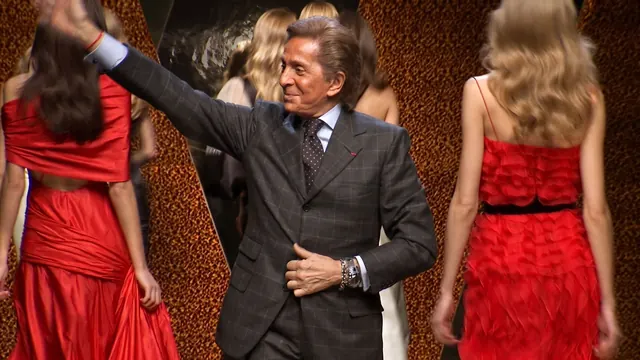
September is turning out to be a very good month for fashion documentaries. First came news that Unzipped, the 1995 Isaac Mizrahi doc, would be returning to theaters. Now comes word that Valentino: The Last Emperor by director Matt Tyrnauer is heading back to streamers. Unzipped depicts Mizrahi’s beginnings; The Last Emperor showcases a designer facing the end of career. Throw in Sofia Coppola’s recent Marc Jacobs doc and you’ve got the full arc.
When Valentino Garavani died in January this year, both the designer’s fans and the merely curious turned to the internet for information about the late designer, and The Last Emperor was unavailable. It was an omission that would not stand.
“After the death of Valentino, and the big shifts in the world of fashion over the last decade, including the passing of the baton from Pierpaolo Piccioli to Alessandro Michele at the house of Valentino—and even a petition to bring the film back on to streaming—it seemed like the perfect time to bring the film back,” Tyrnauer says.
The 2008 movie was a turning point in Tyrnauer’s own life, his first documentary after years spent reporting big stories at Vanity Fair. He’d received the plum assignment to profile Valentino not knowing all that much about the dressmaking business.
“I was not then, and still I’m not a fashion reporter,” he says. “But I always think that’s really better.
Being a fish out of water is a wonderful thing for a journalist generally—and, it turns out, for a filmmaker.”
The designer and his business partner Giancarlo Giammetti provided a top-level crash course. “The immersive experience of doing the Vanity Fair piece knocked me out,” Tyrnauer says.
“I mean, I didn’t realize that there were probably the better part of 100 women right off of the Piazza di Spagna, sewing multi-$100,000 dresses by hand in very cinematic, stark white laboratories, and they became objects of fascination for me, as much as Valentino and his full-color Meissen Swan and boiserie world.”
Before his reporting was done Tyrnauer told Giammetti, “I think this is a movie.” For one thing, over the course of the assignment he had discovered that “Valentino’s press had been a million miles wide and one centimeter deep. I mean,” he says, “there was nothing in all of the almost half century of journalism that talked about the real story, which was the story of the marriage between Valentino and Giammetti.
And the baby was the company.” And for another, “I knew that the movie would be good,” he says. “I didn’t have jaded eyes.
I didn’t go in as someone that had hung around them. I had never been around a couture house.
I’d never spent a lot of time with a European god of fashion. I’d seen every Fellini movie, but to actually see a real-time Fellini movie unfold in front of you, in the world of Valentino—I just ate all that up.”
Tyrnauer set out to make a cinema verité documentary, in the vein of the genre’s masters Albert and David Maysles, Frederick Wiseman, and D.A. Pennebaker.
He kept his day job while shooting, and between seasons, he’d write features for the magazine; then, two weeks before a collection, he’d show up in Rome with cameras in tow. He was with Valentino and Giammetti on-and-off for two years and captured the designer’s 45 anniversary show and retirement.
“Their world—it’s a court, like all the greats of that period, like Yves Saint Laurent and Pierre Bergé, like Lagerfeld. So you become not quite a courtier, because you’re the resident alien.
But in that Italian way, you get swept up in the dramas of all the relationships. I became a kind of willing pawn, well, I think unwitting, but a volunteer pawn in the complex relationship between Valentino and Giammetti, and frequently you see this in the film.”
In one particularly memorable scene, Tyrnauer recalls, “Valentino is literally like hitting the camera lens to push it away. And we become part of the action unfolding; it’s a moment when he’s kind of seeing his life flash before his eyes because he’s going to look at this museum collection of his whole career, and I think it was a mortality thing.
Of course, he lived like many, many, many years after, long into the future.”
Giammetti himself recalls another incident. “Making the film was actually much easier than it might seem, especially when you consider how many different moments of our lives it captures.
Matt had an extraordinary ability to find his way into very private moments without ever making us feel that he was intruding. After a while, you simply forgot that the camera—and the microphone—were there.
I remember once finding myself in the bathroom and suddenly realizing that I was still wearing a live microphone. That probably tells you how completely we had become accustomed to his presence.”
When Tyrnauer presented them with his final cut, Valentino and Giammetti were at first nonplussed. “They didn’t like the film.” Presumably because it showed vulnerability.
“This is why his press was so perfunctory for all those years. They did a brilliant job of inventing real communications in the fashion world,” Tyrnauer says.
Giammetti weighs in: “At the first screening, I hated it. I hated seeing myself so exposed.
For someone like me, who had always been much more comfortable remaining in the background, seeing myself revealed with so little protection was a completely new and rather unsettling sensation. But with time I understood that this was also the strength of what Matt had done.
He had captured something truthful precisely because he had managed to make us forget that we were being observed.”
That first screening at the Venice Film Festival in August 2008 was a big success. So much so that Valentino and Giammetti planned a second premiere at La Fenice, Venice’s opera house; it was the first time the opera house presented a film.
Oprah Winfrey would pluck it up and give it an hour on her show, too. A distribution deal with HBO fell through at the Toronto Film Festival, and as fate would have it, Tyrnauer and co. never landed a buyer and wound up self-distributing the film theatrically, though it later streamed on Netflix.
“In the wake of the Oprah endorsement it took off at the box office,” says Tyrnauer. “My assistant was FedEx’ing film prints around the country; I was approving ad buys in Dallas Morning News.” The documentary broke records for theatrical box office, and had the highest per screen average in the United States for its premiere weekend.
Given the self-distribution success of the first time around, the film’s producers are taking the same approach in the age of streaming, taking it directly to the people on Apple, Amazon, and Fandango starting on September 29.
Giammetti shared his thoughts about its return to the small screen, “For years, I saw it as a document of our work, of a chapter that was closing. Today, it is something much more personal: 96 minutes in which Valentino is there—magnificent, impatient, funny, demanding—exactly as he was. There is great emotion, of course, but also great happiness. The film preserved not only what we did, but who we were.”