
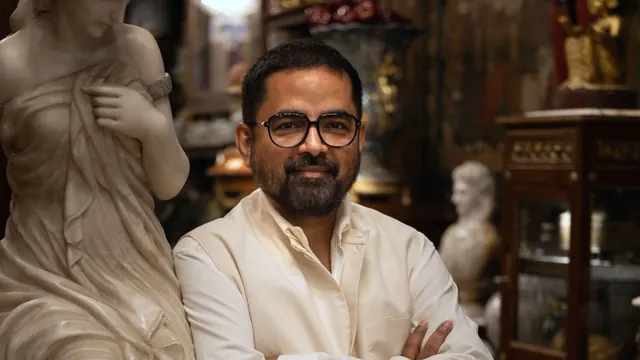
Sabyasachi Mukherjee makes his return to New York Fashion Week on Tuesday, 20 years after his last outing in the city. “Today, I am no longer coming to New York asking what Sabyasachi should become. I am coming to show New York what Sabyasachi has become,” says Mukherjee, founder and creative director. “That makes all the difference.”
The brand made its runway debut at Lakmé Fashion Week in Mumbai in 2002, with a collection called Kashgar Bazaar, focusing on Indian textile traditions in the form of Western shapes and Indian ensembles. It soon made the move into the big leagues, first in Milan and then in New York in 2006, where Mukherjee brought an artisanal collection called Snail, built around the idea of “slow fashion”, to the States.
That first New York outing came with a lesson: a label must be absolute at home before it can be truly international. It’s a high-stakes test for Indian fashion. No Indian designer has yet built a house with the scale, retail footprint, or cultural authority to compete as a genuine global luxury player.
Now, as he gears up to show in Tribeca this week, Mukherjee is betting he can be the first.
From Calcutta to the world
Mukherjee refers to his home city as “Calcutta”, not Kolkata, in interviews, a conscious choice that reflects the house’s codes of celebrating Indian dressing traditions. Calcutta, India’s capital under early British colonial rule, was both a vital hub on trade routes and the country’s artistic and literary capital, home to some of the richest textile traditions. “The point of view remains Calcutta. But the customer can be anywhere,” the designer says.
To help reach this customer, India’s leading retail conglomerate Aditya Birla Fashion and Retail Limited (ABFRL) purchased a 51% stake in the brand in 2021, valuing Sabyasachi at approximately INR 8 billion ($107 million). Of that, roughly INR 750 million ($10 million) was infused into the business to fund its US expansion; the rest went to Mukherjee as an existing shareholder. (ABFRL paid around INR 4 billion, around $54 million, for its stake.)
“When I took on the investment, the decision was fundamentally about continuity,” Mukherjee explains. “I never wanted to build a business that disappeared with its founder.”
A significant part of this legacy-building is bricks-and-mortar expansion. Six flagship stores span Mukherjee’s home city, Mumbai, Bengaluru, Hyderabad, Delhi, and New York.
The Delhi flagship, which covers approximately 2,415 square meters, more than twice that of its predecessor, opened its doors in August and is home to 120 chandeliers and hundreds of artworks. His Mumbai outpost, a 2,000-square-meter space in a heritage building, was ranked among the ‘World’s Most Beautiful Emporiums’ by the Prix Versailles in 2024.
In the two decades since his last New York show, the product offering has also expanded, now spanning high jewelry, handbags and eyewear, with footwear and other categories also in the works, according to Mukherjee. He was one of the first Indian designers to move into high jewelry, launching in 2017 — a shift that other Indian designers, including Abu Jani Sandeep Khosla and Masaba Gupta, have since followed — with the category now accounting for a third of revenues.
Beyond traditional categories, Sabyasachi has a long-running relationship with Asian Paints, India’s leading paint company, which began in 2015 with a collection of luxury wallpapers for its high-end brand Nilaya. Today, Mukherjee has a space at Nilaya Anthology, the company’s 100,000-square-foot design destination in Mumbai, which houses the first gallery of the Sabyasachi Art Foundation; Mukherjee founded the initiative in 2014 to provide employment, mentorship, and commissions to underprivileged fine artists from Bengal.
Sabyasachi posted revenues of INR 6.45 billion ($68.2 million) for fiscal 2026, according to company filings. While this confirms Sabyasachi as India’s largest fashion business by reported revenue, Mukherjee is part of a cohort of Indian designers with the same ambition.
Manish Malhotra made his Paris Couture Week debut this year, runs a flagship store in Dubai, and has expanded into jewelry, beauty and handbags since launching in 2005. Tarun Tahiliani, who’s taken a dominant share of India’s bridal couture market over the last three decades, is about to open his first store outside the country, while scaling his separate ready-to-wear business, OTT.
Then there’s Rahul Mishra, the first Indian designer to partake in Paris Couture Week and who launched his contemporary label, AFEW Rahul Mishra, in 2023.
Mukherjee’s ambition was always to build India’s biggest luxury house — and to do so in his own way. Asked whether he feels he’s achieved that, the designer replies: “No, because my definition of ambition has become much larger. Size is one measurement. What interests me is whether we can build an Indian house with the category breadth, cultural authority, product quality, retail presence, and institutional strength to remain relevant for the next hundred years.”
New York and beyond
The Spring/Summer 2027 collection is called Bengal Byzantine Broadway. “Bengal is the cultural lens, Byzantine provides this extraordinary history of convergence, and Broadway brings the story into the present,” Mukherjee says.
The designer is confident that between his growing retail presence in New York and the foundation he’s built in India, Sabyasachi is ready to return to New York Fashion Week. “New York also has very little patience for insecurity.
You have to arrive knowing who you are.”
The show will help solidify Sabyasachi’s place as India’s biggest fashion export, beyond the store on New York’s Christopher Street, a retail presence at Bergdorf Goodman, Saks Fifth Avenue and Harrods, and collaborations with H&M, Christian Louboutin and Estée Lauder. Its latest announcement, a multi-year collaboration with New York’s Metropolitan Museum of Art, on a high jewelry collection inspired by the museum’s Byzantine archives and priced above $2,000, will debut at Tuesday’s show.
Mukherjee understands that building a global fashion house takes more than sheer scale and solid revenues. “What Europe did extraordinarily well was create systems around its cultural assets.
It turned craftsmanship, provenance, design, and manufacturing into global brand equity. India possesses equally extraordinary cultural capital through thousands of years of knowledge in textiles, jewelry, embroidery, weaving, metalwork and more,” he says.
“The global customer does not need another Indian brand imitating Europe. India has to create a modern luxury language confident enough to participate in the world without surrendering its provenance.”
From his use of craft, embroidery and textiles to his house insignia, the Bengal tiger, the design language is unmistakably Indian. Mukherjee says: “I have no problem learning from the commercial architecture of Western luxury. What I refuse to do is borrow its identity.” This manifests itself in his use of Banarasi and tissue silks, Kantha stitch work, and zari embroidery.
Having watched the business evolve from her London and Mumbai stores, Aashni Shah, founder and creative director of Aashni + Co, a multi-brand retailer known for curating South Asian luxury labels, sees Mukherjee as more deliberate in his strategy than most Indian designers. She points to his ability to anticipate where the market is heading and work toward it ahead of time.
“There is a confidence around buying Indian luxury today that is quite different from 15 years ago,” Shah says. “So I don’t see Sabyasachi’s return to New York simply as another fashion show.
I think it is symbolic of a much bigger shift: Indian fashion no longer needs to arrive at the global table explaining why it belongs there. It already does.”
The show at Spring Studios on Tuesday will mark a crossroads. How the collection is received will, in many ways, determine the next step in Mukherjee’s ambition. “For too long, India was comfortable being the anonymous backend of global luxury,” he says. “We embroidered, wove, cut stones, manufactured and supplied craftsmanship, while somebody else put their name on the finished product and owned the narrative.” For Mukherjee, both his and India’s time is now.