
“The whole image is obviously cool,” says photographer Debora Brune, contemplating the cover of her debut photobook, Uncool. Against a bright orange background, a person looks straight down the lens, their feeding tube emblazoned with the Supreme logo and the book’s title printed above in blocky, sans-serif capitals.
“A medical object that might normally make people uncomfortable suddenly enters a completely different visual language, one associated with fashion, status and being ‘cool’,” Brune tells Dazed. “It’s not about disguising something medical or difficult, but about changing the context around it.
Sometimes a very small visual shift is enough to make you question why one thing felt undesirable or uncomfortable to look at in the first place.”
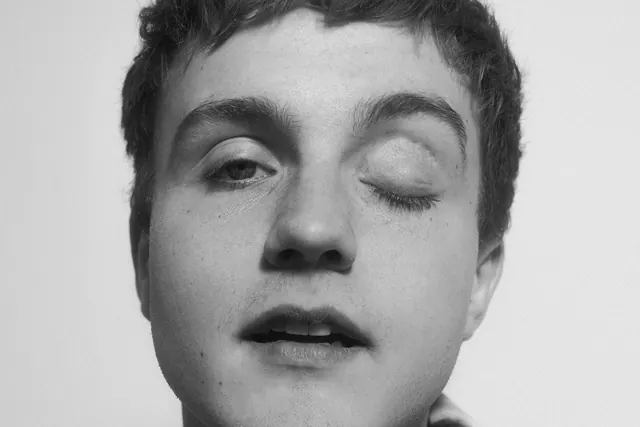
That idea runs through the book’s 80 portraits, made over four years and featuring 27 people, including Brune herself. Wheelchair users, amputees, cancer survivors and people with Down’s syndrome, hearing loss and vision impairment appear in portraits that draw on the language of fashion without asking their subjects to fit its conventional ideals.
The book follows Brune’s 2026 shortlisting for the C/O Berlin Talent Award and selection as a finalist for the Dior Photography and Visual Arts Award at Rencontres d’Arles, and also includes an essay by Alexandra Bondi de Antoni.
Brune began working professionally in fashion and portrait photography in 2021, quickly learning about casting, style, lighting and the decisions that determine who appears in an image and how. As conversations around diversity gathered pace in the fashion industry, Brune noticed that disability was still largely missing from the picture. “And when it was included, it very often became the entire subject of the photograph, or sometimes felt a little forced,” she explains.
Brune, who uses a wheelchair, started Uncool in 2022 to challenge that distinction. “I never wanted to make a project that was simply ‘about disability’ or about explaining it,” she says.
“I was much more interested in what happens when people with visible physical differences are given the same visual freedom and ambition as anyone else I would want to photograph.” The question, for her, was who gets to be seen, in which spaces and under what conditions. “It was never really about trying to prove that ‘every body is beautiful’,” she says.
“I think beauty is a much more complicated conversation than that.”
With artfully zoomed crops and polished studio shoots, the first section of the book could be lifted from any fashion magazine. Helene, for example, is photographed in monochrome, with long chain earrings hanging against a shaved head and a scar running down the nape of their neck.
Natalie-Amber’s torso is framed around a scar and pink, wispy lace; and Hannah is shot wearing sheathing pastel tights, with a prosthetic arm resting at their side. “I wanted to treat physical difference as something that can be completely visible, and can even be the starting point of an image, without reducing the person to it,” Brune says.
“My approach was actually quite blunt in that sense: just taking things as they are rather than tiptoeing around them.”
The portraits are close and uncompromising, lit to make the subjects visible without dramatising their differences. Brune often photographs at her own eye level, “looking at the person as directly as possible, without making the difference feel tragic or overly significant”.
She also seeks connections between things that haven’t traditionally been placed together – like Sophie’s clear moulded hearing aid and a sparkling Vivienne Westwood orb earring, or Catrin’s grid-like burn scars and a Burberry-checked bikini. “Suddenly you have these two kinds of patterns next to each other, one coming from something incredibly traumatic and physical, and the other from this very recognisable, desirable fashion object,” she says.
“I liked that collision a lot because it changes how you look at both of them.”
Brune’s subjects came through ZBD Talent in London, the caster Hien Le, Instagram, open calls and mutual friends, and she never set out to cover a checklist of conditions. “The person had to interest me first,” she says.
The encounters could be intimate, with conversations often moving from small talk to something more personal. For instance, Gui spoke to Brune about how other people’s reactions to his albinism could be as “limiting as the disability itself”.
Kjell, an actor, also shared a line that stayed with her: “I no longer want to explain myself as a body.” In the book, Kjell writes about being told by directors, agents and teachers that their eyelid would prevent them becoming an actor, saying: “Deep down I knew it was bullshit and, with the help of my family, my friends and the right people in the industry, I learned to give no fucks.”
The book’s second section is influenced by Juergen Teller ’s Go-Sees, known for its raw, deadpan aesthetic, uniform framing and street pavement setting. Brune photographs her subjects outdoors, in their everyday clothes and under similar conditions.
“That contrast became really important to the book,” she says. “In the first part I often go very close and make the physical difference very visible, while in the other, everyone simply becomes one person among all the others, so in many of those photographs you can’t even tell whether someone has a disability at all.”
Brune appears among the sitters, too, though she didn’t want her own disability to become the explanation for the project. “It made me realise that I’m obviously not completely outside of the visual standards I’m questioning in the book,” she explains. “I grew up with the same images and ideas of what is considered desirable as everyone else, and I could feel some of those learned reactions when I turned the camera onto myself.”
For Brune, representation works best when it isn’t added as an afterthought. “Not because someone thinks, ‘we need to include this’, but because you look at a person and think they are interesting, they bring something to the image, they fit the concept,” she says.
“I would love for casting to open up more in that direction, where physical difference can simply be another visual quality you respond to rather than a separate category that needs its own justification.”
Get must-see stories direct to your inbox every weekday.
Debora Brune’s debut photo book brings disibilty into the fashion frame, exploring what happens ‘when people with visible physical differences are given the same visual freedom and ambition as anyone else’