
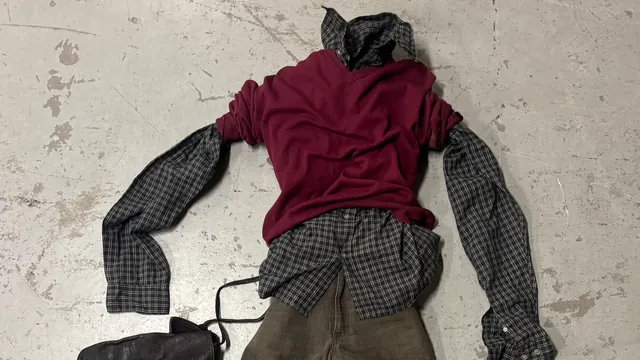
Do clothes make the man? Portrait of the Absent, a new book of flat-lay photographs by Jack Jildevik might have you considering that idea. Over the course of a year the Swedish artist crafted bodiless self-portraits by documenting ensembles he arranged on the floor of a storage facility. “I think it’s fascinating how much of someone’s identity can exist in the things they leave behind,” Jildevik said.
It might be a coincidence, but the flat-lay aesthetic is creeping into (fashion) photography at the same time that Ozempic is shrinking bodies. Not that the trend had anything to do with Jildevik adopting the format for this achingly personal project.
“I find flat-lay fascinating because it can expose the essence of an object while simultaneously distorting its shape. It reveals and conceals at the same time, making something ordinary feel strangely mysterious,” observed Berlin-based graphic designer Elsa Mueller, Jildevik’s collaborator on the book and its publisher (via her new publishing house Prince).
“I find flat-lay fascinating because it can expose the essence of an object while simultaneously distorting its shape,” she continued. “It reveals and conceals at the same time, making something ordinary feel strangely mysterious.”
Born in Stockholm, Jildevik earned a law degree there before moving to Paris to study fashion business and communication at ESMOD after which he worked with CMMN SWDN and Hodakova. An accident broke the linearity of his career and reoriented it towards art.
“I’ve been creating since I was a kid, always exploring, collecting and making things. I was an overly nostalgic child, always drawn to, almost obsessed with, old objects, materials, and the lives they carry.
I think that fascination has followed me through everything I’ve done.”
The artist himself is a ghost-like constant in the book which derives some of its power from the way it resists the centrality of the body and the narcissism that defines culture today. Jildevik’s pictures are as much portraits of garments as of himself.
This idea of a piece of clothing having status as a stand-alone object runs counter to the received wisdom that the body completes a garment. “Removing the body altogether and letting the things that would normally surround or cover it take its place is something that really interests me,” Jildevik said.
“I’ve spent over 15 years collecting clothes and objects, and they’ve all become part of my life in different ways. They carry memories, different periods of my life, and sometimes versions of myself that no longer exist.
With Portrait of the Absent, I started taking these things out of their original context, rearranging them into new compositions and photographing them as self-portraits. … The person is absent, but in a way everything that makes the portrait personal is still there.”
Almost everything—the face is usually the focal point of a portrait. This book forces us to consider how clothing can communicate identity without the body, or gestures, or the visage, but rather through arrangement and spatial orientation.
This interview has been edited and condensed for clarity.
What’s your relationship with objects?
I’ve always been obsessed with collecting. Ever since I was a kid, I’ve always cherished my things a lot—not expensive things, but finding things that only I have.
My parents have always been flea market and secondhand geeks, that’s all that they’re doing, and I guess that I got hooked at a very early age. I started collecting small action figures and porcelain. [Now] I’m working on some art pieces where I build stuff from what I’ve been collecting.
For me, it’s so much about the stories that these things carry. I can’t throw anything away because everything means so much to me.
And what’s your relationship with fashion?
I’m a nerd; I’ve been collecting clothes since I was 15. [My collection ] is a lot of vintage, just flea market finds. All of the designer pieces are bought from mostly old men in Italy and also flea markets in Paris.
I’ve never had a big budget, but I’ve always seen it as an investment because I’m so passionate about it. I’ve never really been interested in the big designer fashion houses.
Martin Margiela was my first love in fashion—my first designer love. I’m not alone in that love….
Before that it was just clothes.
How did you come upon the concept for Portrait of the Absent?
I used to do all of these outfits of characters when I grew up. When I was going out, [I would do] three different characters on the floor.
And then one day I just took a picture of it and then I thought this is kind of... It looked cool.
Eventually I thought that I would make this something bigger. So I decided maybe I should do a month of this.
And then after a month, I just felt like it would be so cool to just do a full year and to challenge myself.
I’ve always also been obsessed with clothes and the story behind them, finding old pieces and fixing them and redoing them. A lot of the time I wouldn’t dare to wear them, but I felt like I could become a character with what I was wearing.
I felt that I was one person, but sometimes you want to be a totally different person. The older I’ve become, the more brave, and I dare to put on all this stuff and be whoever I want to be.
Doing this project that I’ve been working on for the last year with 365 self portraits, [I am asking the question,] ‘Who do I want to be today?’
Are there any repeats?
Some of the pieces are the same, but there are no repeat outfits.
So this person that you want to become, is that a character?
I think it’s more of a character. Especially when you’re feeling blue or down or something has affected you.
I’ve always been an anxious person, someone who overthinks almost everything. Getting dressed has often been a way of escaping those feelings.
Putting on my armor for the day, becoming whoever I wanted to be in that moment. But since I dared to pursue my art, something started to change.
I found a freedom in creating that I hadn’t really felt before. The doubts are still there, but I no longer feel the same need to hide behind that armor.
In a way, I’ve become one with it.
What do you think the book says about you?
I think you can see some kind of obsession and appreciation of the object. [I think you] see clothes in a different, new kind of way. When you remove the body, it’s just clothes.
But I think just clothes can be so much more than just clothes. I want to be able to see me; even if the 365 outfits are so different, you can still see that it’s me, even if I’m not there.
And I think that’s what I find interesting about it as well. I really want to show appreciation of the garments and that I’m obsessed with them.
Having completed the book do you have a new obsession?
I have a lot of obsessions, but I have a lot of new ideas, also how to work with this [idea] and also to do portraits of other people in the same kind of way.
Do you think fashion is art?
Even though Martin Margiela said that fashion is not art, I think about what he was doing, and I consider that art because it’s the craftsmanship and the design and the creation and the process. For me, it’s art.
But if I would get the question and have to say yes or no, I would say no, but it’s a no with a lot of buts and ifs. I don’t think fashion is art per se, but I think fashion can be art.
And I think fashion is such a big word where it includes so much.
It’s a recurring theme that people aspire to creativity through a childlike mindset. What’s your take on that?
I think childhood is, for me, a place where everything was possible. I think maybe I am escaping through creativity.
If I go back to my childhood, I can be free and I can do whatever, and it doesn’t matter. I don’t have to be right, I don’t have to be good, it can just be.
It’s so much easier to just create as your inner child. And then after you can look at it with your adult eyes.
I guess fashion is part of the adult world as we start making assumptions based on garments.
I think clothing can sometimes be so limiting also for a lot of people. You just want to belong...
I can see that in young kids, especially in the schools where everybody has the exact same jeans and hoodie. Maybe it’s always been like that, but with society being the way it is, people just need somewhere to belong to because we don’t really have religion in Sweden.
We are kind of lonely people, or we are reserved at least. And I think just by these signals that we are all wearing the same thing, we are a group or we belong to each other.
And of course it’s the same thing in the offices where everybody looks kind of the same.
How have you observed fashion changing?
All these big groups have changed the fashion industry. And I think also the art world has become something that it’s not supposed to be. A painting for a billion dollars doesn’t make sense. It’s supposed to be cherished and shared.
I’ve always felt that art can show someone’s identity in its rawest form. Reading a book, a poem, seeing a painting or a sculpture, or even hearing the intro of a song.
Nothing makes me feel closer to another person than experiencing something they’ve created that I really connect with. Sometimes I almost feel like I’m becoming one with them, like I’m being invited into their inner world and getting to share that space for a moment.
And I think showing someone something you’ve created yourself can be one of the most exposing things you can do. You’re letting someone into a part of yourself that you might not even know how to express in words.