
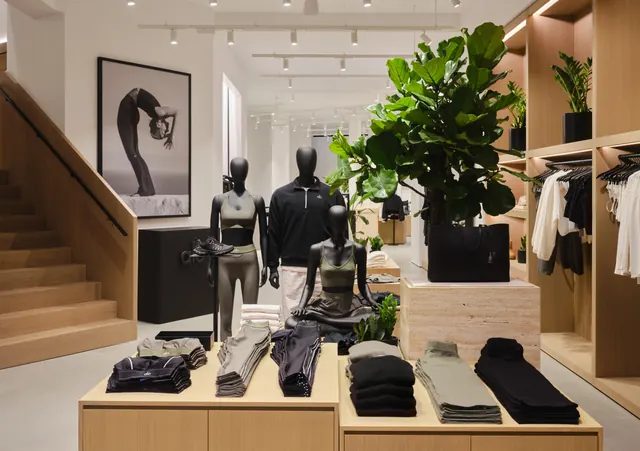
Berlin could use a little yoga, or so ALO thinks. The California-born activewear brand has officially arrived in Germany, opening its first flagship on Münzstraße in Berlin-Mitte with a guest list featuring DJ and producer Peggy Gou , model Toni Garrn , creator Jacob Rott and other familiar faces from the city’s fashion scene.
Spanning 6,000 square feet, the new ALO Sanctuary brings the brand’s studio-to-street wardrobe to the German capital, with womenswear, menswear, footwear, accessories and its increasingly recognisable bag collection. The store is designed around ALO’s wider approach to movement and mindfulness, giving Berlin a new destination for everything from Pilates-ready sets to off-duty dressing.
“Germany is an important market for ALO, and we are excited to begin our journey here in Berlin,” says Benedetta Petruzzo , ALO’s International CEO. “The city’s creative energy offers a distinct setting for our California-rooted approach to premium apparel and wellness. We are entering with a long-term mindset, and this first Sanctuary gives us an opportunity to deepen our relationship with the local community and become part of their everyday lives.”
As expected, the opening festivities had more on the agenda than browsing the rails. Guests could explore tarot readings, reiki, ear-seeding and acroyoga, while neo-soul sounds from ‘A Song for You Berlin’ set the mood. The celebrations also included an intimate dinner at STOKE, around a botanical installation by Berlin-based artist Lilo Klinkenberg .
The opening is part of a broader programme of community events running throughout October, spanning yoga, pilates, cycling, running, breathwork and meditation. With its first German ‘Sanctuary’ now open, ALO is bringing a slice of California to Berlin.
photography. courtesy of ALO words. Gennaro Costanzo
Jumeirah Marsa Al Arab, 1206, Tara Emad at the Terrace garden.
At 1206 , even a langoustine has a journey to complete. Its tail reaches the plate, its shells become bisque, its offcuts find a second life in the drinks programme, and the remaining elements return to the soil of the terrace herb garden. This zero-waste approach to cooking sets the tone for Jumeirah Marsa Al Arab ’s newest restaurant, opening on 30 October and completing the resort’s culinary collection.
Named after a once-hidden room on the property’s fourth floor, 1206 pairs ingredient-led cooking with uninterrupted views stretching from Jumeirah Burj Al Arab to Burj Khalifa. International design studio AvroKO has shaped the interiors around warm, earthy tones inspired by Levantine coastal architecture. Carved marble, handcrafted finishes and custom cabinetry sit alongside garden-integrated joinery and herbal displays, creating a natural connection between the dining room, kitchen and terrace.
Jumeirah Marsa Al Arab, 1206, Dining Area.
Jumeirah Marsa Al Arab, 1206, Pan seared Scallops and Chef Stephanie Haywood.
Jumeirah Marsa Al Arab, 1206, dry aged beef fat crumpet, tartare, horseradish and Grilled Langoustine.
The menu takes British culinary traditions as its foundation, drawing on French, Mediterranean and Scandinavian influences while keeping seasonality, provenance and responsible sourcing at the forefront. Leading the kitchen is Head Chef Stephanie Haywood , whose career spans Michelin-starred restaurants across the UK, Scandinavia and the GCC.
Raised in the countryside of Sussex, Haywood developed an early appreciation for the relationship between the land and the table — a philosophy now reflected in her approach to fermentation, foraging, butchery and open-fire cooking.
Guests get a first look at the menu, which includes an indulgent dry-aged beef fat crumpet topped with tartare, horseradish and caviar; fried chicken wings stuffed with lobster and a house-made 1206 fermented hot sauce. The seafood courses show off similar precision with a grilled langoustine paired with fermented honey, local grains and an aromatic bisque, alongside pan-seared scallops swimming in a smoked chicken butter sauce with grilled apple.
Vegetables receive as much attention as protein, featuring grilled aubergines served with a spiced cashew nut sauce and hazelnut dukkah. Meanwhile, bones and offcuts are turned into broths, stocks and sauces, making the most of the ingredients that enter the kitchen.
Jumeirah Marsa Al Arab, 1206, Grilled Aubergine and Turbot.
Jumeirah Marsa Al Arab, 1206, Fried Chicken wings stuffed with Lobster.
Jumeirah Marsa Al Arab, 1206, Chef Stephanie Haywood.
The terrace herb garden extends this philosophy beyond the plate, supplying fresh greens, herbs and botanicals for both the menu and botanical-led cocktails. The wine list follows a similar approach, with small producers and grower Champagnes taking precedence, alongside an emphasis on sustainable, low-intervention winemaking.
1206 opens on 30 October at Jumeirah Marsa Al Arab. The restaurant will welcome guests from Tuesday to Saturday, 6pm–11pm. Reservations and further information are available here .
photography. courtesy of 1206 for Jumeirah Marsa Al Arab words. Gennaro Costanzo
A landscape does not need a ghost to feel haunted. Sometimes, a mountain, a cave or a stretch of still water is enough to set the imagination working, and it is this uneasy space between what we see and what we believe might be there that Japanese photographer and visual artist Yuji Watanabe explores in ‘Yōkai and Landscapes’, his first solo exhibition in the United States, now on view at Picto New York in Brooklyn.
Curated by Charli Sas, the exhibition brings Watanabe’s ‘Yōkai’ series into conversation with new photographs of Japan’s natural landscapes, pairing supernatural figures with almost-surreal mountains, colourful forests, waterfalls and caves. These landscapes are rendered in such way, feeling like burnt memories of a past life.
The title refers to yōkai, a broad category of beings in Japanese folklore that encompasses spirits, monsters, shape-shifters and objects transformed by supernatural forces. Their stories have long offered ways to make sense of the strange and inexplicable, and Watanabe brings these figures into the present through photographs that feel suspended between theatrical invention and the physical world.
The artist first presented his ‘Yōkai’ series at Tokyo’s 229GALLERY in 2024. Photographed on large-format Polaroids, the images give these folkloric beings a bodily presence, drawing on the visual language of traditional Japanese culture while allowing the uncanny to emerge through contemporary photography.
The new landscapes shift the focus towards the places associated with such stories, photographed on ONE INSTANT peel-apart film and arranged in the manner of an ‘emaki’, a Japanese illustrated handscroll. Read in sequence, the photographs unfold like a narrative, with the figures appearing alongside locations that might otherwise seem entirely ordinary.
Based between Paris and Tokyo, Watanabe has built a career photographing fashion, celebrities and artists for international publications, while developing personal work that experiments with analogue processes and imagined worlds. Editorial projects including ‘Second Skin’ and ‘My Grace’ explore the human form through expressive styling and carefully constructed scenes, similar to his interest in transformation that comes with this latest exhibition.
A soundscape by Pinkcourtesyphone, the project of sound artist and composer Richard Chartier , extends that uncertainty beyond the photographs, giving the exhibition an auditory dimension. With ‘Yōkai and Landscapes’, Watanabe invites visitors to consider how folklore continues to shape our perception of place, and how even an apparent empty landscape can carry traces of stories that refuse to disappear.
Yuji Watanabe, ‘Yōkai and Landscapes’ at Picto New York.
‘Yōkai and Landscapes’ is on view at Picto New York until 15 December. The gallery is open Monday to Friday, 10am–6pm, with weekend visits by appointment. Discover more here .
photography. courtesy of Yuji Watanabe words. Gennaro Costanzo
The hardest part of a gym session might be leaving before you have made it to the sauna. Soho House Berlin seems to understand the appeal, having refreshed its Soho Health Club with a new line-up of training equipment, reformer Pilates, recovery facilities and a juice bar that gives you somewhere to contemplate your life choices after leg day.
For context, Soho House Berlin opened in 2010 in a Grade II-listed former Bauhaus building in Mitte, with 1970s-inspired interiors, a rooftop pool, Cowshed spa, hammam and Cecconi’s restaurant among its established features.
The gym floor has been upgraded with Technogym cardio and strength machines, while a BLK BOX rig and turf area cater to functional training and hybrid workouts. Concept2 endurance equipment adds another option for those who prefer their workouts measured in metres and minutes, while six reformer beds introduce a dedicated pilates offering.
Two class studios round out the facilities, giving members room to switch between strength work, conditioning and mobility without having to squeeze everything into one corner.
Soho House Health Club Berlin, Reformer pilates.
The class schedule is equally varied, including just about everything you can imagine. ATHX sessions, developed in collaboration with Adidas, sit alongside HIIT, calisthenics and Reformer Pilates, with Barre Sculpt, yoga and other hybrid classes also on the programme.
Members looking for a more individual approach can book private pilates, personal training or small-group coaching. One studio comes with views of the Berliner Fernsehturm, the famous television tower, so there is at least something interesting to look at between sets.
After the workout, a dedicated recovery area offers room to stretch, mobilise and catch your breath, while the shared sauna, steam room and traditional hammam give members several ways to wind down. The idea is to treat recovery as part of the routine, instead of the thing you promise yourself you will do once the soreness has already arrived.
At reception, a tile-clad juice bar serves Soho Health Club smoothies designed for different stages of a workout, from pre-training energy to post-session recovery. There is also a retail corner stocked with Cowshed products and wellness names including Adidas, Ancient + Brave and SkinCeuticals, alongside supplements and other fitness essentials.
The refreshed Health Club adds another reason to spend a little longer at the House, whether the plan is an early session before work or Pilates followed by an unapologetically leisurely afternoon.
The gym is open exclusively to Soho House members, from 6am to 9pm on weekdays and 8am to 8pm at weekends. Find out more here .
photography. courtesy of Soho House Berlin words. Gennaro Costanzo