
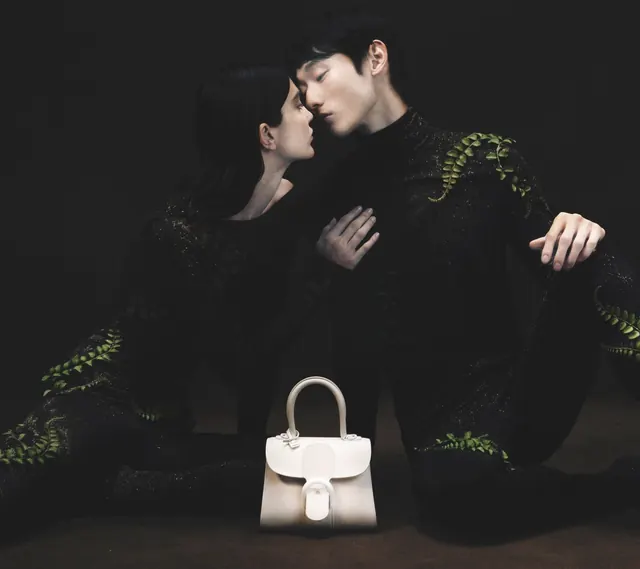
Delvaux has found a way to make flowers last beyond their vase life: for Autumn/Winter 2026 , the Belgian leather house grows them directly from its handbags. Photographed by Lennert Madou , the new campaign unfolds in a romantic, surreal landscape where blossoms emerge from leather, appear across faces and scatter through the scenery beneath skies coloured by the shifting tones of a Belgian autumn.
The end result is a visually-charged celebration of the Maison’s craftsmanship, with botanical fantasy meeting the architectural discipline of its celebrated leatherwork.
Two floral expressions shape the collection — Wild Bloom and Botanica. The first takes a sculptural approach, with tulips, bell flowers and leaves rising from the bags in layered calfskin. Leather marquetry, sheathing, thermoformed structures, laser cutting and hand stitching give each botanical form its own volume, extending petals and stems beyond the contours of the bag.
Botanica, by contrast, draws flowers closer to the surface, combining inlaid and applied leather for an effect reminiscent of pressed blooms. On selected designs, stems, leaves and petals travel across the bag in continuous compositions, turning its construction into part of the artwork. Both lines draw on Belgium’s artistic heritage, from the intricate flower paintings of 17th-century Flanders to the organic curves of Brussels Art Nouveau.
Behind the floral flourishes sits a more technical achievement: ‘Arsenal’ leather, Delvaux’s signature interlocking construction. Developed over more than two years, the material begins with a full hide cut into double-D elements.
Each piece is then individually edge-painted before artisans link them together by hand, one by one, creating a supple structure reminiscent of chain mail. Its geometric pattern takes inspiration from the brickwork of L’Arsenal, the Maison’s Brussels headquarters, translating an architectural detail into an entirely new leather surface.
The technique finds expression across three of the Maison’s emblematic silhouettes: Le Brillant, Le Tempête and Le Pin, each becoming a canvas for a different interpretation of leather. With Wild Bloom’s dimensional petals and Botanica’s graphic botanical motifs, Delvaux brings its Haute Maroquinerie into bloom, showing how the possibilities of a familiar material can keep unfolding.
photography. courtesy of Lennert Madou for Delvaux words. Gennaro Costanzo
Dev Hynes by Zhenya and Tanya Posternak for UGG.
Loungewear has never had the strongest reputation for being flattering or stylish — that was until Jonathan Anderson decided to dip his toes into this other venue too. For his first collaboration between JW Anderson and UGG , the designer turns two of the Californian label’s best-known silhouettes into loafer-inspired hybrids, with musician and producer Dev Hynes , a.k.a.
Blood Orange, bringing them into the everyday through a series of domestic scenes photographed by Zhenya and Tanya Posternak .
The premise is easy enough: take the comfort of an UGG and give it the proportions and detailing of a penny loafer. The Classic Boot and Tasman are reimagined as the UGG JW Anderson Loafer Boot and UGG JW Anderson Loafer, with rounded toes and box-stitching adding a new outline to their recognisable shapes.
Signature UGG materials and cushioning remain, keeping the styles firmly in the realm of footwear meant to be worn, while Anderson’s design details shift them towards something a little less expected.
“I wanted to see how that language could translate into UGG,” Anderson explains, describing the thinking behind the project. “UGG boots are instantly recognisable, and I was interested in seeing something so familiar through the lens of JW ANDERSON. For me, collaboration is about experimentation, bringing two distinct points of view together and seeing where that leads.”
Anderson has selected three colourways for the unisex release: Chestnut, Khaki and Orange, the latter bringing a brighter turn to UGG’s familiar palette.
The campaign follows Hynes around the home as he gets dressed, moves between rooms, sits, stands, leaves and returns, turning the small routines of daily life into the setting for a footwear collaboration. Styled by Anderson himself, the looks place the shoes somewhere between lounging and dressing up, exploring the space between something you reach for instinctively and something that changes the feel of an outfit.
The UGG x JW Anderson collection launches on 15 October online and in selected boutiques. Discover more here .
photography. courtesy of Zhenya Posternak and Tanya Posternak for UGG words. Gennaro Costanzo
Conor Cunningham and Ed Gumuchian for Moose Knuckles.
Even when the weather forecast promises sunshine, city life has a habit of delivering sleet on the way to lunch and freezing wind on the walk home. Moose Knuckles is dressing for that particular uncertainty with ‘City Tundra’, its Autumn/Winter 2026 collection , which imagines the modern city as a wilderness of shifting temperatures, concrete canyons and unpredictable conditions — basically London on a good day.
For the Canadian outerwear label, preparing for winter means thinking beyond the cliché heavyweight puffer, with adaptable layers and new fabric treatments joining its established cold-weather staples.
“This season is about people who don’t wait for perfect conditions because they don’t need to,” says Ludovico Bruno , Global Creative Director. “AW26 celebrates those who trust their instincts, embrace individuality and leave their mark wherever they go.”
The collection’s defining innovation is Iceberg Quilt, a new outerwear construction inspired by the formations of glaciers, featuring sculptural quilting that gives the down-filled pieces a pronounced three-dimensional surface, while lightweight insulation keeps the volume from becoming cumbersome. The Iceberg Quilt Down Puffer is among the season’s standout designs, bringing a more architectural look to a familiar winter essential.
Elsewhere, the Original 3Q 2.0 Down Jacket revisits one of the brand’s established styles, while the Gilded Long Down Parka offers a longer silhouette for colder days. The Banff Down Bomber and Aurora Down Trucker bring shorter proportions into the mix.
Layering is another key part of the collection, with lightweight outerwear designed to accommodate the increasingly erratic transitions between indoor and outdoor temperatures. The expanded womenswear offering also introduces more refined silhouettes, premium materials and considered finishing details, while new technical developments focus on warmth, comfort and freedom of movement.
The clothes arrive alongside a global campaign featuring five figures from music, sport and creative culture: British skateboarder, artist and model Blondey McCoy ; Olympic fencer Miles Chamley-Watson ; UK rapper AntsLive ; experimental pop musician Isabella Lovestory ; and New York skateboarder and creative Melissa Ramirez . Shot by photographers Conor Cunningham and Ed Gumuchian , the imagery places the cast in a landscape where snow, wind and heat become part of the urban environment.
Founded in Montréal in 2009, Moose Knuckles continues to expand its signature Bunny, Freehang, Puffers, The Originals and Gold Series families with fresh textures, prints and graphic details inspired by the intersection of nature and the built environment.
The Autumn/Winter 2026 collection is now available globally, with seasonal releases continuing through autumn. Find out more here .
photography. courtesy of Conor Cunningham and Ed Gumuchian for Moose Knuckles words. Gennaro Costanzo
There’s a long-standing assumption that upcycled industrial materials are destined to remain stuck in a world of utilitarian design, making it a challenge to bring sustainability into the more elevated end of the fashion market. FREITAG , however, is rethinking that equation with ‘ REFERENCE ’, a new generation of bags that brings its longstanding approach to discarded materials into a more refined aesthetic, without erasing the stories that make each piece unique.
Founded in Zurich in 1993, FREITAG built its identity around an unlikely accessory material: used truck tarpaulins. Brothers Daniel and Markus Freitag, searching for a durable, water-resistant bag suited to their cycling commutes, found inspiration in the heavy goods vehicles passing through the industrial neighbourhood around Hardbrücke. Their first creation, the F13 TOP CAT messenger bag, was made in their shared apartment using retired tarpaulins, discarded bicycle inner tubes and car seat belts.
That history remains visible across the streets of Zurich. The brothers’ original neighbourhood has since become home to the brand’s striking flagship tower, constructed from 19 recycled shipping containers beside Hardbrücke station in 2006.
The company later moved its headquarters and production facilities to Nœrd, an industrial complex in Zurich-Oerlikon, where the transformation of truck tarpaulins continues. From the streets that inspired the first bag to a container-built retail landmark and a working factory, FREITAG has made its surroundings an integral part of its identity.
Now, more than three decades after its beginnings, the brand is revisiting a chapter of its own. First introduced in 2009 and discontinued in 2019, ‘REFERENCE’ returns with four new updated designs.
Product designer Anne Bachmann, a 16-year veteran at the brand, led the new generation, developing a collection that places greater emphasis on form, finishing and versatility. “Used tarpaulins have no reason to hide their stories.
Each one of them has a raw elegance of its own. And ‘REFERENCE’ puts that firmly at the centre,” she explains.
For Bachmann, the design process involved looking both outside and inside FREITAG’s own world. Working through initial sketches and research graphs, she found an important visual reference in an editorial featuring Sandra Hüller, whose rawness helped shape the aesthetic direction of the new line.
Other inspiration came directly from the factory floor, where an industrial metal adjustment hook used on heavy-duty shelving caught her attention. Reimagined as a custom magnetic clasp with punched FREITAG branding, the component became the defining hardware detail across REFERENCE, carrying a piece of the brand’s industrial surroundings into its most refined collection to date.
The collection’s pre-launch celebration took place at the Nœrd factory, where guests were guided through the production process by contemporary dancers. As washing machines rumbled and tarpaulins moved from one stage of preparation to the next, performers transformed the practical business of making a bag into a live exploration of movement.
Curated in collaboration with House of Intuition, with scenography by Marie Matusz , the evening featured a performance by Anna Chiedza Spörri and The Collective , alongside music, food and further artistic interventions. Thomas Wakeford, Creative Director, and Peter Hollenstein described the thinking behind the campaign as an attempt to “channel this feeling of movement through contemporary dance.”
The four bags each take a different approach to everyday use. R201 ELLY is a compact crossbody designed for essentials, with a magnetic closure, adjustable strap and enough room for a small umbrella or 500 ml bottle. R202 BATES is the more capacious day-to-night option, with a zipped main compartment, adjustable magnetic closure and space for a 13-inch laptop. Its wide shoulder strap can be supplemented with a detachable crossbody strap.
For those who prefer to carry considerably more, R203 MAZIE is an oversized tote whose fold-in sides change its shape and volume, accompanied by a detachable pouch for smaller belongings. R204 NAN , meanwhile, is a more compact baguette silhouette, with a zipped compartment, external slip pocket and straps that can be carried over the shoulder, over the elbow or in the hand.
Across the collection, trapezoid shapes, carefully placed seams and a magnetic clasp inspired by an industrial shelving adjustment hook establish a shared visual language. The hardware bears punched FREITAG branding, while the bags’ restrained colours — white, silver, red and blue, alongside a limited black edition — allow the individual markings of the tarpaulins to remain visible.
Each piece is unique, its scratches, creases and faded lines recording a journey that began long before it reached its new owner.
The attention to longevity extends to the repair kit supplied with every bag. Made from the same tarpaulin as its accompanying design, the detachable pouch contains a piece of lining and the original sewing thread, giving owners materials that can be used to repair the bag years later. Once those contents are removed, the pouch remains useful for storing cards, keys and other small items.
The production model has evolved, too. The new bags are manufactured with European partners, including in Portugal and Bulgaria, while selected custom-made accessories continue to be produced in Switzerland.
At the Nœrd factory, FREITAG processes used tarpaulins, prepares them for production and reuses water wherever possible; its rainwater collection system feeds a substantial tank — stored in a secret under-passage — that supports factory operations. The scale of the work is considerable: in 2025, the company processed more than 326,000 square metres of used truck tarpaulins.
For CEO Janine Bühler, the collection makes a larger argument about consumption. “REFERENCE is attitude in the shape of a bag. The act of choosing one of these unique pieces is a statement in itself: it stands for resource-conscious material choices, for timeless elegance, and for rejecting the throwaway culture,” she says. “The forward-thinking design, meticulous finishing, and repairability enable a long, intensive bag life – fully in line with the circular economy.”
Additional designs and seasonal colours are planned for Spring and Autumn 2027. For FREITAG, REFERENCE represents an evolution in appearance, but not in principle: a bag can be refined without losing its past, and materials that have already served one purpose can find another life without pretending they are something else.
Discover the ‘REFERENCE’ collection, now available here .
photography. courtesy of Timothy Schaumburg for FREITAG words. Gennaro Costanzo