
For years, people have been referring to their Margiela tabi flats and boots as “hooves” – their signature split resembling the feet of a cow or a deer. The ever-popular shoe seems to have permanently captured our imagination.
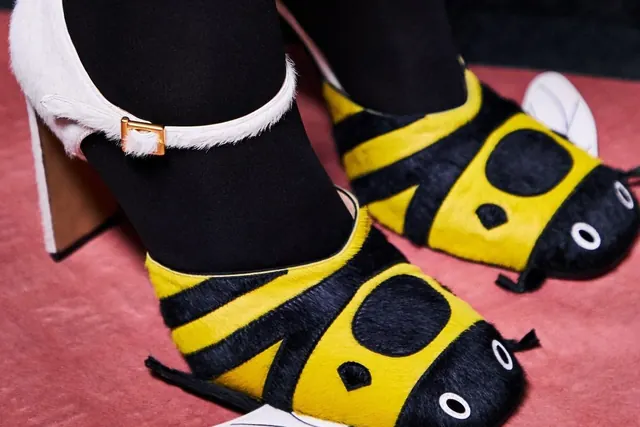
And judging by this past fashion week season, we’re in the market for more animal-related footwear moments. There were Thom Browne’s butterfly and bee platform pumps, Sandy Liang’s bunny wedge heels and Chanel’s mixed animal-print shoes.
Before that, there were Schiaparelli’s FW26 cat-head kitten heels . Of course, designers and artists have always looked to the animal world for inspiration, but the accidental Animorphs –inspired moment we’re in now seems to be reaching a tipping point.
Why do we want our feet to look like creatures right now?
Before Liang’s bunny shoes hopped down the runway, there were the Marc Jacobs mouse flats, first introduced in 2002. Across vintage resale platforms, these are also currently experiencing a revival.
But, according to Elizabeth Semmelhack, director and senior curator of the Bata Shoe Museum, this trend goes far further back than studded silk-nose ballet flats. “ While the current trend feels very contemporary, it actually belongs to a much longer history of designers exploiting the sculptural and decorative potential of shoes,” she says.
“Depictions of flora and fauna have decorated footwear for centuries, and Western shoemakers have long played with the shape of footwear.”
In the 1920s, for example, the heel became the focus, and there have been multiple surges of “strange” footwear trends ever since. In the 1980s, Tokio Kumagai made shoes decorated with cat faces, and in the early 2000s, Andrea Pfister created footwear with heels sculpted to look like fruits and vegetables.
This has, of course, evolved into today’s “freaky shoe” love affair. From dad sneakers to tabis to Vibram five-finger shoes , there’s a new “weird” shoe trend every year.
In large part, 2026’s most viral shoe moments have been barefoot – just think of Margaret Qualley wearing Chanel’s barefoot heel-cap shoes to the premiere of The Dog Stars in August.
If the five-finger and barely-there trends that have dominated the last couple of years in the freaky shoe world are all about showcasing our toes – and, in turn, embracing our raw humanness – the budding creaturewear trend is about the opposite. By turning your foot into a butterfly or cat, the point is to make it look un -human, even if doing so still plays into some of our most primal instincts, including the draw of connecting to the natural world.
“There’s definitely something in the air about animals, and feet are such a loaded part of a person’s body ,” says Liana Satenstein, writer and host of Never Worns . “ If I wore a big kitty cat on my shirt, it’s like, ‘I’m going to a Taylor Swift concert’, whereas if I’m wearing it on my feet, it’s a bit more subversive and naughty.”
While fashion’s freaky footwear fetish still seems to be in full swing (I mean, I’m writing about this right now), Satenstein says the animal-as-shoes trend might be a signal that designers are running out of ideas for shock-value footwear. “We all know that feet are a conversation starter and will always be erotic, but you can only click on so much weird shoe stuff, and once you go barefoot and animal, there’s nothing left,” she says.
“I think we will swing back to beautiful footwear, and this is just the ice age of it all; the extinction of freaky footwear.”
The irony is that we’re depicting animals on our feet at the same time as Trump is gutting the Endangered Species Act and the development of AI is putting a heavy strain on the planet's resources. And perhaps that’s why we want our feet to look like creatures in this moment – because we feel increasingly disconnected from the natural world.
That sentiment may linger on our toes for longer than a trend cycle. “Footwear has been the site for experimentation, and some ‘weird’ things have become normalised over time,” says Semmelhack, pointing to heels being considered strange at first.
“Perhaps some of the ‘weird’ shoes today will endure.”
Get must-see stories direct to your inbox every weekday.
As scent-based gay anthropology explodes on social media and more queer-marketed perfumes are released than ever, we explore the history of fragrance as a sexuality signifier