
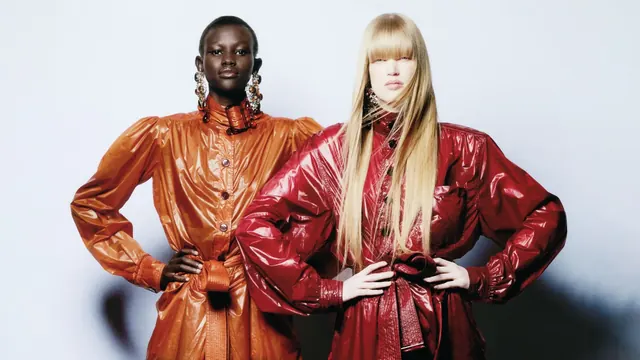
After a decade at Saint Laurent, Anthony Vaccarello is taking his leave. To bid him adieu, we’ve organized a look back at some of his most notable work for the Paris house.
In recent years, the designer has been increasingly drawn to film—in 2023 he established Saint Laurent Productions—which syncs with his approach to history and heritage at Saint Laurent. Vaccarello was not about unquestioning reverence, but relevance; a sort of ideological deconstruction that might have roots in his Belgian training.
The designer’s aim, noted Nathan Heller in a 2025 Vogue profile, was “to make Saint Laurent bigger than fashion.”
Of Sicilian heritage, Vaccarello was born in Brussels, where he would study fashion after a few years of training to be a lawyer. He won the 2006 Hyères prize and went to work at Fendi; later he joined Donatella Versace at Versus, where he was named creative director in 2015.
Concurrently Vaccarello was designing his own line, launched in 2008, which was distinguished by surgically precise cuts that showcased the body in daring ways. Though revealing, his version of naked dressing was tantalizingly suggestive rather than explicitly bare.
“It’s always black, always sexy,” he said in 2011.
Five years later, Vaccarello, still relatively unknown, was handed the keys to a house that defined the look of liberated women: not only with smokings and the like, but with ready-to-wear. “Saint Laurent covered so many things that it’s easy to take something you find interesting and make it contemporary,” Vaccarello told Vogue.
“For Saint Laurent, it was never something flash—it was always real clothes with a good twist, defined by the person who wears it and the attitude.”
Vaccarello’s approach to heritage has been laser-focused. His “modus operandi,” as Mark Holgate noted in a 2018 profile, “has been to take one specific dress—say, 1982’s black velvet puffed-shoulder dress, which he rendered super-short for spring 2017—and use that as a springboard.” That mono-focus projected a sureness of vision that kept Saint Laurent and its heritage in the spotlight.
Vaccarello’s legacy is more than a dramatic shoulder, a leg reveal, or the kink of latex; rather it is his understanding that fashion’s relevance comes from its connection to something larger than itself.
“Everything you see today is linked to what [Yves Saint Laurent] did: There’s danger, there’s the bourgeoisie, there’s showing-not-showing, masculinity-femininity,” he said. “For me, there’s Chanel and Saint Laurent. It’s culture. It’s le patrimoine français.” Main character energy was never of interest to Vaccarello. Like a director, he was more interested in the bigger-picture plot.