
When used in fashion discourse, “commercial” was once the polite way of saying dull. At best, it meant a collection that’s easy on the eyes and astutely merchandized, offering just the right amount of cash-cow designs to translate across markets while ticking off different price points. At worst, a lack of vision on behalf of the creative director or an overbearing executive team.
Recently, that’s changed. Spring/Summer 2027 has been defined by shows that feel at once shoppable and creatively nuanced, generating cult-like covetability and a clear wardrobe proposition. The goal, it seems, is to build immediate consumer appetite and the kind of in-store momentum that results in waiting lists and snaking queues.
Getting it right is hard. But there is a common denominator: the ability to preserve a strong creative signature while giving people a clear reason to buy.
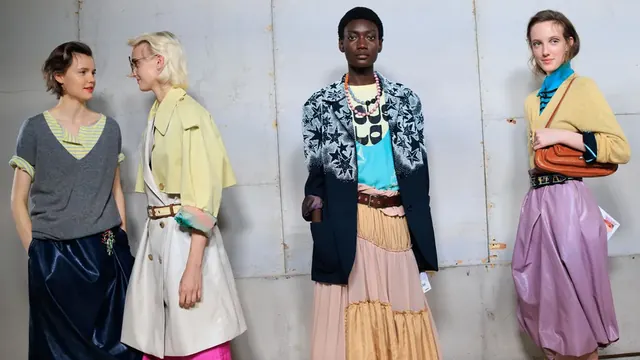
For Julian Klausner’s Dries Van Noten, this manifested in a kooky-but-bijou SS27 collection comprising jeweled and brooched sheer skirts with vintage movie poster prints layered beneath, cropped mini trenchcoats, clashing florals, polos, dress shirts, and — as we’ve seen across the season — a whole lot of skirts.
Elsewhere, typically experimental designer Duran Lantink pared back his characteristically whackadoodle approach to design for a smarter compromise this season. “There’s a bit more wearability in it,” he told Vogue Business of his SS27 collection.
“That’s slowly where I want to go with the prêt-à-porter.” Meanwhile, Demna staged his latest show in the simulacrum of Gucci store — a move that was read by some industry bods as a nod to his commercial KPIs. (Gucci is Kering’s biggest brand, but has faced consecutive annual losses since 2022.)
Glenn Martens admitted that this Maison Margiela collection was his most commercial yet, leaning on everyday pieces like jeans, trench coats and denim jackets, while reinterpreting the templates with trompe-l’oeil folding illusions or intentional stonewash misplacements. From afar, they appeared prosaic; up close, they were avant-garde.
“I’m trying to really figure out how we can bring a strong concept in and be really consistent with it across every garment, without being also scary,” said Martens. “You have to speak to a much broader clientele than Martin [Margiela, the brand’s founder] used to have.
We have to speak to the world, so it’s a bit difficult to go as hard on concepts.”
Martens’s predecessor John Galliano certainly raised global awareness of Maison Margiela with his critically acclaimed, fantastical collections, but the cultural impact of the house outweighed its commercial success under his tenure (many of Galliano’s creations never made it to the store). Ironically, this fashion week, people across London and Paris were queuing to buy Galliano’s new Zara collaboration, to get their hands on more wearable versions of his design signatures for under £1,000.
The commerciality conundrum is a sign of the times. In 2024, the luxury market shrank 2%, losing some 50 million consumers.
Global luxury spending has only just recovered. Following a two-year slump in demand and a return to stabilization in 2025, the sector is set for cautious growth in 2026.
Even still, the luxury market must contend with headwinds including the Middle East crisis, the Chinese real estate crisis, luxury price hikes, and a K-shaped economy cutting out mid-tier and aspirational shoppers. Nowadays, it’s the status quo for even the most cult of luxury brands to be owned by publicly traded conglomerates, who need to drive growth for shareholders, adding further commercial pressure in trying times.
“There are so many uncertainties that designers are creating collections that feel a little safer,” PR guru Lucien Pagès told Laure Guilbault following the Paris shows. “They feel more real, in a way that’s also more connected to what clients want. Even the most creative collections felt more grounded in reality. Designers are striving to make reality desirable.”
The good news for executives is that these creative-commercial blends have been landing with consumers. During Paris Fashion Week, the Dries Van Noten store was reportedly packed with shoppers, snapping up Klausner’s FW26 collection and showing that the relatively new designer’s vision is paying off.
Maison Margiela has also seen growth over the past two years, reflecting the strength, creativity and growing relevance of the house, says Maison Margiela CEO Gaetano Sciuto, explaining that the connection between creative vision and commercial execution is fundamental to the brand's continued development. “We have a talented creative team led by Glenn’s creative direction, with a strong sense of collaboration across Maison Margiela, bringing the creative vision and the different teams of the business closer together — aligning the organization around a common ambition,” he says.
“We are building on this momentum with clear ambition for the future.”
What’s a runway for?
The creative-yet-commercial fil rouge has been bubbling away for a few seasons. Consider, for example, Dario Vitale’s SS26 collection for Versace, a highly styled selection of vibrant, vintage-looking separates and accessories that quickly became catnip for fashion insiders.
Or Matthieu Blazy’s Chanel SS26, which launched in-store to a swarm of editors, discerning celebs, and high-profile figures — many vying to get their hands on the esoteric mint croc pumps. Both Vitale and Blazy have used bold prints, colors and textures on more classic silhouettes, like the jean, the court shoe or the Mary Jane, to create highly recognizable — yet wearable — clothes and shoes.
This increasingly seamless connection between runway collections and store stock heralds a new meaning for commercial, repositioning the role of the runway. Shows are expensive, and more players are battling for attention, so designers need clear objectives to ensure it’s not just a spectacular vanity project.
“I’d be wary of optimizing creativity for any single number, but a useful thought exercise is [asking]: Does the show create desire for something a customer can act on?” says Katy Lubin, Lyst’s VP of brand and communications. “Some runway moments spike in search and never convert, because the thing people fell for isn’t available, isn’t affordable, or isn’t memorable six months later.
The most commercially successful collections put the fantasy and the entry point in the same look.”
Creating brand hunger while ensuring brands remain the pinnacle of creative prestige is no small feat. Looking ahead, design and executive teams will need to work in tandem to to hone a new formula.
Striking a balance
There’s a sense of “getting the temperature right” on the runways at the moment, says luxury strategist Richard Gray. “[Brands need to offer] something very special, but nothing that’s going to make the horses bolt.” His rule of thumb for success is simple: a piece should be 70% wearable and 30% seductive.
In that sense, designers must lead with items that have a clear use value and fit neatly into consumers’ lives. “Better still, it should work with three things you already own and somehow make all three feel new again.”
For David Thielebeule, Bloomingdale’s fashion director, a commercial collection works best when you don’t notice it being commercial. “Jonathan Anderson and Glenn [Martens] understand that instinctively,” he says.
As Thielebeule sees it, they create clothes customers want immediately, reinforced by a strong idea at the core of the collection. “It’s about creating desire without sacrificing a point of view.
You want the coat, you want the barely-there dress, you want to inhabit the world, and that’s what fashion is meant to do: make you want something you didn’t know you needed five minutes earlier.”
To this point, experts agree that the best commercial product isn’t necessarily the easiest to wear. “It’s often something familiar enough to understand, but unexpected enough to want,” says Gaia Guglielmi, chief buying and commercial officer of off-price retailer Yoox.
She contends that sell-through, conversion rates, categories, and price points all matter in her buying considerations. However, the strongest collections have a balance, providing an element of newness (such as a unique proportion or a detail on a shoe) that can make you look at the item differently each time.
The most important aspects? “The design, the quality, the meaning, the value it embeds, and whether it’s something you’ll still want to wear once the initial excitement has passed.”
Fashion buyers are increasingly savvy to what works. “We’re constantly looking at data to optimize our buys, making sure we have the right category mix and the right depth across the collections,” says Brigitte Chartrand, Net-a-Porter’s chief buying and merchandising officer.
“It’s about offering pieces that feel exciting and distinctive, but also have multiple uses and different ways of being styled, so you don’t feel like you can only wear it once.” Here, buyers can provide brands with valuable qualitative feedback on performance, highlighting uplift in particular categories. They can also draw attention to gaps in their ranges to ensure they’re commercially watertight.
For brands to better capitalize on runway buzz, they are working to reduce the lag between the runway show and the in-store drop. At Kering, group CEO Luca de Meo has made big changes with Gucci — which makes up 40% of the group’s sales — in a bid to regain its position as world number one for desirability.
This has meant reducing SKUs by 20%, and the ongoing development of a more refined stylistic vision headed up by Demna. De Meo is also scaling the ‘see-now, buy-now’ model, shortening the development and production cycle so that runway items hit the stores faster.
While many players tried and got rid of this model in the past, striking a balance with select product drops post-show could be a smart move.
The streamlining of buying and the urgent need to up the commercial ante is not the death knell for runways, though. At Liberty London, buyers order a significant portion of the range through pre-collections, which gives their assortment a strong commercial foundation. From there, the runway becomes a space to discover more avant-garde designs — distinguished by craftsmanship, fabrication and details.
“Our private shopping teams are receiving requests to pre-order specific looks almost as soon as clients see them on the runways,” says Joshua Orlandini, Liberty’s head of fashion buying, noting that some of the most distinctive pieces from the FW26 collections are among the fastest to sell. “That tells you the runway has created a genuine sense of desire.”