
Ruth Asawa’s wire-knitted sculptures are, like Isamu Noguchi’s wood and paper lamps, among the most iconic American designs—adored, occasionally knocked off, and associated with a postwar aesthetic that is streamlined and concise but at the same time almost sensuous in terms of material. The pieces, whether made of wire or even stone, manage to breathe.
“Noguchi to Asawa: Designing Postwar America,” a new show at the Barnes Foundation in Philadelphia, makes the point that the experiences of Asawa and Noguchi as prisoners in World War II internment camps weren’t just parenthetical to these designs, but central—and that the violence of internment, and its lingering effects, may be in your living room. “Few consider or register,” writes Anne Anlin Cheng, a professor of English at Princeton, in the show’s catalogue, “the complex and scarred racial-ethnic histories behind the makers of these objects.”
The show, which is part of the Barnes’s year-long consideration of the 250th anniversary of the United States, explores the work of Asawa and Noguchi, as well as four other artists: the architect and furniture designer George Nakashima; the sculptor Leo Amino; the graphic designer S. Neil Fujita; and the fiber artist and weaver Kay Sekimachi.
Noguchi, Nakashima, and Amino were adults on February 19, 1942, when President Roosevelt signed Executive Order 9066, which forced Japanese American families to quickly abandon or destroy their property and board trains to the holding centers. Asawa and Sekimachi entered the camps amid post-Pearl Harbor anti-Japanese hysteria when they were teenagers.
While the tent camps were being hurriedly built, military guards moved families to temporary “relocation centers”—a desperate experience that American history tends to downplay. Asawa and her family, for instance, were forcibly relocated to the Santa Anita racetrack in Arcadia, California, where they lived in two horse stalls.
Often, Cheng writes, “the Asian American subject is praised for her reticence, for not ‘whining,’ for not utilizing her victimhood, for pulling herself up by the bootstraps—a rhetoric and cultivation of resilience that often results in silencing Asian American injuries.” In a 1948 letter to her husband, Asawa wrote: “We have all suffered intolerance innocently. I no longer want to nurse such wounds; I now want to wrap fingers cut by aluminum shavings, and hands scratched by wire; only these things produce tolerable pains.
You will have to look at me on streetcars or bus[es] when you hear someone shout ‘dirty Jap.’”
In the first section of the show, called “Prelude/Incarceration,” the layout and feel (designed by Stephanie Goto) nod to the claustrophobic impact of the stark camp buildings themselves: a long narrow wall covered in black mimics the cheap tar paper that lined the camps’ barracks—what amounted to elongated, wind-leaking shacks. (As an adult, the poet Mitsuye Yamada remembered inmates in Minidoka, the camp in Idaho, using mess hall butter knives to stuff cracks in the walls with newspapers and rags, writing: “But the Idaho dust/ persistent and seeping,/ found us crouched/ under the covers.”) The pre-internment work of both Noguchi and Nakashima—a supercool Bakelite baby monitor, its shape a cross between an American nurse’s cap and a kendo sparring mask, by the former; a deliriously compact black walnut lounge chair by the latter—is exhibited alongside Amino’s Air Raid, a sky-searching figure holding a wounded body in their arms that reads like a prayer against war.
Anti-Japanese sentiment had motivated Amino’s move from Los Angeles to New York in 1935; the US deemed East Coast Japanese populations as more dispersed and thus less of a threat.
The counterpoints to the pre-camp pieces are those made within the camp wires, both by adults and children. Nakashima and Fujita were adults when their families were forced from Seattle and LA, respectively; while Noguchi entered the Poston War Relocation Center—built on the Colorado River Indian Reservation—voluntarily, in hopes of organizing a farm collective and craft school, both of which foundered.
(Noguchi managed to return to New York after six months.) Without schools, adults in the camps organized classes: three suddenly unemployed Disney artists, for example, taught the teenage Asawa drawing for four to five hours a day. “It was my first experience, in a serious way, with how an artist works,” she would later recall.
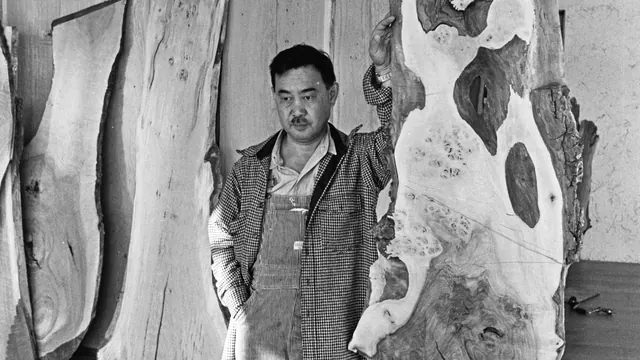
Indeed, the camps acted as de facto cultural schools, with general transfers of generational knowledge. Nakashima learned traditional Japanese carpentry skills, which he brought to his postwar practice in Bucks County, Pennsylvania. We see Asawa and Sekimachi in training: Asawa’s watercolor of detention barracks on an Arkansas swamp; Sekimachi’s graphite drawing of the stables her family inhabited, titled Tanforan, Our Stall. (Sekimachi was tutored by the artist Chiura Obata.)
A room called “Minor Arts” explores the fields the artists made their way into in the postwar world. In contrast to the so-called “major arts,” the minor ones—furniture, ceramics, textiles—are, by the exhibit’s definition, those considered the provenance of women or non-Western cultures.
The show suggests that the artists were overtly doing what Americans had come to expect of them since first becoming entranced by ceramics and furniture from Asia in the 1876 Centennial Exposition (also in Philadelphia), while covertly working through issues like equality, heritage, and social relations.
“Why did it have to be fine art? Why not objects of use and popularity?” Noguchi would ask. His ceramic cups sit in saucers that are more like volcano cones, geologic. “By use, I meant enjoyment—things for everybody’s enjoyment. I thought that a really new creation could rise above the demeaning categories of applied art and the like. Originality might survive mass-production.”
Sekimachi’s post-internment work ranges from placemats for Bloomingdale’s to the gorgeous monofilament weavings that might be creatures from the ocean’s abyssal plain, but are better described by her title, Amiyose, which is a Japanese word meaning “to weave,” the word itself indicating a subtle gesture of determination, if not resistance. In the 1973 text Beyond Craft: The Art Fabric, renowned MoMA curator Mildred Constantine and textile designer Jack Lenor Larsen described Sekimachi’s work as “without precedent and without successors.”
In the gallery entitled “Neither/Nor, or The Impossible Object,” the show situates the Japanese Americans’ work in Jim Crow America, where, for instance, the artists recount not being certain which restrooms to use, which water fountains to drink from, not being white and not being Black. Similarly, Nakashima’s black walnut conoid chair might not be a chair at all.
In the following gallery, “Transparency, or the Invisibility Aesthetic,” the tear shape of Refractional #50, a 1967 work of colored resin by Leo Amino, is almost like a drop of light. Elsewhere, both Asawa and Sekimachi’s sculptures take up space while also being invisible.
In “Labor and Industry,” Sekimachi’s 1962 weaving samples for Knoll show us, in their Knoll-ness, that these artists could make their way into the everyday post-WWII machinery of America. Asawa’s knitted wire lobes are stars here, and her techniques, derived from Mexican craft workers, stand alongside S.
Neil Fujita’s 1958 design for Alcoa, the aluminum company dressing jetliners and fighter jets and spaceships, the tools of what would then be pitched as John F. Kennedy’s “New Frontier.”
The exhibition’s galleries spiral into the coolest mid-century living room ever: there’s a Noguchi lamp and table, a Nakashima radio cabinet, and Fujita’s still-astounding LP covers for Columbia Records: Dave Brubeck’s Time Out, Charles Mingus’s Mingus Ah Um. You see the makings of 1960s and ’70s cool, and that cool is subtlety redefined.
It gives new meaning to the covers of the bestselling novels in the room’s bookshelves—In Cold Blood and The Godfather—when you know that Fujita, the man who created them, was an artist who, after being held at gunpoint behind barbed wire in Wyoming, went on to fight for the U.S. Army’s 442nd Infantry, the most decorated unit in WWII.
At the exhibition’s press opening, curator Cindy Kang talked about trying to dispel the idea that internment was an isolated incident that these artists then moved on from. Objects contain the past, and in this show, we are shown that grief and damage are connected to these works’ beauty. “You cannot disentangle them,” she said.
“Noguchi to Asawa: Designing Postwar America” is on view at the Barnes Foundation through January 10, 2027.