
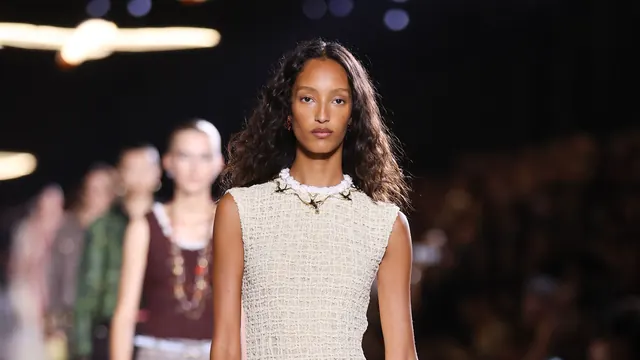
Against a backdrop of macro uncertainty and continued upheaval within fashion itself, designers at Paris Fashion Week (PFW) put on a series of shows grounded in reality.
“The week has been superlative,” says Linda Fargo, senior vice president of the fashion office and store presentation director at Bergdorf Goodman. “The stakes were really high, and I think the houses and designers more than met the challenge.”
On day one, Matières Fécales showed at Place de la République featuring 99 looks, as a nod to the 99%, the people that the brand’s designers Hannah Rose Dalton and Steven Raj Bhaskaran “want to empower”, as Raj Bhaskaran told Vogue chief international correspondent Luke Leitch. Each of the 99 models was a person of color.
“It was really a standout moment of the week: the poetic, the personal, the political and the beautiful, all in one show,” Fargo says. “It was a very strong start, then Dior and Saint Laurent the next day.
I thought, ‘OK, I think we’re finished. I don’t think I can absorb anymore.’”
And yet we did. There were plenty of other highlights including Chanel, Celine, Dries Van Noten, and Tom Ford. The light, airy looks on the runway felt particularly fitting for the unexpected warmth of October in Paris, with the temperature at some shows feeling almost reminiscent of the most recent men’s or couture weeks.
“The atmosphere is very positive, despite a challenging economic and global climate,” Pascal Morand, executive president of Fédération de la Haute Couture et de la Mode (FHCM), said. “There is an intense energy and a desire among designers to express and showcase everything they have to offer.
There is a strong sense of product and of consistency across the collections. It is also worth noting the number of exhibitions and cultural events during PFW, which reflects its vitality.”
Events were plentiful, from the opening of “Penn & Fashion” at the Maison Européenne de la Photographie, to “Rafael Pavarotti, Photographer” and “Look: 40 Years of Fashion at the Museum” at the Musée des Arts Décoratifs. PFW also coincided with Celine Dion’s Paris residency.
Some show-goers made their way to La Défense Arena to see her perform, showing up clad in Celine Dion merch to the runways thereafter. While the Canadian singer did not show up on fashion’s front rows, as many expected, she performed at the L’Oréal Paris show and was photographed outside the Royal Monceau in many different looks, including a tailored outfit from Sarah Burton’s Givenchy Spring/Summer 2027 collection.
“Her hotel is the new runway,” PR guru Lucien Pagès joked.
Here are the rest of the key takeaways from Paris Fashion Week SS27.
A reality check
Milan Fashion Week was rooted in reality, as features director Lucy Maguire reported, and the mood continued in Paris. From elections in Brazil and the upcoming US midterms to the French presidential election in 2027, the world outside fashion seems impossible to ignore, while the industry has yet to regain momentum.
“There are so many uncertainties that designers are creating collections that feel a little safer,” Pagès says. “They feel more real, in a way that’s also more connected to what clients want. Even the most creative collections felt more grounded in reality. Designers are striving to make reality desirable.”
“I think that designers are conscious of the [commercial necessity] because of the climate, because of things not moving in the stores. What are we going to sell? They respond to that,” says designer and journalist Edward Buchanan. ”Everyone has to create immediacy. Otherwise it'll sit on those racks.”
Maison Margiela creative director Glenn Martens took a decidedly more commercial approach this season. “I’m trying to really figure out how we can bring a strong concept in, and be really consistent in the concept in every garment, but without being also scary,” Martens told Vogue chief critic Sarah Mower.
In this day and age, the designer says, “You have to speak to a much broader clientele than Martin used to have. We have to speak to the world, so it’s a bit difficult to go as hard on concepts.”
After two daring and provocative ready-to-wear shows, Jean Paul Gaultier creative director Duran Lantink took things down a notch this season. “There’s a bit more wearability in this collection.
That’s slowly where I want to go with the prêt-à-porter,” Lantink said at a show fitting. Despite the rebuild and expansion of the brand’s ready-to-wear network, Lantink still sent out numerous silhouettes featuring the iconic cone bras and a skirt embroidered with loud bells, alongside other couture-like pieces.
At Schiaparelli, a house rooted in sculptural and avant-garde design, there was a sense of realism, too. “We shouldn’t expect anything as straightforward as five-pocket denim chez Schiap, but Roseberry is working to develop the more casual side of the ready-to-wear business,” Nicole Phelps wrote in her Vogue Runway review.
Even Rick Owens had a softer proposition. “I thought it was one of his softer collections. I loved the diaphanous gowns that came out in the beginning,” noted luxury consultant Roopal Patel, who also praised the “phenomenal details” at Celine. “It’s so chic, effortless, but it’s also not complicated clothes — it’s in the styling, the details, the accessories.”
“I do think it was a commercial season, but I also think people liked it,” Thakoon Panichgul, designer and editor-in-chief of HommeGirls, said. “Celine was completely commercial, but in a way, that was really beautiful. ‘Commercial’ isn’t a bad word. But I always thought that. The brands that we like are the ones that take commercial fabrics and really manipulate it in ways that are original, so that’s exciting.”
Celine and Chanel perhaps best demonstrated how wearability could be embraced in the most compelling way. Continuing a year-long success streak, Chanel artistic director of fashion activities Matthieu Blazy presented a SS27 collection that featured fresh iterations of the hit Charvet shirt, rounded-shoulder jacket and a yellow two-piece skirt and top.
The creative reset continues
SS26 was a historic season in Paris, marked by an unprecedented number of designer debuts. This season saw just two: Courrèges’s new artistic director Drew Henry, and Carven’s design director Kai Nesselrath.
Alaïa hosted two intimate presentations featuring a collection designed by the studio, following the departure of longtime creative director Pieter Mulier, who left for Versace early this year.
Saint Laurent and Chloé dominated show chatter, both of which had all the makings of farewell shows. The Saint Laurent show, which marked Anthony Vaccarello’s 10th year at the helm, closed with a performance by singer, actress and the designer’s longtime friend Charlotte Gainsbourg.
The chorus repeatedly echoed the line: “You are so much, Yves Saint Laurent.” At Chloé, Chemena Kamali sent eyelet lace, tailoring, and raincoat silhouettes down the runway. “This season, I was guided by my love for Chloé,” she wrote in the show notes.
AI on everyone’s mind
Just as fashion month began, AI specialists warned that the technology may be advancing a bit too quickly.
For Carven’s Nesselrath, the response to these growing AI development concerns is poetry. He chose a show soundtrack that featured the voice of Anna Karina, in Jean-Luc Godard’s dystopian sci-fi movie Alphaville, reading a poem by Paul Éluard.
“It’s an amazing movie. It felt so familiar to today: this darkness and AI taking over, and the only way to navigate it is through poetry and love.
So when she said this poem, it really made me think of the times of today,” Nesselrath said.
Is literature the answer perhaps? The Valentino show, which took place at the historic Bibliothèque Sainte-Geneviève, invited guests to bring a book of their choice to donate to local libraries.
“I like human work because I am from that era. I am better off doing things by myself,” Valentino creative director Alessandro Michele said backstage after the show.
“If you think that we are destroying real books and giving them to AI, it makes me really uncomfortable. A library is a masterpiece.”
“I think designers are thinking more about innovation than AI, which they are rejecting creatively,” Vogue Runway’s Amy Verner said. “Whether this is owing to fabric innovation and technique or purely aesthetic, I’ve noticed something in the air this season: the shimmering silver looks at Dior and Celine, the extreme flora-fauna creations at Mugler, and even the achingly sleek sexiness at Tom Ford — it’s as though we are starting to see futuristic versions of what we have always worn.
I think it has to do with questioning who we are as humans today.”
A season of skirts, bras and shoes
“Overall, there’s a very feminine direction — a lot of skirts, bras and fluid fabrics,” says Alix Morabito, chief merchandising officer at Galeries Lafayette.
The skirt trend, best embodied by Prada’s skirt-only collection, was once again spotted in Paris. “It’s definitely the season of the skirt. There have been more skirts this season than I’ve ever seen before,” Patel says. Fargo agrees: “ Dries Van Noten was very important in that. At Valentino, too, you had a very elaborate skirt, but then it would be paired with a plaid shirt. It’s in the styling and the mixing.”
Lingerie-inspired dressing was another prevailing theme, “maybe to induce an inside love, an inside intimacy,” Fargo suggests. Or is it a possible side effect of the GLP-1 boom, where a rise in thinner bodies could mean an increase in baring skin?
Ester Manas’s collection was the result of a collaboration with Belgian heritage lingerie house PrimaDonna. Haider Ackermann’s Tom Ford put forward structured bullet bras and high-cut swimsuits.
At Jean Paul Gaultier, Lantink incorporated the house’s iconic cone bras into many silhouettes. At Balmain, Antonin Tron sent out bras, corsets, and satin garter skirts.
Miu Miu’s stretchy bralettes, meanwhile, put a sporty twist on the trend (see Gigi Hadid’s runway look).
There was much lightness and transparency throughout the season’s collections, perhaps a reflection of the exceptionally hot summer (and fall). “A lot of the houses made their collections seasonally appropriate. They felt like summer. It was definitely at Dior, but I feel like I saw it all week long,” Fargo says.
At Louis Vuitton, Nicolas Ghesquière presented an ultra-light collection. “The construction behind this, making things extremely light, is very complex. The engineering, the development of fabric to fight that gravity is also complex,” Ghesquière said after the show. “How do you do clothes that are almost like swimwear, like a second skin?”
Asked if the heatwave that swept across Europe this summer has changed the way he thinks about design, he replied: “It has had a strong influence. We all felt like we needed a different wardrobe, we needed to think differently. It’s almost like you have to weigh the clothes now to think they can be relevant for today and for the future.”
Romanticism was also present, whether in the bloomers at Victoria Beckham, the butterfly appliqués at Zimmermann, the eyelet lace at Chloé, or the embroidery at Cecilie Bahnsen.
The color palette was wide-ranging. “The evolution of quiet luxury continues to gain momentum, with a clear majority of solid-color looks enlivened by embellishments — pearls, embroidery and the like — and by increasingly confident color choices, ranging from softer shades like pastels and muted tones to much bolder, brighter hues,” says Elodie Abrial, sales director of Groupe Bon Marché.
“Cobalt blue, primary colors and vivid hues are what I’m already seeing being embraced,” Fargo adds. “Fashion can act a little like an oasis against an uncertain world, which is possibly why there was a sense of optimism in the colors this season.”
Meanwhile, shoes are emerging as a key category, offering an entry point to luxury for customers who have been priced out of the heritage brands. But this season has seen more maximalist styles with the ability to make an outfit enter the fore.
Jean Paul Gaultier doesn’t produce bags, but is now rolling out shoes. “That’s something that we really want to go for,” Lantink said. “Since the pre-collection, we started selling shoes, which will be introduced this season, too.” The new sandal, which the brand internally calls “the tulip shoe” after its flower-like webbing between the toes, appears in numerous colorways and iterations — from flats to heels to lace-up versions.
Chanel, Givenchy, Dior and Saint Laurent had great shoes, according to Patel. “The gold snake shoe at Saint Laurent was the talk of the town,” she says. Since Blazy’s first show at Chanel a year ago, the house has seen a full-blown shoe frenzy, especially those cap-toed heels. For his SS27 show, Blazy sent out 83 looks, each completed with a different pair of heels.
On Tuesday evening, Louis Vuitton closed the curtain on fashion month. The show set, which was a recreation of a cityscape with futuristic cars hovering over the runway, was a collaboration with set designer James Chinlund that contrasted with the lightness of the collection.
“In the chaos we are all living in, there’s a moment where everyone is trying to find a way,” Ghesquière said. “I wanted to express that with the set, how everyone is circulating in this megalopolis.
What's going to be the traffic like in the cities of the future? Some say vertical.
Others say, it's gonna be underground. We don't know.
But it was a very symbolic way of saying how everyone is trying to make the best way possible.”