
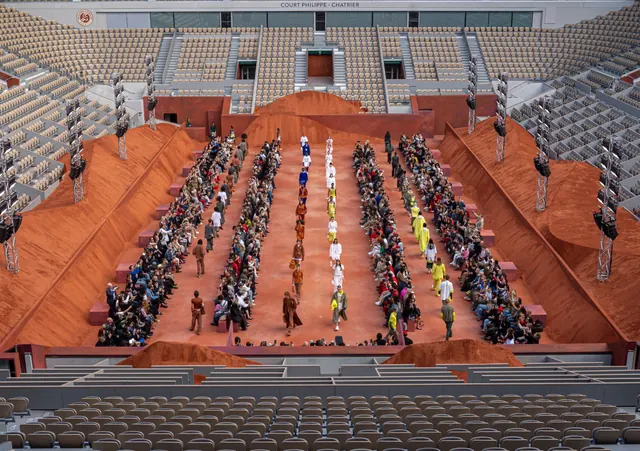
For Spring/Summer 2027, Lacoste finds all the colours of tennis, just not where you might expect them. Staged on the Philippe-Chatrier court at Roland-Garros, creative director Pelagia Kolotouros looks beyond pristine tennis whites to the red clay beneath the players’ feet, the green embedded in the house’s identity and flashes of electric yellow reminiscent of a ball in motion.
Aptly titled ‘Dress Code: No White Required’, the collection takes the familiar rules of tennis dressing and loosens them up.
It is an idea rooted in the sport’s history. The collection recalls French tennis champion Suzanne Lenglen, who challenged the conventions of tennis dressing in the 1920s, swapping restrictive clothing for pieces that allowed greater freedom of movement. Almost a century later, Kolotouros approaches Lacoste’s own codes with a similar sense of freedom.
On the runway, familiar preppy staples appear slightly out of order. Oversized polos are layered over technical long sleeves, ties hang casually over sportswear, and wide trousers pool over sneakers. Tailoring follows suit. Jackets grow generous, coats become elongated and suits are belted rather than rigidly constructed. Even at its most polished, the collection never feels overly proper.
The colours of tennis run throughout, but their interpretation is less obvious. Rust, burnt orange and earthy brown take their cues from the clay court, appearing across fluid tailoring and glossy technical sportswear.
Deep greens nod to the house’s unmistakable identity, while cobalt blue and acid yellow cut through the earthier palette. White remains, too, but it is no longer untouchable.
Shirts, trousers and outerwear appear creased, washed and marked with red clay, carrying the traces of the court with them.
That worn-in quality extends to the materials. Garment-dyed and enzyme-washed cotton sits alongside softened silk, deconstructed tropical wool, perforated jersey and technical fabrics. Rather than concealing wrinkles, fading or signs of wear, the collection makes them part of its character. Rounded bags reminiscent of tennis racket cases continue the sporting references beyond the clothes.
Discover the Spring/Summer 2027 collection here .
photography. courtesy of Lacoste words. David Baczyk
It has taken Matthieu Blazy remarkably little time to make Chanel feel like his own. Just one year into the job, the designer has already sent the house’s desirability into overdrive, with his early collections prompting queues outside boutiques and a renewed appetite for the Chanel wardrobe.
Now, with Spring/Summer 2027 , Blazy appears ready to explain exactly where that instinct comes from. The latest instalment of his ongoing ‘La Conversation’ series travels through the life of Gabrielle Chanel herself, tracing the different women she became through the clothes she created — and finding freedom in every incarnation.
“Throughout their lives, women become multiple selves, different faces of the same coin,” Blazy writes. “It’s about the women within a woman.
And here, it’s about one woman, Gabrielle, who then became Chanel.” The collection consequently reads like a wardrobe autobiography: Edwardian tailoring gives way to liberated jersey, masculine codes turn into feminine suiting, and familiar Chanel signatures are pulled apart, softened and reassembled. The avian imagery hanging above the runway made the final idea almost impossible to miss.
Freedom, in Blazy’s Chanel, has wings — duck ones to be specific.
Tweed was firmly back on the agenda, appearing in jackets, skirts and separates, but Blazy kept pulling it into unfamiliar territory. The new “smocked tweed” was engineered with stretch so that the traditionally structured suit could behave almost like sportswear, while other tailoring was worn directly against bare skin.
Jersey, too, was pulled back into Chanel’s history, with references stretching from Gabrielle’s early relationship with jersey underwear to the tailored suit of her later years. Blazy paid special attention to the backs of the garments, incorporating trailing lines of shadow boning, splayed peplums and low rolls that subverted standard tailoring expectations.
Freedom was palpable everywhere in the clothes. Dresses and skirts appeared in fluid, sheer fabrics, while feather-light tailoring was offset by elaborate embroidery and beading. The house’s beloved silhouettes remained recognisable, but their surfaces were busier, brighter and gradually more playful. Swifts and swallows appeared as buttons, jewellery and embroidered details, while cloud-like layers of printed silk created soft, billowing shapes across the body.
The accessories were having a particularly good season, as previously teased by the designer. Bird earrings took flight from the ears, while cloud-shaped bags hinted at different moments of the day; there were also new takes on the classic flap, a fresh style with a watch-chain lock and, eventually, the pièce de résistance: a birdcage minaudière containing tiny birds making their escape.
Gabrielle Chanel’s own 2.55 handbag, borrowed from the Patrimoine archives, bookended the show in the opening and closing looks, turning one of the house’s most recognisable objects into a wonderfully personal archive reference.
Anok Yai appeared in a celestial, star-speckled gown that seemed to take its cues from the night sky, while Bhavitha Mandava returned to the runway following her appointment as a Chanel ambassador. Rachel Ojuromi, the Lagos model who went viral after recreating Chanel looks with her friend Debby Fasingha, also made her Paris debut for the house.
After all those birds, clouds and references to liberation, a remixed version of Britney Spears’ ‘Gimme More’ suddenly blasted through the Grand Palais, shortly after a soulful rendition of the eternal ‘You Don’t Own Me’, sending the final looks out to one of the least expected soundtracks of Fashion Week. “This is not a historical collection; it’s a collection about Gabrielle Chanel’s layered stories,” Blazy writes.
“Ultimately, Chanel took off, and each step she took led to her being free, like a bird.”
photography. courtesy of Chanel words. Gennaro Costanzo
Elevating the ordinary is an ambition that has always defined Miuccia Prada’s secondary line, but the latest Miu Miu presentation in Paris indicates that everyday dress gains a whole new perspective when classicism meets the running track. For Spring/Summer 2027, Miuccia turns its focus entirely towards a recontextualisation of the quotidian wardrobe, building a collection where sportswear, knitwear and leather collide.
Titled ‘Here and Now’, the collection approaches ordinary dressing with a lighter touch than Prada, opening with almost preppy combinations of menswear-inspired blazers, loafers and tailored separates before letting the eccentricities accumulate. Miu Miu describes the collection as “an ambition to do better”, with familiar garments heightened, transformed and placed into new combinations.
Staged as the physical base for ‘Geste de Consolation’, a major interdisciplinary project by filmmaker Alice Diop for Art Basel Paris, the runway became a setting for these clothes to interact in a series of nonconformist dialogues full of friction and contrast.
Sport became one of the collection’s main languages, but Miuccia refused to keep it in its own category. Performance jersey appeared as abbreviated tops, with sports bras and bralets worn over or beneath dresses and other pieces, while tiny sports shorts and track trousers collided with tailoring.
The mix gives the collection its distinctly Miu Miu tension: one part country-club wardrobe, another part changing-room scramble. Olivia Colman was among the models walking the show alongside Gigi Hadid, Emma Corrin, Jamie Bell and Liu Wen.
Skirts naturally had another starring role, following their more conceptual treatment at Prada but arriving here in a considerably more utilitarian mood. Some came in tartan, others in plain leather, while low-slung styles were paired with cropped tops and sneakers.
Dresses moved through multiple shapes, from neat mini silhouettes to deliberately crumpled forms, with strings and crossed lacing becoming the collection’s recurring detail. The latter functioned as fastenings, allowing denim, pleated skirts, cocktail dresses and even shoes to be altered.
The show also debuted the new Wrangler x Miu Miu Upcycled collection, which deconstructs vintage late-twentieth-century denim sourced by specialists before reconstructing it with Miu Miu’s signature crossed lacing. Among the pieces is Wrangler’s cowboy-cut jean, given a new front through hand-customised crisscross stitching.
Leather, knitwear, suede, satin, gauze and metal mixed throughout, with suede laminated in wax to encourage a cracked, aged appearance and evening fabrics crushed against metal hardware. The prints were every bit as memorable, bringing back geometric motifs in wonderfully kitsch combinations that nodded to Miu Miu’s own history and wider popular culture.
The footwear introduced the fifth chapter of the New Balance x Miu Miu collaboration, reworking New Balance’s late-Nineties RC150 racing shoe in technical mesh, with loose customisable laces threaded through external loops. Alongside it came worn-looking loafers, buckled thong sandals and snakeskin-effect pumps finished with sneaker-style laces. Bug-eye sunglasses appeared in a parade of colours, while reptilian finishes also surfaced across the accessories.
The bags deserve their own attention, with new shapes spanning snakeskin-effect clutches and messenger bags to oversized leather bowling styles, giving the collection some particularly covetable counterpoints to all the sportswear.
photography. courtesy of Miu Miu words. Gennaro Costanzo
Fashion has never been particularly good at following the old advice about not judging a book by its cover. Alessandro Michele seems to agree, which may explain why Valentino ’s Spring/Summer 2027 collection came with its own library, its own reading list and, eventually, an entire wardrobe of very attention-grabbing “covers”.
Titled ‘Antibiblioteca’, the collection was presented at Paris’ Bibliothèque Sainte-Geneviève, where guests were asked to bring a new or unread book to donate to public libraries through Bibliothèques Sans Frontières and Fauvettes City Club.
The idea comes from Nassim Nicholas Taleb’s description of Umberto Eco’s vast personal library, where the unread books matter precisely because of everything they might still teach us. Michele transfers that logic to clothing, treating the runway as a collection of possible lives: garments that may be worn repeatedly, photographed once, cherished forever or never leave the wardrobe at all.
“For this reason, a show can be seen as a sort of visual antilibrary,” he writes.
The clothes certainly looked ready to be remembered. Michele’s familiar maximalism arrived in full colour, with hot pink, magenta, lilac, cobalt, vivid green and lemon yellow competing for attention. Satin bustiers were paired with contrasting skirts, while sequins, lace, feathers and elaborate embroidery kept the surface busy. Plissé appeared throughout, alongside dramatic ruffles and fluid, fishtail-like shapes, producing a wardrobe that seemed determined to make its presence known from across the room.
The accessories were equally committed to the assignment. Chunky jewel-encrusted chokers, oversized pearl earrings and long opera gloves turned even relatively simple looks into full compositions, while bows appeared everywhere — at the waist, across garments and as oversized finishing details. Some of the more playful pieces came topped with baseball caps emblazoned ‘VILLAIN TEEN’, a phrase Michele had already introduced for Resort 2027, where it appeared across caps, knitwear and accessories.
Menswear slipped comfortably into the same world, with tailoring mixed with sheer knitwear, scarves, jewellery and slouchier trousers, while shearling appeared as trims on shirts and other pieces. The intention was not about separating day from night, or masculine from feminine, but actually about collecting as many different personalities as possible under one roof.
The bags offered another particularly tempting chapter, with the Rockstud Spike returning in medium shoulder styles spanning kidskin, suede and embroidered nappa leather, adding yet another layer of texture to Michele’s already crowded visual vocabulary.
The final page ended the story with a saturated magenta gown with a long, pleated train and an enormous bow cascading from the back. It was unmistakably Valentino, unmistakably Michele and the sort of dress that makes you wonder whether the point of a wardrobe is always to be practical. As Michele writes, “Even the garments that we will never wear… still speak to us of the lives we could have lived.”
photography. courtesy of Valentino words. Gennaro Costanzo