
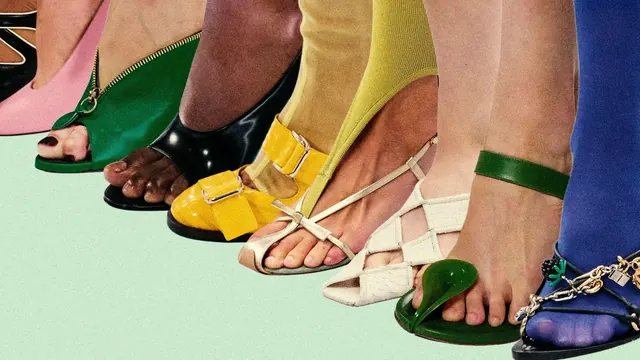
At the Spring/Summer 2027 shows, from New York to Paris, there have been few front rows without at least one pair of Dario Vitale’s printed Versace court shoes in the mix. The Tina Party pumps, priced at $950, proved most popular.
It’s a sign of the times. As the Wall Street Journal reported last month, and as handbag prices continue to climb well above the $5,000 mark, consumers are turning to more accessibly priced designer shoes — typically sub-$2,000 — to satiate their luxury splurge impulses.
The Chanel frenzy in Paris last season pointed to this trend: few editors bought a bag with their fashion industry salaries, but many bought Matthieu Blazy’s bold croc and spotted heels. This season, outside the SS27 shows, the funky pump was a shoe of choice.
On the runways, brands responded in step. At Prada, though the collection was built around the skirt, shoes were a focal point.
The brand revived its 2007 curved banana heels and introduced cutout, bejeweled slingbacks. At Dior, footwear designer Nina Christen offered up sexy Dior-charmed T-straps and plenty of toe cleavage.
Ann Demeulemeester brought back the gladiator sandal with an abundance of buckles. Loewe displayed a dizzying assortment of cutout, elongated, fantastically colored footwear.
It’s a departure from previous seasons, where shoes were more pared-back, from Prada’s pointed kitten heels in neutral tones last season to Dior’s classically spotted pumps.
“I can’t remember a season in many, many years where the focus of footwear has been so incredibly strong,” says luxury consultant Robert Burke of the new collections. “It was a deliberate move to put an emphasis on creative footwear, which can change an outfit.”
It can also swing a purchase. “Middle-class consumers are squeezed globally — hence their interest to stay in luxury with cheaper categories in absolute dollar terms,” says Bernstein luxury goods analyst Luca Solca. “Shoes cost a third of handbags on average, hence the relatively stronger appeal.”
For Nordstrom fashion director Brooke Bobb, picking favorites is difficult because of the sheer amount of standout shoes this season: “I loved the kinky cutout kitten heels at Jil Sander, the perforated pumps with brooches at Prada, Loewe’s charm sandals, Celine’s silvery lace-up heels, and all the sublime shoes at Dries: metallic block heeled loafers; two-tone high vamps; crystal-covered pumps!”
The footwear pendulum has swung back from low-key to maximalist, buyers agree. Tiffany Hsu, Mytheresa’s chief buying and group fashion venture officer, notes a clear shift away from the ease and practicality that’s dominated the last few years. “There is more excitement around shoes that bring glamour and personality back into the closet,” she says, noting Saint Laurent’s squiggly snake tail heels and Rick Owens’s strong boots and embellished “cage-like” shoes as standouts.
“Shoes have more personality right now,” adds Bobb, who believes the minimalist era of high vamp pumps, monochrome slingbacks and skinny thong heels is coming to a close. “This is the season of shoes that make a statement, whether by way of an off-beat shape, a playful embellishment, or a slick, sky-high heel — even better if it’s slightly curved like Christian Louboutin’s sculptural stilettos for Matières Fécales.”
In Herbert Levine creative director Trevor Houston’s view, there are two things happening at once: “a need for more expression, given the current state of the world, and a need for function to keep up with our intense lifestyles,” he says.
The era of freaky footwear
While 2022 innovations such as Alaïa’s mesh flats and Tory Burch’s pierced mules signaled the shift toward funky footwear, it took a hot second for luxury to fully catch on. The Row’s jelly sandals — designed by Houston, who now helms Herbert Levine and is also behind recent season shoes at Khaite and Tory Burch — took things a step further in 2024.
But it was last season that signaled a bigger era for footwear, cemented by March’s Chanel-heel-mania.
The abundance of peep toes and funky shapes on the runway can be partly credited to a new wave of challenger brands, raising the bar for fresh, off-kilter footwear. Newcomer Jude and recently revived Herbert Levine have become popular because of their recognizable, unusual designs. Both are on heavy rotation across celebrity wardrobes, with fans spanning Tracee Ellis Ross, Nicole Kidman and Kaia Gerber.
Jude founders Jurgita Dileviciute and Denitsa Bumbarova credit the brand’s growth not just to celebrity moments, but to the brand’s strong editorial and retail positioning (stockists include Bergdorf Goodman and Dover Street Market). “It felt as though our shoes, both distinctive as an object and easy to wear, arrived at the right time,” the founders say.
“Those seemingly small details, such as the nuances of Jude’s colors, the little peep-toe or the daggered mid-heel, were just what everyone didn’t know they needed.”
Meanwhile, Herbert Levine launched e-commerce in July, less than a year after its wholesale-only relaunch, citing strong demand in markets including the US, the UK, France, Italy, and the UAE. “I’d like to think more people are looking for one-of-a-kind shapes, but ones that don’t compromise on wearability or comfort,” Houston says, adding that working with mostly female creative directors has informed his understanding of what women need from their shoes.
For Tory Burch, footwear now accounts for a third of the business. The pierced collection that debuted for Spring/Summer 2023 remains one of the brand’s most popular styles, so this season, Burch introduced a new pierced pump and loafer.
The original Pierced Mule also now comes in new calf-hair and embossed snake textures. But Burch isn’t resting on her laurels; this season, she also introduced hand-woven leather slingbacks and heels adorned with beads and faux shark teeth.
“There is a growing fatigue around perfection and a real desire for shoes and accessories with personality and wit,” Burch says, adding that her starting points tend to be architecture and sculpture. “They challenge me to think about proportion, form, and hardware in ways that feel unexpected or even strange at first, yet ultimately work to enhance the lines of the body.”
Many emerging designers were early to invest in footwear development, using unusual design as a launchpad for their fashion labels. Footwear was the top revenue driver for August Barron’s first decade, the founders told Vogue Business last year — particularly the insider-favorite, super-wide and studded Level boots, which the brand was selling out of before it even began producing clothing at scale.
On the flip side, some of the shoe designers behind brands’ innovative footwear — including Dior’s Christen and Abraham Ortuño Perez, who designed Loewe’s broken egg heels and Jacquemus’s double-stacked sandals — have launched their own shoe-first lines, recognizing freaky footwear’s growth potential. Perez launched Abra in 2020, and debuted at Paris Fashion Week in 2024. He’s now launched ready-to-wear, but shoes remain a bestseller.
One leg up luxury brands have on these challengers, though, is resources. Shoes are expensive to develop, and major players have higher research budgets and access to the best ateliers and craftspeople, allowing them to push the envelope on new designs.
“It’s not as easy for some of the contemporary brands or mid-tier brands to produce a shoe like what we’re seeing on the runways,” Burke flags. But that’s not to say they can’t, or won’t.
Though Jude’s priciest shoe is currently $1,690, the founders said at launch (when their most expensive offering was about $950) that they were keen to push into higher price points with more interesting and creative — aka cost-intensive — pieces. This puts pressure on luxury labels to continue to innovate in the footwear department.
After all, luxury consumers — no matter their budgets — want newness. Footwear is an easier way for brands to inject that, as shoes, though still pricey to develop, tend to be cheaper to manufacture than bags, and brands typically introduce more new footwear styles a season than they do handbags.
We’re in a time when consumers are keen to purchase pieces that will easily transform their look, Mytheresa’s Hsu says. “We expect to see strong interest in heels with a distinctive shape or a beautiful embellishment, particularly when they balance drama with wearability,” she adds.
“The most successful shoes will have a strong fashion identity, but will also be genuinely flattering on the foot. Consumers want something special, but they still want to feel beautiful wearing it.”
Shoe trends also move slower than clothing or handbag trends, with many freaky shoe styles, like the Margiela Tabi, enduring season-to-season. It’s an investment that is in some ways smarter than the latest logo It-bag, because there’s rarely an obvious emblem that can make a bag feel passé if it falls out of favor.
Plus, if you’ve spent more than $5,000 on a handbag, it’s a long-term commitment. Instead of buying one bag, a luxury shopper might buy three to four pairs of shoes, which transforms their outfit four times over.
It’s only the beginning, insiders believe. “Things go in cycles and footwear’s been relatively consistent for quite some time,” Burke says, arguing that we’re at the beginning of a footwear surge. “For brands, this is a very big business opportunity. Regardless of what direction the ready-to-wear goes, you can still wear a statement shoe with a pair of jeans.”
More from this author:
In the Queue for John Galliano’s Zara
Nike Announces Layoffs, Operating Changes as Q1 Sales Fall Further
What Should Emerging Designers Do When a Celeb Wears Their Brand?