
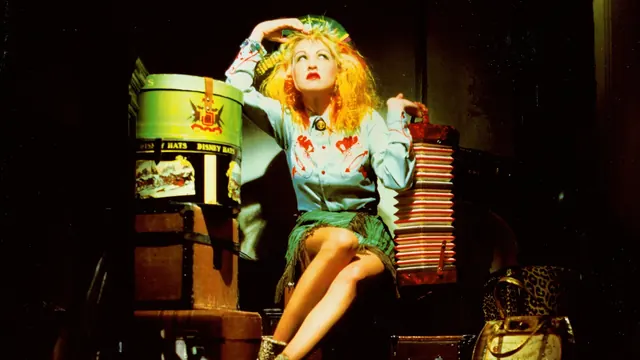
Cyndi Lauper is one of the original 1980s maximalists. Effortlessly mixing punk, vintage, and copious amounts of jewelry, the Girls Just Want to Have Fun singer paved the way for dressing for the female gaze in pop music and beyond.
For Lauper, nothing was off-limits for expressive modification, including her mane of colorful hair and artfully experimental makeup. Now, in tandem with the 40th anniversary of her sophomore album True Colors, the Grammy, Emmy, and Tony winner is hosting Cyndi Lauper: Suitcase of Memories, a two-part auction kicking off Oct.
22, at Bonhams.
The sale includes items like the True Colors newspaper skirt, worn on both the album cover and the accompanying music video. Laura Wills, founder of the popular shop Screaming Mimi’s and friend to Lauper, helped create and style many of her early outfits, like the aforementioned skirt.
Then there’s the leopard-print pajamas worn in the Girls Just Want to Have Fun music video, or the red plaid dress and jewelry Lauper wore at the first-ever MTV Video Music Awards in 1984.
But that’s not all: there will also be jackets and skirts from Alexander McQueen’s Spring 2008 collection and a white bustier from Vivienne Westwood’s Spring 1996 Les Femmes Ne Connaissent Pas Toute Leur Coquetterie collection, all from Lauper’s personal closet. “I just think it’s time to share all of this stuff,” Lauper tells us by phone ahead of the auction.
In honor of the sale, we caught up with the icon to chat about personal style, DIY fashion, her early outfits, and much more.
On the most surprising thing she found in her archives…
“The newspaper skirt! I thought I lost it. When I found it at the bottom of the trunk, I couldn’t believe it. There were things I thought I lost because I moved, and I had to go here and there, and my kid was born. So all of a sudden, what you [once] saw as so important wasn’t anymore because somebody else was there, which always happens when you have children.
On the book that inspired her style in 1985…
“I went to a bookstore, Rizzoli’s, and I found Image Makers: Sixty Years of Hollywood Glamour [written by Paul Trent and designed by Richard Lawton, 1972]. I looked through Image Makers because my face, to me, was a weird face with big fat cheeks, and I didn’t even know how to make that look good.
So I went through history, I went looking for fat cheeks, right? I noticed that in the ’20s, there were people with these round faces, and I started to look at the makeup.
Because what I was doing in ’85 and ’84—and even parts of ’83—was working with this wonderful artist, Patrick Lucas, who, if you said to him, ‘I have this check shirt on, but could you do checks on my eyelids?’ He’d just look at me, and he’d go, ‘Yeah. Yeah.’ Or, ‘Could you try this?’ And he’d go, “Oh yeah, I could definitely do that.” And he was so creative, and there was so much color.”
On her obsession with tulle …
“Even when my clothes didn’t have color, I would add some tulle. And a lot of it.
I was inspired by the displays that Biff Chandler was putting up in Screaming Mimi’s, because I worked there. If I was going on stage, and it wasn’t colorful, my hair just wasn’t big enough, I would freaking tie the tulle on my head like Esther, the mannequin that was in the store who looked so fabulous and inspiring.”
On embellishment as performance art…
“At that time I was painting myself. I’d even go on TV in France, where you're supposed to stand there and sing or go ahead and dance. I would think, ‘What are you going to do during the solo?’ So I would ask them to bring a ladder out, and I’d play drumsticks on the ladder to the solo.
One time, I was so excited about what I could do, because I was an art major. Anyway, I had spray paint, and during the solo I spray-painted my legs. Sometimes you get the thought and you’re like, ‘What if?’ You have to figure it out. And part of figuring out how you do it is the art.
I thought, well, there’s a spray paint you use on your hair. If you could use it on your hair and live through that, maybe you could use it on your legs with white fishnets.
So that’s what I did. And I did it in France.
God bless the French. The visuals that I was able to do in France… I would talk them into it, and they would go, ‘Okay.’ I would think to myself, Okay, I love these people.”
On the iconic headdress and metal bra..
“I saw this one picture of Rudolph Valentino’s girlfriend, who was this silent film star, because there she was in the headdress and the beads all over her. I thought, ‘Oh, look at that.
That would be interesting.’ Laura Wills put together the beads and the metal bra, and it was beautiful. I can’t even believe that it was me, but it was me.
Annie Lebowitz saw that picture, and we wanted to work with her. We had a meeting, and I showed her Image Makers.
Next time I saw her, she brought a book on the French surrealists.”
On the evolution of her personal style…
“I still mix some vintage pieces, but when you’re younger, and you have an old house dress on, there’s a yin and yang. But if you’re an older person, with an older house dress, to me, it’s just all yang. Unless there’s a little twist there, it just becomes elegant and beautiful with a little mystery.
Listen, I still believe in mystery and fun when you dress. I have a disco ball in my bathroom, and I intend to put all the little disco balls on the ceiling, so that when I go to get dressed, it’s like a fucking party and you feel empowered.
You could say there are rules. Yes, there are.
But you have to use your eye, and you have to see the balance, and you have to understand that part of it. Because even if you’re doing deconstruction, it’s better to learn the construction and then deconstruct from there because then you have the foundation.”
On finding inspiration from her family…
“My whole family was in the fashion business when there was a fashion district that was really big in New York. They were the seamstresses, cutters, pattern-makers.
My uncle started in the industry, and then he worked his way up to a cutter. And then from a cutter, he worked his way up to a really terrific pattern maker who was sought after.
Then he became a coat designer. Actually, I have one coat that he made for my aunt, and she gave it to me.
I came from Italian people. My first relative who came here, she was a seamstress, and that’s how she earned her money.
And then she met my uncle, and the two of them worked in the industry, and then brought over the other members of the family.”
On finding fashion inspiration in New York…
“I love the different cultures. I feel very blessed to have grown up here in New York where I could go to Chinatown. I think that’s part of how I dress even now, if I go to a different part of town. I love looking at people, I love walking in Central Park and hearing all different languages.
When I did the Hey Now video, my dress was made from sari material that I found in Little India. Well, it’s not there anymore.
It’s getting shrunk, shrunk, shrunk. I bought it in a shop where they sold saris.
And of course I didn’t realize that you don’t dry clean that stuff here. All the women that buy saris take their saris back to India to clean, not here.
But I still have it. It’s part of the history of what we did.
And that video I’ll never forget because I directed it, and we were able to take all of those wonderful influences that we had in New York City, and we still kind of do. We had that whole rock ‘n’ roll thing that was going on downtown, now, the East Village.
It moves all the time because rents go too high and then they exclude the developing artists. Without the developing artists and developing ideas, unfortunately, you become a very stiff, sterile, ill place.”
On accessorizing…
“Jewelry accessorizing is very important, young lady, and you know it because I’ve seen how you dress. But accessories are important.
Laura found an Italian waiter’s jacket. I love stuff like that, the very working-class stuff that then you put these brooches on it and it changes everything.
Or a hat with not a lot happening, but then you start to put some pins on it. I love hats.
In fact, in 1986, I went into a vintage shop and Lennie Petze’s wife, Cecile Petze, walked me in and said, ‘Cyndi, look up at the ceiling.’ And on the ceiling were all these fantastic old hats. They were so inspiring.
I think I bought them all, and then that became very much a part of my look for the whole True Colors launch.”
On her love of corsets and padded dresses…
“A lot of that was Laura, who was taking these old corsets and dyeing them to these incredible colors. Some of those corsets were like dresses, so that’s how I wore them.
When I performed, I wanted layers so I could remove one, and I was removing something emotionally. When you sing, you’ve got to open a vein.
If you want to really connect with people, you can’t be afraid to be a human being and let all of it come out of you. But it was fashion, my dear.
Even still.
I got a lot of shit for this dress that we stuffed the first time I played the Garden. We stuffed the bottom of this dress, and it was like a balloon dress, which, at that time, balloon dresses were starting to happen.
And underneath was the corset dress, which enabled me to be free and move. When I first had the idea of wearing the corset, I thought that a corset is something that they put around women, kind of like shoes that deform your feet.
Like foot binding.
So I thought to myself, okay, I’m going to wear it as a blouse. I’m going to demystify this shit.
I’m going to wear it as a blouse, and I’m going to start to wear chains. And chains were big at that time, but I wanted to wear a chain around my ankle because, to me, growing up, watching the women in my life and what they were and weren’t allowed to do—we were the servants, the free domestic help.
We cooked and cleaned and did all this. You’re going to spend your life at the sink, which, of course, wasn’t my plan.
But I didn’t want to lose the fact that that’s where we came from.”
On her DIY fashion culture…
“I wore a chain as a belt, but I didn’t have enough money to buy other chains. So I would go to the church ladies where they’d sell all their rhinestone chains. And I would buy a lot of rhinestone chains, string them together, and then wear them on top of the chain. My mother would get a Simplicity pattern, and then we’d adjust the pattern to the thing we saw in the magazines.”
On letting go of things in her wardrobe…
“I sold a lot of the headdresses. I want to have a headdress dinner party where you have a headdress, and we all eat and watch Ziegfeld Follies and have some elegance.
I think hats are fun and you don’t have to have just one. I love hats.
That’s why I bought the whole ceiling [of hats], but I let those go. There are a few things I kept just to have, but most of it I let go.”
On the designer and artist that shaped her…
“The first time I went to England, I ran into the Vivienne Westwood shop. I got a skirt and a shirt, and I just thought, I have Vivienne Westwood.
I really think she was something else. I always say, ‘As long as I don't look like a conservative person.’ Only because I don’t want to feel like I can't breathe.
I’ve worked with Gaga when she was first coming up, and all of a sudden I just started waking up a little bit, and I got excited again about clothing and things. You go through slumps, and then you wake up again.
She was one of the kids that woke me up.”
On her next era of style…
“I’m going to wear what looks good on me, and I think that it’s harder for older women. You don’t want to lose your Bohemian roots. That’s what I always want to hold on to, the artist way, the artist look, as opposed to just... Let’s face it, sometimes you have to do something, you have to dress in a suit, but you don’t want to.
I use color and the lack of color for certain things. I still wear bracelets, and they jingle and make noise.”