
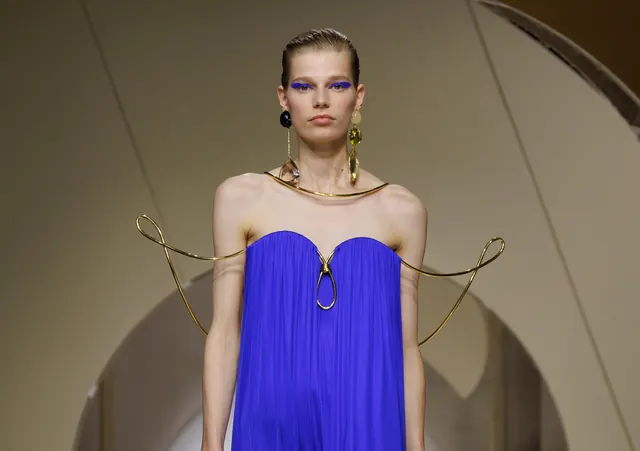
Sarah Burton has already established one rule at Givenchy : tailoring is non-negotiable. For Spring/Summer 2027 , she simply set to see how far she could take it, sending out a wardrobe of oversized coats, sculptural dresses, sharply cut suits and leather that hugged, draped and reshaped the body.
“I wanted a sense of balance and clarity,” Burton says of the collection, “A wardrobe to bring precision and simplicity to dressing as we speed through the multiple perspectives and perpetual motion of all our lives.”
That sense of structure was everywhere, but it came with a distinctly playful edge. Pinstripes were worked into sharply tailored looks, while coats and trenches arrived with generous proportions and sculptural construction. Asymmetrical cut cocktail dresses introduced dynamic geometry, running parallel to an expansive use of leather that moved across sharp utility jackets, bodycon silhouettes and fluid, wide-legged trousers.
Belts wrapped around almost everything, from tailoring to dresses, with some featuring what looked like a tiny powder compact as their central buckle, while others were reduced to brightly coloured knots cinching the waist. Bags arrived in rounded crescent moon shapes in shades including cobalt, white and chartreuse, with fringe versions echoing the movement of the clothes.
Then came the jewellery — or perhaps extensions of the clothes themselves. Several dresses were punctuated by elaborate gold structures curling outwards from the chest and shoulders, almost botanical in form, while oversized floral motifs appeared on garments and evolved into dandelion-like embellishments on heels.
The footwear also included Burton’s updated Shark Pinch Boot, with a front zip that could be worn open to expose the leg, giving one of Givenchy’s most recognisable shoe shapes a considerably more relaxed attitude.
The colour palette refused to behave modestly either, serving up bright red, cobalt and electric blue hues, joined by pinks and flashes of white, sometimes appearing in full looks and elsewhere colliding within the same outfit. Towards the finale, texture became the main attraction as elaborate embroidery, beading and long fringe transformed the evening pieces, culminating in two heavily flower-embroidered kimono-style gowns.
One travelled from vivid pink into white in a soft bleeding gradient, while the other offered a darker interpretation of the same floral excess.
Discover the Spring/Summer 2027 collection here .
photography. courtesy of Givenchy words. Gennaro Costanzo
Loewe ’s new creative chapter is starting to look increasingly comfortable in real life. Jack McCollough and Lazaro Hernandez describe Spring/Summer 2027 as a proposition for dressing, asking: “How does this new Loewe language become a wardrobe?” The answer for the duo resides in an essentials wardrobe, filling the runway with striped shirts, anoraks, polo shirts, boat shoes, soft tailoring and plenty of pieces that could plausibly make it into a Monday-to-Friday rotation.
“It’s an old-world – new-world conversation,” the designers explain, bringing together Modernist colour blocks, Spanish Baroque gestures and the American pragmatism that shaped their own sartorial references.
The show itself took place inside a circular, two-tiered arena at the Château de Vincennes, designed by Casper Mueller Kneer to evoke amphitheatres, stadiums and theatres, with zigzagging benches placing the audience unusually close to the clothes.
Tailoring is consequently given plenty of attention, but with a much lighter hand than the word might suggest. Striped jackets and shirt dresses are rendered in skived leather, shaved down to a lighter summer weight, while familiar trench coats and knits acquire those extraordinary moulded resin collars that quickly became one of the show’s most memorable details.
Three-dimensional and detachable, the collars are formed from resin and finished by hand with more than 20 layers of varnish in shades of blue, yellow, red and an iridescent finish reminiscent of sunglasses.
The wardrobe’s more recognisable basics were given equally playful treatment. Polo shirts were cut backwards on the body, anoraks appeared in silk and a basketball jersey became the first layer for a chiffon slip dress finished with beaded fringing. Sunglass-like resin details also appeared on knitwear, while boat shoes were softened with contrasting laces.
For the glass-beaded elements, the design duo collaborated with LOEWE FOUNDATION Craft Prize 2025 finalist Cécile Feilchenfeldt . Glass beads were woven directly together without a base fabric, creating sheer surfaces that shimmered and shifted as the wearer walked; one dress requires almost 85,000 individual beads and around 300 hours of work.
Lightness continues in these sheer dresses and skirts, wrapped and tucked with the spontaneity of a beach towel, while familiar florals on satin scarves flare out from taleguilla-style pants, chinos and dresses to balance the elaborate handcraft with coastal New England ease.
The new Puzzle Featherlight Charm takes the house’s signature Puzzle and stretches it into an ultra-supple East-West shape with a zipped compartment and back pocket, available in Featherlight Nappa Lamb, suede and glossy crocodile. Its keybell holder can also be loaded up with charms and found objects, which feels particularly appropriate for a collection so invested in personality.
The new Pasito bag goes in another direction, draping a supple nappa dustbag over a classic box construction, while the Amazona 180 is softened in similarly supple leather. There was plenty happening below the ankle too, from loafers and stilettos to softened boat shoes and heels finished with paper-thin satin bows.
Discover the Loewe Spring/Summer 2027 collection here .
photography. courtesy of Loewe words. Gennaro Costanzo
There is a Japanese word that feels almost impossible to translate without losing something in the process: ‘ma’, the space between things. At Issey Miyake , that figurative space became the whole point of Spring/Summer 2027 .
For ‘Figure of Ma’, Satoshi Kondo explored what happens in the gap between fabric and body — and how much freedom can exist there — opening the show with a performance by Tess Voelker , where dancers moved across a reflective runway before the clothes themselves emerged from beneath a vast veil.
Garments ballooned, billowed and bounced around the body, with air becoming almost another construction material. Some of the draped silhouettes brought to mind the generous folds seen on classical statues, fabric gathered and moulded around the body before falling away again. Others took the idea much further, creating enormous rounded forms that seemed to inflate as their wearers walked.
Colour kept the collection feeling buoyant, with vivid yellows, purples and blues dominating the runway alongside lighter and darker shades. The saturated palette worked especially well against the black, mirrored setting, where every passing silhouette appeared twice and the colours seemed to hover beneath the lights.
Kondo also returned to one of Issey Miyake’s most recognisable techniques: pleating. This time, the folds came in different scales and directions, with some pieces resembling sheets of crumpled paper while others bounced vertically around the body. ‘Tempo Pleats’, one of the collection’s key series, uses horizontal pleats that spring back with movement, while ‘Caprice’ layers differently coloured sections into swaying, semi-sheer forms.
More sculptural pieces kept the contrasts high, with ‘Balloon Twist’ pieces hand-twisted and bound with moulds inserted into the cloth, trapping air between the material and the body. Meanwhile, ‘Draped Ensemble’ reduced construction to a single lightweight piece of fabric wrapped and gathered into shape — washi (traditional Japanese paper).
Voluminous, fine-nylon Ballooning windbreakers featured a short-front, long-back pattern cut equipped with drawstrings to draw in air with every stride, running parallel to the Bubble series, which showcased translucent organza hand-painted by artisans in Kyoto using a floating ink-marbling technique to replicate the slick surface of a soap bubble.
One of the collection’s most fascinating developments came in ‘Cocoon Body’, created with Wacoal using a three-dimensional moulding process originally developed for lingerie. Melted resin is sprayed onto a torso mould, with the resulting shape preserving traces of the draping process itself; the material even contains 60 per cent plant-based resin, while excess material can be recycled back into production.
The footwear and accessories choices kept that focus on natural human movement going. The show debuted the Camper × Issey Miyake Peu Lift collaboration , a project that re-engineered Camper’s classic barefoot-feeling shoe.
Discover the Issey Miyake Spring/Summer 2027 collection here .
photography. courtesy of Issey Miyake words. Gennaro Costanzo
After five years of Nicolas Di Felice ’s sleek, Space Age minimalism, Drew Henry has opened the Courrèges archive back up, reaching beyond the familiar vinyl mini to the more experimental spirit of the early 1960s. Henry’s debut Spring/Summer 2027 collection for the house takes a colourful route towards the future, presenting a wardrobe that feels wonderfully easy to play with: tunic dresses, oversized utility trousers, sculptural hats and a generous dose of primary colour, all tied together by the house’s unmistakable graphic codes.
There was plenty of Sixties shorthand throughout, from crisp white ankle boots and high collars to short, straight dresses and long tunic-like silhouettes that appeared across both womenswear and menswear. But Henry gave these references a more functional attitude, loading pieces with pockets, buttons and belts. The Courrèges logo appeared proudly on front pockets, reviving the house’s historic 1967 AC lettering as another archive detail brought back into circulation.
Multiple button openings appeared across garments, allowing elements to be fastened, loosened or repositioned, while strips of fabric were set loose around tops and skirts so that they fluttered as the models walked. The materials kept that sense of construction going: vinyl and PVC returned alongside knitwear, with some vinyl trousers assembled from contrasting panels and softer pieces bringing a welcome change of texture.
The colour palette was wonderfully expressive, leaning into a bold composition of primary reds, deep blues and sunny yellows. These intense core tones were broken up by vibrant flashes of apple green, hot pink, clean white and bright citrus orange, applied across an eclectic mix of matte textures and glossy finishes.
Some looks went almost entirely monochrome, letting one saturated shade carry the silhouette, while others stacked contrasting blocks of colour for the graphic combinations that made the house famous in the first place.
Accessories were having their own fun. Belts appeared over dresses, coats and trousers, sometimes functioning as part of the construction, while a series of wonderfully odd mushroom- or bucket-shaped hats in PU leather brought an element of surrealism to the Sixties vocabulary.
A few looks were finished with gridded garlands of 3D, flower-like applications that crawled across the legs and feet of the closing looks, adding soft, organic shapes to an otherwise highly graphic wardrobe.
The set was made up of 450 mismatched chairs sourced from different decades and contexts, each with its own history. Courrèges writes that SS27 was truly conceived for “a sense of play,” describing the collection as a celebration of “the freedom to wear what makes you happy, not having to justify the things you love.”
Discover the Courrèges Spring/Summer 2027 collection here.
photography. courtesy of Courrèges words. Gennaro Costanzo