
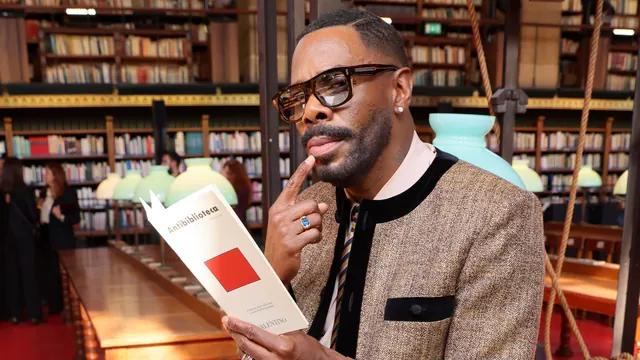
Fashion week is built around looking, but Valentino wanted its guests to do a little reading, too.
While a show invitation usually tells you where to be, when to arrive, and sometimes offers a cryptic clue as to what awaits on the runway (for Dior, it was a walnut. At Schiaparelli, a Kandi friendship bracelet); at Valentino’s spring 2027 show, Alessandro Michele asked guests to bring along a book.
“New or from your own library,” read the small green card tucked inside the invitation. After the show, the collected volumes would be donated to local libraries.
The collection was presented under the title Antibiblioteca: Catalogue of the Unread, making its front row into a reading list of sorts. If clothes can tell you something about a person, as even Michele knows, their bookshelf might tell you even more.
A printed compendium of imaginary-sounding books accompanied the invite—from The Hand That Slows Down to Write to Keeper of a Light No Ship Needs Anymore—which provided a clue to the thinking behind the show. While looks at the show leaned into the designer’s ethereal, romantic spirits, this was also an exercise in literary self-portraiture.
Forget the It-bag—for a moment, anyway—because the most telling accessory today in Paris was the book you were readying yourself to part from.
Beka Gvishiani, founder of Style Not Com, brought Chanel Solitaire by Claude Baillen
I’m bringing a memoir by Claude Billen (Delay), published in 1973, dedicated to her dear friend Gabrielle Chanel. Claude is Coco Chanel’s last surviving friend, and it’s fascinating to read about the greatest fashion icon through the eyes of a friend.
Francesca Ragazzi, Head of Content at Vogue Italia, brought Lui! by Natalia Aspesi
This is where I studied literature and breathed in freedom, convinced that the future belongs to women. But we must never let our guard down: Natalia Aspesi’s words in this 1978 book are more relevant today than ever.
Cynthia Erivo brought Giovanni’s Room by James Baldwin
I adore James Baldwin, and I believe this is one of the most beautiful love stories ever written.
Lorenzo Zurzolo brought Ragazzi di vita by Pier Paolo Pasolini
I chose to donate Ragazzi di vita by Pier Paolo Pasolini because he’s one of my favorite authors; it’s set in Rome, my city; and it’s a story of friendship, freedom, and coming of age—but above all, it’s a book that reminds us how important it is to see and listen to those who live on the margins. It’s a novel that, even years later, remains relevant.
Samara Weaving brought Evenings and Weekends by Oisín McKenna
Nicole Phelps, Global Director of Vogue Runway and Vogue Business, brought Dalí. L’œuvre peint
I would have brought Basin and Range by John McPhee, but I haven’t finished it yet. So, instead, Luke Leitch picked this book out for me from the “take a book, leave a book” shelf at his bohemian hotel. Dalí strikes me as exactly the kind of artist that Alessandro Michele, at Valentino, might appreciate.
Luke Leitch, writer at Vogue Italia and Vogue Runway, brought an old French catalog of works from the Uffizi
Valentino has its roots in a certain idea of Italian beauty, so when I saw this old French catalog dedicated to the works housed at the Uffizi in Florence, I immediately chose it. I took the book—with the management’s permission—from my go-to hotel in Saint-Germain, La Louisiane, a sort of Parisian Chelsea Hotel, before it, too, was swept up in gentrification.
It’s the hotel where Sartre and de Beauvoir lived, and its regular guests have included Henry Miller, Miles Davis, and Jim Morrison. All of this helps make its guest library particularly interesting: so thank you to La Louisiane for donating this book to Valentino.
Dan and Livia from Atlas of Shows brought Exercises in Style by Raymond Queneau
Books are a source of pride, a burden, and a tool for us. A source of pride because we love them: we love their stories, their content, but also the books themselves, as beautiful objects.
A burden because, as physical objects, they’re bulky, heavy, and there are so many of them. Finally, we’re architects and we use them constantly as research tools: they’re invaluable and irreplaceable.
We often like to give books as gifts because they carry a message: one that speaks to us and one intended for the recipient. It’s an entire silent exchange condensed into a single object.
We decided to choose Exercises in Style by Raymond Queneau from our bookshelf: the exact same story told 99 times, each time in a different way. Each version feels like a completely new story, simply because of the way the narrative style unfolds.
With fashion, it’s not all that different: a fashion show is still a fashion show; the models walk the runway. It’s the way the story is told that makes each show unique. For us, this happens through the set design.
Marta Oldrini, Fashion Market Editor at Vogue Italia, brought Leonardo Sciascia’s Il Giorno Della Civetta
I decided to bring a classic by Leonardo Sciascia, Il Giorno Della Civetta, which I had read for the first time in high school and which, at the time, I hadn’t particularly enjoyed. A few months ago, I started revisiting some of the books I’d read back then, to see what happens when you encounter them again, many years later, with a different age and sensibility.
Vanessa Scalera brought Memories from the Underground by Fyodor Dostoevsky
It reminds me of the most turbulent period of my life—adolescence: a striking encounter with the protagonist. It satisfied my sense of alienation, rebellion, and rejection of conventions. It tackles themes typical of growing up. Who am I? Why do I want to be alone and yet, at the same time, long for others?
Yukari Tsukahara, Social Director of Vogue Japan, brought A Night on the Milky Way Train and Other Stories by Kenji Miyazawa
I always travel with this novel, A Night on the Milky Way Train and Other Stories by Kenji Miyazawa. Simple yet philosophical, it’s a book that contains some of the stories many Japanese people encounter during their school years.
The title story follows two boys who board a train traveling through the galaxy and set off on a dreamlike journey. Welcome to Miyazawa’s fantastical world, where nature, imagination, and a quiet sense of morality coexist.
Patrick Pendiliuk, Fashion Features Director at Vogue Germany, brought The House on the Cliff by Riley Sager
I don’t think reading always has to be about depth, education, or something particularly uplifting. Sometimes you just want to let yourself be swept away by a compelling story.
I’m not usually someone who gets swept up by BookTok or viral literary trends, but I’d heard so much about Riley Sager’s The House on the Cliff that I finally decided to give it a try. And I have to admit—albeit with some reluctance—that it really is that incredible.
Even during Fashion Week, when I was getting far too little sleep, collapsing into bed at the end of the day, and catching 6 a.m. flights, I still made time to read it. Everyone deserves a book that keeps you glued to the pages, even when you really should be sleeping.
Michela D’Angelo, Stylist and Fashion Market Editor at Muse Magazine, brought Uncanny Valley by Anna Wiener