
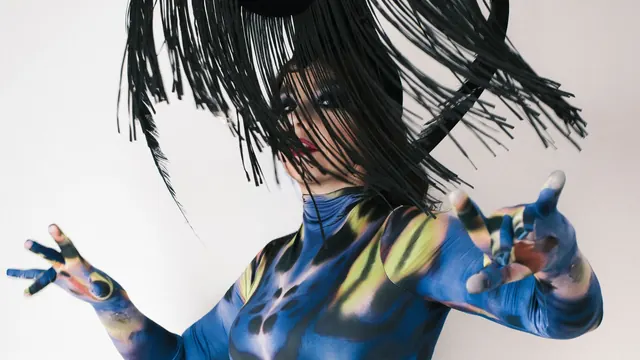
In perhaps the most fashionable scheduling conflict ever, Björk couldn’t attend the latest Mugler show, one that she inspired, no less. Alas, she was in Bielsko-Biała, Poland, for the opening weekend of her touring exhibition Björk: Ancestress, Sorrowful Soil & Nerve Bloom (remix), performing a special DJ set that closed the Wędrujący Festiwal.
So the Icelandic artist did the most Björk thing possible: she wore a look from the collection the same day it debuted in Paris. Who needs front-row pomp when you have a Polish market full of ravers?
For this latest rendezvous, styled by longtime collaborator Edda Guðmundsdóttir, Björk became Mugler’s satellite record-spinning model in a purple butterfly-print second-skin top and black leather corseted high-waisted skirt. Above it hovered a magnificent bit of house history: a fringed feather headpiece from Manfred Thierry Mugler’s spring 1997 haute couture collection, Les Insectes. The result collapsed nearly 30 years of Mugler into one silhouette: part woman, part extraterrestrial.
“I am so honoured to be wearing clothes from the mythological Mugler,” Björk tells Vogue, recalling seeing the house’s work up close at an exhibition with her makeup artist Hungry and marveling at its “miraculous craft, textiles and patterns: biological sci-fi galore!”
“The collection began with primal instinct, this idea that everything ultimately returns to nature,” Mugler designer Miguel Castro Freitas told Vogue backstage at the show. “There is an inherent tension within us all, a desire for pleasure that exists beyond reason or restraint.”
On the runway, organic Art Nouveau lines imparted wicked curves onto suiting, sculpted Mikado silk nodded to ’60s futurism, and feathers masqueraded as cheetah spots beneath organza. Synthetic hair cascaded down a dress; décolletages resembled insect anatomy; translucent flowers made from plastic bottles sprouted from crocodile-embossed tailoring.
Suddenly Björk’s omnipresence made perfect sense. Titled Naturalia X, this collection is the third and final installment of Castro Freitas’s A Trilogy of Glorified Clichés, proposing nature as less wholesome or pastoral, more saucy, psychedelic, and occasionally menacing.
“Her raw emotion, radical freedom and untamed spirit have always been a source of inspiration,” Castro Freitas added. He sees a kinship between Björk and Mugler’s founder in their shared “refusal to conform to conventional ideas of beauty or glamour.” Translation: both are one of one.
While she may have been DJing many miles away, the singer was certainly at the Mugler show in spirit. Thirty-two screens surrounded the runway with Casper Sejersen’s remixed imagery from her songs “Possibly Maybe” and “Venus as a Boy.” Minutes before the show began, Italian composer Teho Teardo told Vogue how Björk had entered his score.
“We invited Björk to collaborate, but she was busy,” said Teardo, a longtime collaborator of Castro Freitas who has created the soundtracks for each of his shows for the label. Instead, she gave him permission to use one of their existing tracks, which he completely reimagined.
Choosing it proved more visceral than intellectual. “I felt something in that voice that was calling me, like an external force saying, ‘Come here, come on through,’” he said.
“It was as if she was saying, ‘Hey, come close.’ So I got close.”
Björk has long made the case for fashion as connective tissue between sound, body, nature, technology, and fantasy. She also exists as many a designer’s favorite artist.
Alexander McQueen, Hussein Chalayan, Iris van Herpen, Marjan Pejoski, Bernhard Willhelm, Olivier Rousteing, Jonathan Anderson, and Robert Wun are among those who have entered her creative orbit. McQueen’s cyber-geisha creation for her 1997 Homogenic cover is embedded in fashion history.
More recently, she wore a Robert Wun ballooning couture piece for her Icelandic solar-eclipse rave.
Today’s pop stars with their endless brand deals and ambassadorships could never. Dressing Björk reads less like a press hit than a designer career high. The transaction tends to work both ways: whatever enters her orbit invariably comes out looking more Björk than anything else.
Backstage just after the show, Castro Freitas was still processing that Björk was simultaneously performing in his clothes hundreds of miles away. “For me, it’s very emotional,” he said, almost at a loss for words. “She has been one of my favorite artists ever.”
When he and Teardo first approached Björk’s team, “we got that very enthusiastic reaction from her side. For me, it meant the world.” And rather than identify one look as particularly Björkian, he sees her influence threaded throughout.
“The whole collection somehow reflects the way her music and her persona have informed and inspired me throughout my career, without being so literal,” he said. Like an onion, he explained, the references come in layers.
Back in Bielsko-Biała, the exhibition was similarly spilling beyond conventional confines. Following its Reykjavík premiere, the exhibition places three large-scale audiovisual installations, Ancestress, Sorrowful Soil, and the new Nerve Bloom, across three locations in the Polish city. Björk’s appearance at the festival-closing Rave na Targowisku extended that idea onto the open-air dance floor, making her the first person to wear Castro Freitas’s latest out in the world.
“A runway is always a special moment,” Castro Freitas says, “but what matters most to me is how the clothes live beyond it.”
Fashion has spent decades pinning Björk to the moodboard. Just don’t call her a muse, a label she has balked at as reductive rather than reflecting a creative exchange.
Castro Freitas is careful not to. “Björk is far more than a muse to me,” he said.
“She is a symbol of self-expression and absolute freedom.” For a legacy house and legacy artist both built on metamorphosis, there could hardly be a more Muglerian proposition than that.
“It was a tall order for Miguel to express that fantasy as a confident continuation of the archives, but he nailed it,” Björk said. Pairing his work with the archival headpiece, she says, “was magical.” Talk about high praise.