
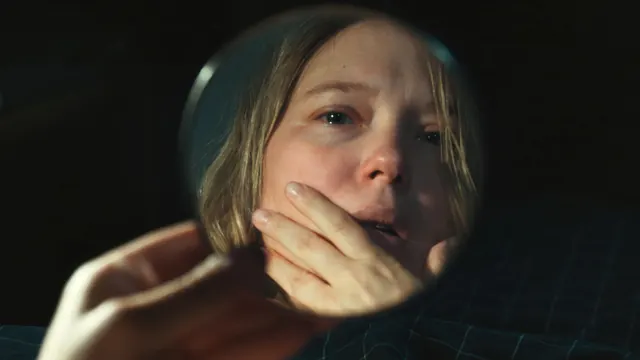
Recently, Léa Seydoux was in a bathroom in New York when a woman—“very American, face full of makeup”—approached her with the nagging feeling that they had met before.
“I feel like I know you,” Seydoux remembers her saying, briefly slipping into a nasal American accent. “I’ve seen you somewhere.”
Seydoux, who has spent nearly two decades appearing in some of the world’s biggest films (including installments in the Mission: Impossible, James Bond, and Dune franchises), didn’t rush to solve the mystery for her. “I was like, ‘Really?’” she recalls, clearly amused by the encounter. After scrutinizing Seydoux’s face, the woman eventually decided that she simply reminded her of somebody she knew. “She couldn’t really place me.”
It’s an apt anecdote for Seydoux to relay while discussing The Unknown, Arthur Harari’s eerie, shape-shifting new film that premiered in May at Cannes, played at the Toronto International Film Festival last month, and is currently screening as part of the New York Film Festival.
In it, the fixed markers of identity begin to unravel. Niels Schneider plays David, a withdrawn Parisian photographer who meets a mysterious woman, played by Seydoux, at a party.
After an impulsive sexual encounter, he wakes up to discover that he is somehow inhabiting her body. But what begins with the pulpy mechanics of a body-swap movie settles into something stranger and more unsettling: a film about the gulf between being inside a body and being perceived from the outside.
That kind of premise is especially enticing to Seydoux. She met Harari, the Oscar-winning cowriter of 2023’s Anatomy of a Fall, years before shooting began, when he was still developing the story alongside the graphic novel the film is based on. “He just told me about this idea, and I was like, Okay, wow, this is really very original,” she says. “I like projects where I feel that they will be a challenge.”
Seydoux has three films making the festival rounds this season: The Unknown (set for release early next year), the Zellner brothers’ deadpan alien comedy Alpha Gang, and Marie Kreutzer’s psychological drama Gentle Monster (which will stream on Netflix in November). All three played at the Toronto International Film Festival this month, and when we meet one morning in Toronto, she’s clearly exhausted.
The projects may differ wildly in tone, but they circle some of the same questions. When we last spoke, around the release of Bertrand Bonello’s 2024 film The Beast, she was starring in another work in which identity, desire, and the borders of the self become slippery. “I’m drawn to stories that have a metaphysical dimension,” she observes.
Metaphysical, philosophical, resistant to easy definition: Seydoux seeks these qualities out not because she wants a movie to provide answers, but because she prefers that it not. “I like films where, as a viewer, I can come and make my own film in a way,” she says.
“I don’t like films when the director tells you how to think. I don’t like to be manipulated as a viewer.” She pauses.
“I need to feel that I have my own space.”
Her career has moved fluidly among French auteurs, blockbuster franchises, sci-fi, melodrama, romance, and the more unclassifiable reaches of international art cinema, all while eluding typecasting. Nor has she ever seemed inclined to trade on her much-photographed movie-star beauty, which is no less striking in person.
“I’ve never been this kind of actress to play, like, ‘Hello, hi, welcome here,’” she says, chuckling at her own performance of uncomplicated geniality. “I’ve never played the girl next door.” (A poster for the 2024 rom-com French Girl, with Zach Braff and Vanessa Hudgens, watches over us from a wall in the production offices where we’re speaking.)
Early in her career, people did try to put her in those familiar boxes. “I was never, never chosen,” she says of auditioning for television and more conventional parts. “I couldn’t really play them. It really didn’t fit.”
Things changed, she says, once she began meeting filmmakers with singular visions. Now, when Seydoux chooses a movie, the role itself is almost beside the point.
“Never the character,” she says immediately when I ask whether, at this stage in her career, she is drawn first to a part or to the filmmaker. For Seydoux, working with a director is a kind of conversation.
“You want to talk about this subject? Let’s make a film, let’s explore together,” she says.
The question she asks herself is less Do I want to play this woman? than Do I want to inhabit this world? “And will I also be able to make my own film within the film?” she adds.
It’s an unusual way of thinking about acting, though acting is not exactly the word Seydoux would use for what she does. “I don’t act,” she says. “And actually”—she leans forward, a small grin revealing her famous tooth gap—“I don’t really know how to act.”
Seydoux never trained formally and doesn’t describe herself as a particularly technical performer. Instead, she talks about entering a film as though crossing into a parallel existence.
“When I do a film, I live inside it,” she says. “I really live the character’s emotions for real.” Cinema, in her formulation, becomes a collection of alternate lives.
“I see cinema as past lives or coming lives,” she says. “Let’s try and have another life for two months.”
That’s a fitting philosophy for The Unknown, a movie in which another life is not a metaphor but a waking nightmare. David’s transformation scrambles gender, desire, power, and the seemingly straightforward relationship between a person and the face everyone else recognizes as theirs.
Seydoux knows something about having a face that others feel they already know. Growing up, Seydoux understood, on some level, that she was pretty—“jolie,” as she puts it. “I knew it, and I didn’t know it.” But she says she never built her identity around it. “For me, this thing—as fame, for example—it’s not something that I used as power over people.”
Beauty and celebrity belong, for Seydoux, to the same category: useful perhaps, sometimes enjoyable, but fundamentally fleeting. “I’m conscious of the fragility of things,” she says. “It’s éphémère anyway.”
In The Unknown, a body can inspire desire, fear, envy, or recognition, yet still reveal little about the person inside it. Seydoux has spent much of her career playing women who are looked at intensely—but she seems far more interested in whatever remains inaccessible.