
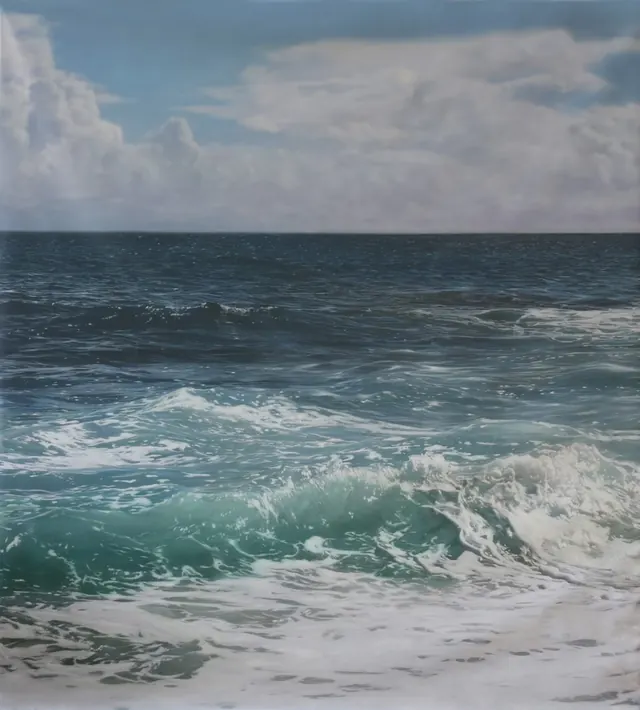
At first glance, some of Stephan Kaluza ’s paintings could easily be mistaken for photographs, with landscapes that seem close enough to touch or even step into. There is something inviting about them, as if they were offering a glimpse into an untouched world somewhere far away.
For his new exhibition ‘From Dust to Bloom’ at JD Malat Gallery in Dubai, the German artist returns to a subject that has followed him throughout much of his work: exploring nature and the way we see it. The exhibition brings together works from several of his series, each approaching nature in a slightly different way.
Kaluza starts with photographs he has taken himself, using them as the basis for paintings that do not necessarily depict a place exactly as it exists.
‘Transit 307’, oil on canvas, Stephan Kaluza 2026
The space between what is real and what we make of it has interested Kaluza for years. In his ongoing ‘Transit’ series, the natural world appears intact and almost idyllic. There are no obvious signs of destruction. Rather than showing what has already been damaged or lost, Kaluza focuses on the beauty that is still there and what it would mean for it to disappear.
Not every work in From ‘Dust to Bloom’ holds onto this idyllic image. In some, parts of the landscape appear distorted, almost as if a raindrop had landed on the lens of the camera capturing the scene. The ‘Sunset’ works take another approach, breaking familiar motifs apart until parts of the landscape begin to dissolve into abstraction.
Left. ‘Transit 320 (diptych)’, oil on canvas, Stephen Kaluza, 2026. Right. ‘The Disappeared’, oil on canvas, Stephan Kaluza, 2025
Despite these differences, it is easy to get lost in Kaluza’s work. It draws you into a version of nature that feels almost perfect, but one that could just as easily disappear. What first looked like a world you could simply step into becomes one that might not be there forever.
‘From Dust to Bloom’ by Stephan Kaluza is at JD Malat Gallery in Dubai from 17 th September to 31 st October 2026. Find out more here .
Left. ‘Transit 307’, oil on canvas, Stephan Kaluza, 2026. Right. ‘Transit 297’, oil on canvas, Stephan Kaluza, 2025
words. Alexandra Schmidt edit. Huma Humayun images. Courtesy of Stephan Kaluza and JD Malat Gallery
Irene Cattaneo + ‘Queen of the Night coffee table’, ‘Il Gardino Segreto’, 2026. Photography. Enrico Fiorese
For the German-Italian artist Irene Cattaneo , art is made to be lived with, a form that holds feeling long after the moment has passed. That conviction has never been more tender than in ‘Il Giardino Segreto’ (The Secret Garden): an immersive installation hidden within a walled Venetian garden, where a bronze swing hangs low over the greenery and sunlight filters through the leaves.
Produced by Lo Studio – Nadja Romain , the Venetian studio that represents her alongside Paris’s Galerie Gastou , it is her most personal work to date.
Cattaneo’s work grows out of lived experience: emotion, memory and the cities that shaped her. She was raised in Rome and later trained at Central Saint Martins in London.
“I’m hyper-emotional, a little bit of an oversharer. That’s very Italian,” she shares.
That side of her feeds an instinct for craft and material; the German half tempers it, tying each feeling back to an idea. Her work often begins with a word: a pun, a phrase turned over until it yields a shape.
The cloud recurs as her signature motif, a form that never holds still. “I express my emotion without it being about me,” she says, the feeling carried through a myth, a novel or a line of verse.
It all converges in her latest installation. Born of her new motherhood, ‘Il Giardino Segreto’ unfolds as a dream-like garden where the real and the imagined quietly blur.
The instillation turns on a single centre: the ‘Effie Briest’ swing set, a seat hung by chains from sinuous, root-like arms of patinated bronze. The title borrows from Theodor Fontane’s ‘Effi Briest’, which opens on a girl mid-swing, her fate already sealed by the reader’s foreboding.
To Cattaneo, it is “the hard balance of fun and risk, freedom and fall”. She made it in the first months of motherhood, and it holds both halves of that feeling at once.
‘Effie Briest swing set’ at ‘Il Gardino Segreto’, Irene Cattaneo, 2026. Photography. Enrico Fiorese
The rest of the garden turns on the same tension of early motherhood, the instinct to shield a child against the wish to let them go out and grow. A well of solid stone, set in dialogue with the garden’s old Venetian well-head, draws the eye downward to an illuminated inscription at its base: the phrase “well, well, well”, lighting the dark it might otherwise keep.
Snowdrops, cast in glass and bronze, stand as a tribute to her own mother. The first flower to break through frozen ground; they are an emblem of resilience and new beginnings.
In a pair of tables she calls ‘Pareidola’, the cloud returns to earth. Named for the child’s game of finding shapes in the sky, they turn ‘cloud’ into ‘could’, possibility made solid.
Everything here is made by hand, in the workshops of the lagoon. “There’s nowhere like Venice,” Cattaneo says.
“Here you can turn what you feel into something you can hold.”
‘Les Bienfaits de la Lune’, Irene Cattaneo at Galerie Gastou, 2025. Photography. Enrico Fiorese
Two people have been central to Cattaneo’s work. In Venice, that is Nadja Romain.
Before founding Lo Studio, Romain spent years producing film and art, working with Matthew Barney, Philip Glass and Harmony Korine. Lo Studio operates as a gallery, an advisory and a salon, dedicated to keeping craft traditions alive.
It was Romain who gave Cattaneo the nerve to attempt something this ambitious. “Nadja gave me my first carte blanche,” says Cattaneo.
But the work of realising it was far from straightforward. Coaxing the installation into a private garden, in a city that resists at every step, took three years.
“Venice is complex,” Romain explains. “It rains, and the city stops.” Romain reads Cattaneo’s work more closely than anyone.
“I saw the motherhood before she was even pregnant,” Romain tells us. “She was expressing something that was really there; she just wouldn’t talk about it.” That instinct is the foundation on which everything else is built.
‘Les Bienfaits de la Lune’, Irene Cattaneo at Galerie Gastou, 2025. Photography. Édouard Auffray
If Nadja Romain gave Cattaneo the room to create, Victor Gastou has given it to the world. With his father Yves, he leads Galerie Gastou, a Paris house that has championed the meuble-sculpture for four decades.
It is the gallery that has taken her name beyond Venice, to Paris and an international stage. “Victor brought it to another level,” Cattaneo says, “thanks to the historical credibility the gallery has, and it brought me outside of Venice, to Paris.” Her inaugural solo show there, ‘Les Bienfaits de la Lune’, drew on Baudelaire’s prose poem of a child blessed by the moon: the same literary instinct that runs through all of her work.
The alliance is a natural one: the gallery has long prized precisely what she makes, objects poised between sculpture and use. Gastou frames it almost as Cattaneo does.
“They hold such power,” he explains. “They elevate us, they inspire us.
These objects, this beauty, help us live.” Between a producer who grants her freedom and a gallerist who lends her lineage, Cattaneo has both liberty and a bar to clear. “Freedom and trust,” as she puts it, “but also an unspoken standard I have to keep”: the rare scaffolding an ambitious young artist needs.
Left. ‘Les Bienfaits de la Lune’, Irene Cattaneo at Galerie Gastou, 2025. Photography. Enrico Fiorese. Right. Irene Cattaneo. Photography. Ilaria Zago
That scaffolding is already carrying her onward. Before the year is out, Galerie Gastou is set to present her work at Design Miami Paris, PAD London and NOMAD Abu Dhabi, three of the fairs where collectible design makes its name.
‘Il Giardino Segreto’ marks a turning point, and Cattaneo knows it. “The biggest step for me is simply that now I’m aware of what I want to make.” Romain, who shares that conviction, sees the same horizon.
“What we’re seeing now,” she says, “is just the beginning.”
Find out more about Irene Cattaneo here .
words. Olivia Cichero edit. Huma Humayun
Jean Schlumberger at his working table, Hotel Regina, by Luc Bouchage, 1951, MAD.
Paris Fashion Week is on the horizon, but the most compelling line-up in town isn’t hitting a the runway this season. Instead, Tiffany & Co . is setting up camp in the French capital to launch a multi-year preservation initiative dedicated to the creative universe of the legendary jewellery designer Jean Schlumberger.
Partnering with the Musée des Arts Décoratifs , the luxury house is embarking on a monumental digital archive project to rescue, conserve and scan roughly 5,000 original sketches and 5,000 historic documents that have remained tucked away from public view.
To kick off the partnership, the duo has conceived ‘I Am Only a Pencil’, an immersive private exhibition curated in tandem with the Virginia Museum of Fine Arts that maps out the precise evolution from a simple stroke of graphite to a multi-million-pound high jewellery masterpiece. The installation pairs fragile, historical works on paper directly with the physical treasures they generated, focusing heavily on items recovered from the private collection of Schlumberger’s lifetime confidante, the renowned philanthropist and landscape architect Rachel Lambert “Bunny” Mellon.
left. Jean Schlumberger, sketch for the Jasmine necklace, 1961-2, MAD right. Jean Schlumberger, sketch for the Tulips necklace, 1959, MAD
Jean Schlumberger, Sketch for the Butterflies Bracelets for Rachel Bunny Mellon, 1956, MAD.
When Schlumberger joined Tiffany & Co. in 1956, he ushered in a new era for the house, bringing an eccentric and highly imaginative vocabulary of birds, flowers, marine life and fantastical forms to jewellery through an instinctive sense of movement, colour and wit. The exhibition follows these recurring motifs through a series of thematic displays, with Hedges and Flowers, Jasmine and Tulips among the creations shown alongside their corresponding designs.
Other sections explore the influence of Surrealism on his objets d’art and the role of couture in shaping his creative output.
The visual layout naturally culminates in a comprehensive study of the ‘Bird on a Rock’, arguably the most enduring high jewellery profile in modern history. The display brings out one of the very first iterations of the brooch ever manufactured — the personal piece belonging to Mrs Mellon, which features the signature diamond-set cockatoo balanced atop a striking lapis lazuli stone rather than the traditional citrines or aquamarines seen today.
left. Jean Schlumberger, Mermaid (Siréne) (Candlestick), 1969 right. Jean Schlumberger, Table Clock, ca. 1962
left. Tiffany & Co. Jean Schlumberger, Bird on a Rock brooch, 1965 right. Jean Schlumberger, Sketch for Sphere for Rachel Bunny Mellon, ca. 1964, MAD
Yet ‘I Am Only a Pencil’ is about more than revisiting a celebrated chapter in Tiffany’s history. By bringing fragile original drawings and archival material together with the finished jewels they produced, the exhibition also preserves the less visible stages of jewellery design — the sketches, ideas and experiments that might otherwise disappear long before the finished pieces do.
The wider archive initiative extends that idea considerably, ensuring that thousands of Schlumberger’s original works survive not simply as records of Tiffany’s past, but as a source of inspiration for the designers and researchers still to come.
The ‘I Am Only a Pencil’ exhibition was presented privately to invited guests in Paris on September 28, with selected material from the wider Jean Schlumberger archive initiative to be made accessible digitally. Find out more here .
photography. courtesy of Tiffany & Co. and Musée des Arts Décoratifs words. Gennaro Costanzo
From the star-studded sandy beaches of the Côte d’Azur to the lavender-filled fields of Provence, the South of France holds many attractions for visitors. Over the years, the dramatic landscapes – and a quality of light that must be seen to be believed – have also drawn in artists of the likes of Van Gogh, Cézanne, Matisse and Bonnard, each of them leaving behind a legacy.
Today, the area’s art scene continues to thrive, from Les Rencontres de la photographie d’Arles to countless prominent galleries and museums. Even a small town such as L’Isle-sur-la-Sorgue in Vaucluse, Provence, is home to contemporary art museums well worth visiting.
But this is also a place where art and hospitality go hand in hand and where many hotels are more than a place to simply rest your head. Schön! alive highlights three destinations where art and design are as much part of the experience as fine dining and feather pillows.
See the full feature now only in Schön! alive .
Where art becomes hospitality. Toile Blanche is both a boutique hotel and a living gallery, where contemporary art is woven into every corner of the property. images. Courtesy of Toile Blanche toileblanche.com
Renzo Piano Pavilion. Set among Château La Coste’s vineyards, the pavilion reflects the estate’s unique dialogue between contemporary architecture, art and the Provençal landscape. photography. Stéphane Aboudaram / WEARECONTENT(S) opposite Oscar Niemeyer Pavilion. One of several architect-designed landmarks at Château La Coste, its flowing concrete forms and glass walls reflect Niemeyer’s unmistakable modernist vision. photography. Stéphane Aboudaram / WEARECONTENT(S)
Curated interiors. Jean-Michel Wilmotte’s redesign pairs bespoke furnishings with contemporary artwork throughout the hotel. photography. Oliver Fly chevalblanc.com
Get your print copy of Schön! alive at our Schön! store and at Amazon . Download your eBook .