
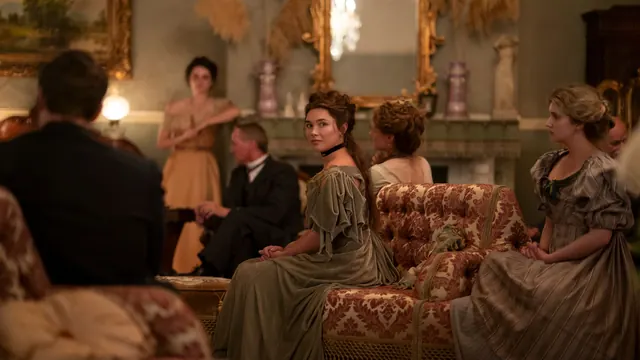
We’re in the midst of a period-drama-packed fall. Before Sense and Sensibility heads to theaters and Pride and Prejudice hits Netflix, another lush literary adaptation is set to dominate the streamer: a new take on John Steinbeck’s magnum opus, the sweeping East of Eden.
Created by Zoe Kazan—who just so happens to be the granddaughter of Hollywood legend Elia Kazan, director of the 1955 big-screen version of this story, starring James Dean—the miniseries takes a new focus: Cathy Ames, the tale’s irresistible, larger-than-life anti-heroine, played by Florence Pugh. After beginning to understand, as a little girl, the overwhelming desire that men have for her, she eventually learns to use it for her own gains.
She becomes entangled with a powerful man who casts her aside, winds up at the door of Adam Trask (Christopher Abbott), and marries him, moving from the East Coast to California. But Cathy is dissatisfied with her long days as a wife and mother to twin boys, Aron and Cal.
So she flees, leaving the family’s Chinese-American housekeeper, Lee (Hoon Lee), to care for them, and enters a brothel run by the formidable Faye (Martha Plimpton). There, she builds a new life, renaming herself Kate.
Responsible for crafting Cathy-turned-Kate’s knockout, late-19th- and early-20th-century wardrobe was Kirsty Cameron, the New Zealander also behind the intricate costumes in Jane Campion’s The Power of the Dog, another tale of love and loss in the American wilderness. With East of Eden now streaming on Netflix, Cameron talks us through our leading lady’s turbulent, fashion-filled arc—and her own most surprising sources of inspiration.
Vogue: What references were on your mood board for creating Cathy’s look?
Kirsty Cameron: I looked at a lot of photographers, especially those who were taking candid snapshots of real life more than 100 years ago. Two stood out: Edward Linley Sambourne and George Hendrik Breitner. They both photographed women on the streets in this very cool way. It reminds you that these people were modern in their own time, which is important to think about when doing period work.
There’s also Alice Austen, David Hamilton, Deborah Turbeville, and Arnold Genthe’s photos of [San Francisco’s] Chinatown [which provided inspiration for Lee’s look].
We also had a huge list of painters, going from [Mary] Cassatt and [Pierre] Bonnard to [Berthe] Morisot, [Henri de Toulouse] Lautrec, and [Edvard] Munch. Because the photography is black and white, the paintings brought a real sense of the colors of the period.
Can you talk me through Cathy’s long arc in terms of her clothes?
Her character goes through so many changes. When she’s a child, she’s being dressed by her mother and being brought up to be a wife, which she never intends to be. She plays along with it, so there’s already an artifice in what she’s wearing.
When we see her at her youngest, she’s reading Alice’s Adventures in Wonderland, but she also seems to be dressed like Alice?
Yes, we were totally jamming off Alice in wonderland [for that look]. I looked a lot at Lewis Carroll’s photographs as well.
Then Cathy grows up and meets Mr. Edwards.
And he’s dressing her to play this role of his mistress. We wanted to create a kind of brocade heaviness [in these looks] and think about what he was buying for her and what she was buying for herself when she’d go out and spend all of his money on these more elaborate pieces—which, of course, leads to the dress that she gets beaten up in.
Zoe wanted it to have a really feminine quality, which contrasted with the damage that’s done to Cathy in that dress. We printed that silk fabric and constructed those layers; when she’s on the ground, those layers needed to have the capacity to speak to a sort of femininity and brokenness [in Cathy].
That incident brings Cathy to Adam.
[Adam and his brother, Charles] really have nothing else but men’s shirts and their [deceased] mother’s dresses, so Cathy wears her dresses. There’s a faded quality to them, as well as the sense that this is the mother that Adam revered, who he transposes onto Cathy.
Next comes Cathy’s wedding dress. What went into crafting that?
We made a couple of renditions of that dress, and I remember going to [Florence’s] trailer and her trying them on. The one we ended up going with is the simplest of them all. It’s beautiful, elegant, and has a kind of timelessness. Those [sorts of wedding portraits] always look timeless. There’s also an innocence there, which is unusual for her character.
After that, Cathy and Adam move to California.
In this chapter of the story, there’s a sense of Cathy exploring her own taste. Zoe and I always spoke about her as being quite tasteful. She’s playing a part, but she’s also exercising her own sensibility.
In the show’s final chapter, Cathy becomes Kate.
With Faye, Cathy plays the innocent country girl, but that look quickly develops into these elaborate brothel gowns which she uses to fit in. She fits in with these girls and then she rises above them to the top.
As Kate, [once she’s in charge], she exercises a kind of self-branding. Zoe even talked a little bit about Patti Smith—this sense of someone who’s created their own image which is so recognizable.
Kate likes a cleaner, more elegant line, less decoration, and a more edited, sophisticated aesthetic. And she loves the dramatic.
This was, perhaps, her chance to be who she’d always wanted to be, but never had the capacity. It’s her own performance, as opposed to performing for somebody else.
It’s also a uniform and the palette is severe, but there’s variety to it and texture, and Florence wanted it to be really sexy. She also loved the idea that Kate collected all of these mementos from men, so those are on her body as well as being next to her bed and on her desk.
And then, of course, all the girls at Kate’s wear all black, too.
And finally, what other characters were fun to dress?
The guys—I love menswear. Creating those pieces from calico or a homespun cotton…and we did huge amounts of dyeing, as well.
I love Charles and Adam’s farm clothes. Mike Faist [who plays Charles] took his clothes out to the location [where we were shooting] and spent a weekend wearing them.
I love Adam’s vagrant clothes, too. He has a huge trajectory, but it’s much more subtle than Cathy’s.
He absconds from himself, in a sense, but then he comes back to the farm, falls in love, and we see a heightened sense of self—you see his suit, his taste, elegance, optimism, and intense ambition. But he’s also trying to get down with the Californians, so he brings some of his farm clothes and wears them to ride.
Then he’s forsaken, but later, there is a return to himself and a kind of settling into who he is. There’s a plainness there.
There’s also Abra [the young girlfriend of Aron Trask, Adam and Cathy’s son]. Her looks were fun to play with because she brings a modernity to the story. Again, we looked at those candid early street-style photographs. She wears these pleated skirts and things you can stride around in much more easily.
And Lee, of course. He’s playing a role, too, in the beginning. He wears his Chinese garments on the farm, he plays the humble servant, and then when he goes to Chinatown, he wears his suit. Over time, he evolves into who he really is. I love his character so much.
This interview has been edited and condensed for clarity.