
In the early days of her eponymous label, Giovanna Flores only wanted to share her own brand imagery on social media and her website. She was focused on building a specific, strong brand identity, not plastering celebrity photo ops on her socials.
Only recently has her thinking shifted. “Over the last few years, I’ve started incorporating press, and I saw how much it helps with visibility and introducing the work to new people,” the designer says.
Now, the odd celeb — Kathleen Hanna at Daisy Chain Fields; Greta Lee doing press — is sprinkled in between an abundance of lookbook photos, samples, and sunflower stills. “I’m thinking about how to share in a way that still feels aligned with the visual language of everything else [across the brand],” she says.
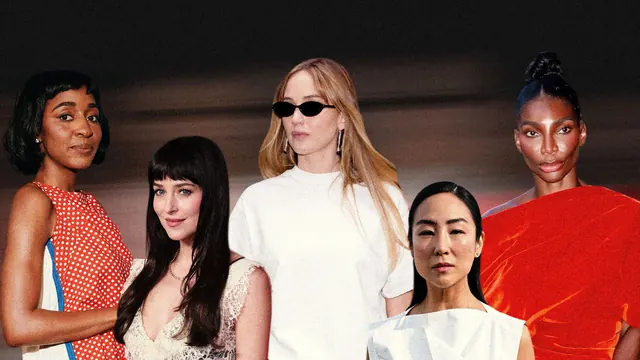
Like it or not, these celebrity moments earn emerging designers credit and cachet early on in their careers. Ayo Edebiri and Lee (both styled by Danielle Goldberg) have worn Flores’s designs, earning her industry coverage as an insider’s best-kept secret. Similar A-list accolades have been lauded on Colleen Allen, the New York designer who’s dressed stars from Nicole Kidman to Michaela Coel.
But for all of the coverage and sales a celebrity dressing moment can generate, it can be hard for brand founders to stay on top of the fast-moving celebrity style news cycle, much less make the most of the moment, especially early on when they’re operating their brand by themselves, or with a tiny team. Lending samples is a big commitment for a small brand that only has one of each, particularly when there’s no confirmation as to if or when a talent will actually wear a look.
Though Flores is now leaning further into the celebrity of it all, she’s figuring out an approach that works for her. She’s part of a cohort of emerging brands who are determining how to make the most of the celebrity dressing opportunity, without stretching themselves too thin or diminishing their still-developing brand identity with quick-hit comms. It’s a fine line to balance, but one well worth toeing.
Curation is key
For a brand in its early days, the public figures that wear its designs help shape its narrative. Because of this, Greg Mitola, founder of brand development and communications firm Etagere, through which he works with brands such as Colleen Allen, Heirlome and 6397, is ultra-specific about who he will lend to.
Mitola offers Colleen Allen as an example: “If I were to describe Colleen as a person and also as a brand, she’s confident, she’s sexy, she’s a little witchy and there’s something slightly off, but she’s also relatable. When we are thinking about the types of women that make sense and represent her, we want to make sure that the VIP is doing that.”
Lii founder Zane Li has taken a similar approach. “We’re big film and music fans so we’re selective when it comes to who we work with — we care about good movies and good actors more than someone who’s viral or ‘hot’, so that’s the biggest deciding factor,” he says.
“And we care about someone who’s smart, genuine, and has a sense of humor. We’ve been really lucky and flattered that the kind of girls we like — Renate [Reinsve], Ayo [Edebiri], Eva [Victor], Greta [Lee], Jennifer [Lawrence] — have been interested in us, too.”
For Jason Rider, Li’s stylist husband, celebrity dressing is something that can bring attention to a brand, but also requires caution especially in the early days. “Talent have such big personalities and big styles that can really make a look feel more special — but they can also detract from it.
We try to be thoughtful about who has a similar language as the brand,” he says. Flores takes a similar approach.
“A big part of my job is thinking about branding and communication. Editing is one of the most important things,” she adds.
It’s more than a simple yes or no. Mitola notes that most stylists will only dress their clients in a look that hasn’t already been worn on a carpet or for a press appearance.
This adds a layer of strategizing, because brands need to weigh the person who would wear the look and the context they would wear it in. If it’s someone Mitola feels fits the brand perfectly, but the opportunity is less than ideal (such as a lower tier event), he won’t offer up the most important dress in the collection.
“You make a suggestion of looks from their selection that you think would be suitable for you as the brand, not just placating the stylist and the celebrity with what they want, because at the end of the day, it’s for you to control your image,” Mitola says. An emerging brand is paying for everything, he adds.
“They are packing up this garment bag themself, and that sample costs thousands of dollars to make. And if only one person is going to be able to wear it, we need to make sure we’re getting our money out of it.”
Heavy admin
There’s lots of prep that goes into capitalizing on a celebrity style moment. In the instances where he has an idea of when and where something will be worn, Mitola drafts a press release; ensures products are available for purchase and that high-res and ghost mannequin shots are ready; and prepares hyperlink and affiliate commissions.
“Once we have the image of the celebrity, we throw it in and then blast it out,” he says. After that, he’ll post to Instagram, then share with retail consultants for them to share with their VICs.
This is all easier to do when the brand has a heads-up. Without it, it’s a matter of keeping Google notifications on for the brand, but also monitoring the looks of people a brand has loaned looks out to via stylists’s social media and Getty — which, of course, is easier with a team or consultancy on board than without.
Oftentimes, it’s a matter of the latter, because communication tends to be worse in celebrity requests than editorial styling requests, says Rider. Of celebrity requests, he says, “it’s honestly quite elusive and less organized than editorial styling requests.” Whereas, from magazines, a brand will receive blocks of specific dates and addresses, celebrity requests tend to be quite vague, he notes, adding that you don’t always know if you’ll get a garment back.
“That’s probably because [the stylists] are at the whim of these really busy people, but it can be a bit annoying considering we’re a small brand with one sample set.”
Brands can — and should — ask to be notified, Mitola says. “You as the designer can say, ‘Hey, I’m sending this to you.
Can you please let me know if anything gets slotted so that I can prepare and make the most of that moment?’ Or if you don’t get notified, you can be like, ‘This is so amazing, I wish I had known so I could have maximized this opportunity because now press won’t cover this, and the dress has been worn, so I can’t loan this to another celebrity,’” he offers. “Because that’s the thing: if you don’t tell us, we can’t pitch it to Vogue.com two weeks later, so it’s now not going to get the visibility that it needs for the season.”
Sometimes, it’s also a matter of capacity. Flores is thoughtful about who she wants to wear the brand, but also about her own time and bandwidth. “Because I’m one person, I’m not always able to accommodate every request,” she says.
While capacity is limited for small designers to fulfill these requests, the right celeb moment can pay off in sales. This year’s LVMH Prize winner Julie Kegels told Vogue Business that when Dua Lipa wore a look last year, it sold out on the brand’s site “in a second”.
Li says that, when Lawrence wore his skirt with a white tee, sales ticked up. “I think Jennifer’s look showed people that our kookier ideas could have a place in the real world, which helped sales a lot.” And when Kaia Gerber wore a Yana Matkivski dress to the US Open, it sold out of current stock and on pre-order.
It’s a double-edged sword, says brand consultant Chantale Mager, who previously consulted for Kegels and currently works with Matkivski. “This celebrity moment created this amazing initial pull for sales, but for these really small brands that don’t have huge production numbers or cash sitting there to immediately go into another production run, it can be difficult to fully capitalize on it,” Mager says in reference to the Gerber-induced sellout.
She notes that, given Yana Matkivski is launching on Net-a-Porter this season, the wholesaler will wind up receiving the dress before those pre-ordered.
Building relationships
The best thing a brand can do, designers and consultants agree, is cultivate strong relationships. Not only will this make stylists think of brands in the first place, but it positions them to be more communicative about the looks they’re putting on their clients and when. It also makes it easier to ask for images from the hotel or the dressing room, to have as alternatives to potentially lackluster step and repeats.
The benefits of this are clear on both Lii and Giovanna Flores’s feeds; Edebiri is pictured in a two-piece against a white wall, rather than the sponcon backdrop at the gala she wore it to; Paloma Elsesser poses against a scenic Napa Valley backdrop in the first image of her wearing Giovanna Flores to an industry forum, with on-stage images buried in the swipe.
“Someone we’re friends with, like Danielle [Goldberg], who we’re on a texting basis with, will check fittings with Zane and let us know if someone’s going to wear something. But otherwise, you sort of never know and hope you’ll be tagged one morning when you wake up,” Rider says.
Mitola advises that brands ask about fitting dates; if not to get visibility on the looks like Goldberg offers Li, but simply to stay atop of timelines. Flores doesn’t have a press team, so is usually in touch with the stylist or their assistant. She’ll check in with them, and confirmation depends on the stylist and the way they work, as well as timelines, she says.
Developing these relationships has been central to Flores’s work with celebrity stylists, she says. “I want to trust that the stylist or person understands the clothes and will dress in a way that feels representative of the brand, but there’s also the practical side of trusting someone with the safekeeping and care of the samples,” she says.
“It’s been great for me to build those relationships, not only having new people learn about my work, but also getting to learn about them and their work and style has been really fun and rewarding for me.”
More from this author:
Sinéad Burke On Launching an Adaptive Fashion Line with Asos
TWP’s Path From Best-Kept Secret to Serious Fashion Player
Can an Arnault Help Revive Nike?