
In August, American clothing brand Abercrombie & Fitch posted a Reel on Instagram showing several pairs of denim pants being lined up and folded next to one another. But this wasn’t simply another day at the shop. These realistic, detailed jeans were no larger than the palm of one’s hand and, in fact, crafted entirely out of pasta.
The Reel has been viewed more than five million times, significantly surpassing other videos shared on the platform by the brand. Followers responded enthusiastically to the culinary craft. “What’s wrong babe? You haven’t touched your fettujeane,” joked one user, whose wordplay went on to be liked 15,486 times. Many others complimented Abercrombie for its creativity.
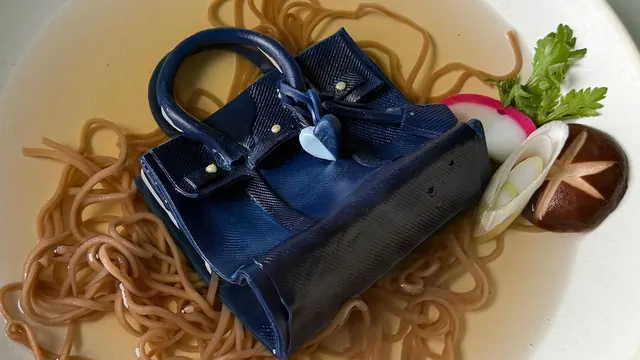
The edible art is the handiwork of the Korean artist Min Kyung-jin, who turns everyday food and ingredients into whimsical, miniature sculptures. Min — who goes by the online moniker @Sibatable (an amalgamation of Shiba Inu, her dog’s breed, and “table”) — studied culinary arts at university and spent a year in the US, but eventually returned to Korea where she got married and had children.
As her children got older, she sought a daily creative challenge. “I realized how many different ways food could be transformed by baking, melting, setting or cutting it,” she says.
And so, Min began making edible creations and sharing them on Instagram in February 2022.
She is among a recent wave of artists that luxury and fashion brands have been collaborating with, in a bid to demonstrate their commitments to human artistry. It’s an approach that brand consultant Miranda Shanahan has coined “effort signaling”. For many, the concept of making things by hand indicates time, skill and therefore value — a message that high-end brands have become eager to associate with, Shanahan says.
Indeed, as a rising number of shoppers question whether luxury is still worth its high price, with some believing that luxury goods were generally better made in the past, before industry executives became focused on mass production and corporate profits, some brands have been investing heavily into campaigns that promote the human touch behind their products.
Growing investment in human artists also comes as debate around artificial intelligence and how luxury brands should be using the technology intensifies. When brands including Prada and Gucci released wildly surreal campaigns featuring entirely AI-generated images, the public response was polarized.
Some viewers applauded luxury’s willingness to experiment with AI and break new creative ground, while others criticized the synthetic imagery for lacking depth, highlighting concerns around the replacement of traditional creative skills like photography.
“As it becomes harder for brands to defend their price points, people are choosing these painstaking crafts,” where the labor is evident in the outcome, says Shanahan. “The more you can show the length of time to produce anything is now the biggest signifier of value.”
The human touch
Brands of all sizes are collaborating with highly skilled, slow craft creatives. Hermès, which has a long history of collaborating with artists, recently commissioned illustrator Stuart Patience, artist Sarah Martinon and motion designer Armand Béraud to create animated, hand-drawn illustrations, in celebration of its new state-of-the-art flagship in London. It also tapped the comic artist Antony Huchette to create an animated video to promote its homeware collection.
Meanwhile, Chanel turned to Karlotta Freier to create an illustrated teaser for its Fall/Winter 2026 Haute Couture show; Dior worked with the French animation studio Remembers on a short film for its Miss Dior fragrance; Lacoste has been collaborating with artist Rayan Takhedmit on an animated series showcasing its famous crocodile logo in playful environments; and Spanish house Loewe has paired up with illustrator Annie Choi on anime-style visuals since 2023.
While human creativity has increasingly become front and center for all kinds of brands, Fontaine Anderson, creative director of contemporary fashion brand Damson Madder, says it has long been “at the heart of Damson Madder’s ethos”. She points to previous partnerships, including one last fall with set designer Saskia Martindale, who recreated its signature coats and jackets in oversized cardboard, and another with the popular creator and artist Jia Xin, who transformed simple ingredients into one-of-a-kind food art for its SS26 homeware launch.
Meanwhile, its summer campaign was regimained by artist Dee Monti in stained glass. “We are constantly looking for ways to communicate our brand universe on social media,” says Anderson.
“Championing innovative creators is central to our long-term creative strategy.”
The shift toward human artistry is also taking place outside fashion. For its promotional rollout and lyric-music videos, Olivia Rodrigo’s new album, You Seem Pretty Sad for a Girl So in Love, commissioned artists, illustrators and makers to create handmade art, stop-motion animations and other physical mediums in an intimate, diary-like aesthetic.
For her inaugural Daisy Chain Fields music festival, Rodrigo also partnered with 10 female-owned Etsy shops on a handmade, bespoke merchandise collection that was sold at the festival as well as online.
Sports teams are getting involved, too. Soccer club Arsenal’s launch campaign for its 2026/27 third kit, in collaboration with Adidas, utilizes hand-drawn sketch-like animations. Model and lifelong fan Adwoa Aboah can be seen alongside players Noni Madueke, Steph Catley, and Martín Zubimendi amid nods to local North London landmarks like Rowans and JussJerk.
As brands take greater interest, artists — many of whom historically face low and unreliable pay — are benefiting. Min has seen a significant uptick in brand collaborations in recent years. In July, she created underwear out of pasta for Victoria’s Secret, and has recently worked with Marc Jacobs, Coach, J.Crew, and Damson Madder, to create campaigns that showcase her unique craft that requires long, painstaking hours and often repetitive processes.
Of her process, Min finds inspiration in music, films, cartoons, and parts of everyday life. “When something interests me, I think about whether it connects with a particular food or ingredient,” she explains.
From there, the process is part planned, part improvised — much like the art of cooking — and can take two to three hours. Though, she notes that brand collaborations can take up to two to three weeks due to the planning, testing, and approval process.
Things don’t always go to plan. On one occasion, when Min was baking bread in the shape of Ugg boots, “the dough kept rising unpredictably and completely lost its shape”, she says. “I went through eight bags of flour, making it over and over again until I finally got the shape I wanted. A lot of experimentation and trials go into the perfect presentation you see in the final edit.”
Tammy Smulders, founder and CEO of creative strategy firm Trends&Culture, observes that the unique creative expressions and imperfections of the human hand can help brands differentiate. “Even when brands are not using AI in advertising, many use the same photography teams or stylists and things can look very much the same,” she says. “Brands are now thinking about how they can bring something that feels more distinctive.”
Show, don’t tell
Today, an ever-increasing cohort of consumers seems to believe that AI is “good” when used behind the scenes to optimize supply chains, but “bad” if it risks replacing human artistry or makes high-end experiences feel generic.
Now, even ads that look too glossy or computer-generated are viewed negatively — even if they were created using traditional physical skills or effects, says Shanahan. For example, when lifestyle brand Gohar World recently shared its upcoming collaboration with sportswear giant Asics on Instagram via a surreal video featuring a table with human legs dancing, some viewers questioned if the post was AI.
It prompted the brand to reply in the comments and also update its caption to explicitly state that the content was not digitally generated. Gohar World subsequently uploaded a behind-the-scenes video sharing how the campaign was created.
“If there’s even the slightest suggestion that AI was used in the creative process, there is immediate backlash from consumers,” observes Shanahan. “AI has become a scapegoat for all of the ills that we have in the world right now.”
However, just because something isn’t made by hand, it shouldn’t connote lesser value, Shanahan says. She believes there is more brands can do when it comes to storytelling, such as lifting the curtain on key moments, products or people, and showing how something came to be.
It could help win customer trust and loyalty, she adds, at a time when “people are losing respect for luxury and questioning why they should pay lots of money”. Shanahan caveats, however, that “the people getting angry in the comments are not likely the ones spending lots of money on a single garment, but overall, the value promise isn’t there anymore.”
Beyond the great AI debate, Smulders believes that luxury shoppers increasingly seek emotional wellbeing and unadulterated joy rather than just status symbols or basic product utility. With that view, human-made arts and crafts “gives luxury a wink as it can be very playful”, she says.
“It has a humor, a whimsicality, and I think we’re in a place where people just want a bit of lightness. They don’t necessarily want luxury that takes itself so seriously all the time.”
Ultimately, brands must actively prove their value at a time when modern consumers are increasingly skeptical and careful with their spending. Today, people look past empty marketing buzzwords, and flashy celebrity endorsements don’t carry as much weight as they once did.
The key, Shanahan believes, is to show “the effort that goes into making anything. People want to believe that brands care about what they're putting out and that they're not just churning stuff out at the lowest possible price point to make the maximum amount of money.”