
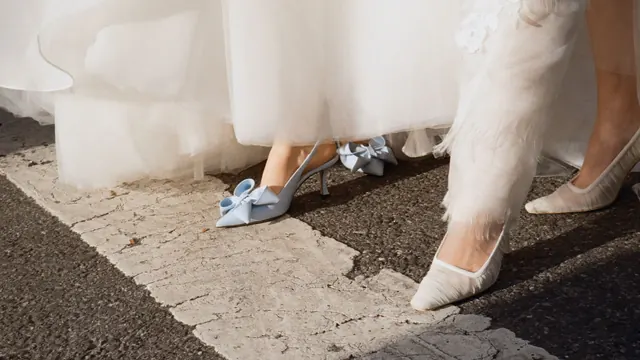
I used to think that there was something a bit sad about an older bride. As an older bride myself, I can say that. In October, I will be getting married—on my 40th birthday.
By sad, I just mean our eyes have been trained to see the bride as an emblem of youth: cherub-cheeked and dewy, the promise of an entire life glimmering in her eye.
And the absence of that does feel, well… sad? The abundance we project onto the 25-year-old bride becomes, by 40, a question of what is left. Marry late enough, and the implication is that we’re witnessing a semi-defeated, it’s-better-than-nothing settling situation.
Even the nice things we say about women who marry later belie the assumption. Finally! Worth the wait! There is an entire vocabulary built around the idea that the years before marriage were simply leading toward it.
When people hear I’m getting married on my 40th birthday, they almost invariably say some version of, “What a way to celebrate!” But birthdays and weddings ask very different things of us. Birthdays ask us to look backwards; with weddings, we look ahead. One measures the life you’ve lived. The other imagines the one you have yet to. On October 3, I’ll be asked to do both.
After a certain age, birthdays seem to become less about what might happen than what hasn’t. And the midlife mindfuck dawns on you: who am I compared to the version of myself I imagined?
For most of my 20s and 30s, the answer was complicated. I spent nearly a decade as a reporter and editor at Women's Wear Daily, which meant that much of my young adulthood was spent going to fashion shows and covering parties. I built a career I loved. I traveled. I got sober. I got a dog. I made a life for myself in New York.
And still, there were moments when it seemed as though all of that existed through the prism of a glaring omission. That’s the strange thing about being an unmarried woman after a certain age: no matter how much else you have done, people can make you feel as though the most interesting thing about you is the one thing you haven't.
My mother has a friend who, whenever she describes her to someone new, invariably introduces her in the exact same way: “She’s 55. Never been married.” This poor woman, defined as being in a perpetual holding pattern.
For years, I felt I was in one too. I had internalized this idea that I was on the precipice of something, of my “actual” life to start.
What that “actual” life entailed was some hazy composite of what I thought it was supposed to look like: the husband, the kids, the house in the good school district. Getting married was just the entry point, the point where your life finally clicks into the shape you’d been promised it would.
But now, I don’t feel like that. I think that’s the part we get wrong about marrying later.
I didn’t spend my 20s and 30s in some sort of holding pattern, waiting for life to begin. I spent those years figuring out who I was and showing up for myself in a way that I don’t think a coupled me would have.
Not because marriage necessarily makes a person less independent, but because there was no default person to call, no automatic second opinion, no one whose job it was to figure it out with me. I had to do that on my own.
I’ve had to do a lot on my own. I’ve had to lift heavy things without assistance—groceries, obscenely overpacked luggage, Container Store tubs of books every time I moved apartments.
I had to figure out personal finance on my own, set up a Roth IRA, and learn what an index fund was long before ChatGPT existed. I froze my eggs, mixing medications on my kitchen counter and jabbing myself nightly.
I learned how to live alone, travel alone, solve problems alone. I learned that there are very few domestic catastrophes that can’t be solved via a YouTube tutorial and enough misplaced confidence.
DIY-ing my life has made me a self-sufficient human and taught me that I can build a pretty fabulous life alone. Marriage now isn’t a necessity, it’s a choice. Which, paradoxically, is what made me ready to get married.
I met my fiancé, Martin, a dashingly handsome British expat, in New York when I was 38. Our texting banter was phenomenal, and I was thrilled to discover he was even funnier in person.
Our first date was on a freezing night in January, which made our already-ridiculous beverages all the more so. I ordered the only mocktail on the menu, and he followed suit.
We were both taken aback when veritable bowls of peach liquid arrived, festooned with pineapple wedges and tiny umbrellas.
The 25-year-old version of myself wouldn’t know what to do with my fiancé. He didn’t play games or manufacture intrigue.
From the beginning, there was something almost startlingly straightforward about him: he liked me, he told me, and he showed me. He texted me after each date about setting up the subsequent one.
He was emotionally available in a way I probably would have found too earnest. I might have dismissed him as “too nice”—a criticism that I now find baffling, because I know now how rare it is to find someone unafraid to love you openly, deeply, and unabashedly.
It is the thing I feel luckiest to have found in him.
So yes, perhaps in my wedding photos I won’t be quite as cherub-faced as what we graft onto brides. There will be lines around my eyes that weren’t there at 25. There will be 40 years visible in my face, because there will be 40 years behind it. But I don’t find that sad anymore, because I know what happened during those years.
The woman in those photos will have built a career. She’ll have lost people, left relationships, survived heartbreak, gotten sober, frozen her eggs, paid her own bills, carried her own obscenely heavy suitcases and figured out, slowly and sometimes painfully, who she is. She won’t be standing at the beginning of her life. She’ll be bringing an entire life with her. And perhaps some tubs of books.