
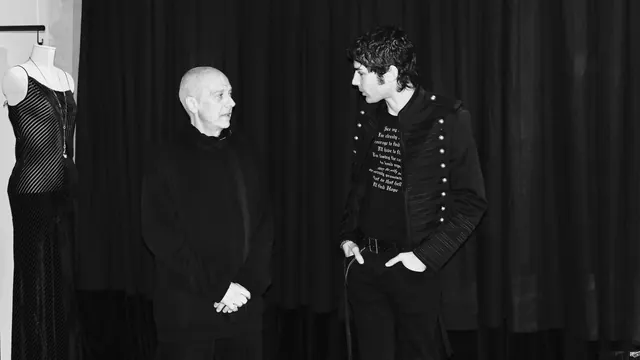
If anyone needed proof that subcultures still exist, all they needed to do was walk into the Parisian friary that housed last season’s Ann Demeulemeester runway show on the Saturday evening of Paris Fashion Week.
A musical duo called Beguiling Junior played husky rock music as about 500 20-year-olds all decked in Ann Demeulemeester took their seats around the vaulted space. Led Zeppelin guitarist Jimmy Page sat across from me, while one row behind him and to the right, a couple was making out throughout the show, his messy hair buried in her neck, her pale pink chiffon dress draped across his leather jacket.
If that couple looked up, they’d have seen Billy Idol walk.
“This is such a scene,” breathed British Vogue’s Julia Hobbs, sitting next to me.
“It’s one of the most important aspects of the work [creative director] Stefano Gallici is doing,” says Ann Demeulemeester CEO and owner Claudio Antonioli six months later while showing me around the VIC room of the flagship store in Milan’s Via Monte Napoleone.
“Stefano’s ability is not only to create collections with a strong personality but also to build a community around the brand. Today, there is a very young group of people following Ann Demeulemeester, people who identify with its world and its collections.
At the same time, we have managed to maintain the brand’s original community, which was very important to me. What you saw at the show was very intentional; when the music, the people and the atmosphere come together, a fashion show becomes a moment of connection and belonging.”
One of the Antwerp Six, Ann Demeulemeester (whose real name is Ann Verhelst) founded the brand in the Belgian city in 1985. Together with her husband Patrick Robyn (who paused a career in photography to focus on the company), they built a cult following that adored the brand’s romantic aesthetic and deconstructivist tailoring.
Antonioli, who also owns a nightclub, a restaurant and a dog shelter on the outskirts of Milan, has made a career of finding community. He started as a buyer and opened his first multi-brand store, Antonioli, in Milan in 1987.
Over the years, it grew into a chain with boutiques in Milan, Lugano and Ibiza, specializing in avant-garde fashion and young designers. “It’s important when you have a multi-brand store to invest your money into helping the next generation of designers get discovered,” he says.
In 2015, along with Marcelo Burlon and Davide De Giglio, he founded New Guards Group (NGG), which would famously house Virgil Abloh’s Off-White but also Palm Angels, Heron Preston and A Plan Application, among others. All brands that are rooted in spaces where fashion is used as an expression of community and belonging.
He recalls: “I met Virgil through Kanye West. Back then, Kanye was trying to start a brand in Milan and called me, along with a few others, to consult on the project.
Virgil had Pyrex Vision at the time. I understood back then the importance of being at the center of a cultural moment; Virgil was there, and he was a good designer with a celebrity friend.
We approached him and asked if he wanted to take it global. We couldn’t do it with Pyrex because it shared the name with the glassware brand.
So we started Off-White. We posted one picture with Kanye, Virgil, and Pharrell [Williams], and the brand took off like a Ferrari.
We didn’t invest anything in the group because all the stores paid a 30% deposit when they placed their orders. So we started production with that 30%, and within just a few years, we managed to reach incredible levels of revenue.”
Antonioli, Burlon and De Giglio sold NGG to Farfetch in 2019 for $675 million, and after a year-long break imposed on him by a non-compete agreement, the entrepreneur was ready for a new adventure. “I wanted to work on something I really loved.
All my life I wore black; Ann Demeulemeester, Rick Owens, Raf Simons, Helmut Lang… I looked to Ann Demeulemeester, who has changed the way we think about fashion through her very strong vision. I got in touch, and she said, ‘OK, Claudio, come to Antwerp, and we’ll talk’.”
It was 2020, about eight years after Demeulemeester stopped designing for the brand. “My first objective was to bring back the emotions that had made the brand so important,” he says.
“I didn’t want to simply go back to the past and create a copy of what had been done before. I wanted to recover the identity that had made so many people fall in love with it.
And I wanted to build a new chapter that could speak to new generations without losing the brand’s authenticity.”
He argues that his most important move in achieving that was placing Stefano Gallici at the creative helm in 2023. Gallici, who had joined the Antonioli Group in 2019, was only 27 years old at the time of his appointment and largely untested, though not for Antonioli.
“When I decided to end the relationship with the previous creative director,” Antonioli says, referring to Ludovic de Saint Sernin, who only showed one collection with the house, “Stefano was already part of the team. I had had the opportunity to get to know him and see his way of working up close.
One of the most important things was his knowledge of Ann Demeulemeester. He wasn’t coming from the outside to simply interpret it: he already knew the brand deeply and shared its values.
It felt very natural to consider him for the role, and today I feel very fortunate to have made that choice.”
Antonioli says he is relatively hands-off these days because he trusts Gallici’s vision. Instead, he likes to jump in and out of projects depending on where he is needed most. How can he tell that a piece will sell well? “I am a buyer, not a creative person. But I have an instinct,” he replies.
He goes on: “We are famous for the Napoleon jackets at the moment. They were in the show, and together with the vests, they perform well.
We put together a limited-edition jacket for H Lorenzo in LA, and it sold out in record time. But I don’t want to keep doing one thing because it works.
I don’t like this type of merchandising advice. We follow the ideas of Stefano and the team.
If the people like it and we sell, great.”
So far, the people seem to like it. According to the company, performance is good across all categories, and Antonioli is happy that ready-to-wear represents an important part of the business. Ann Demeulemeester posted revenues of €20 million at year-end 2026, with 55% year-on-year growth. They are projecting revenues of about €27 million in 2027.
Another reason for the success is the prices, which have been kept relatively democratic. On the website, the most expensive womenswear item is a $10,750 long fur coat with a shawl collar, and the cheapest is a tank top for $270.
The Napoleon jackets cost between $1,750 and $2,480, while a leather tote bag is $1,860. “We have the prices a little bit lower than other luxury brands.
We want to be respectful, but when people sell a pair of denim trousers for €2,000… please,” says Antonioli. The brand’s Vive 5-Pocket jeans sits at $930.
The celebrities like it too: besides Charli XCX, who seems to have spearheaded the Ann Demeulemeester renaissance by wearing five different looks in her videos for the song ‘Rock Music’, the brand is also regularly seen on Dua Lipa, Suki Waterhouse, Halsey, Kylie Jenner, Jenna Ortega and Amelia Gray. Antonioli says it’s all organic, and that they never pay people to wear the brand.
Now that the product is in order, for Antonioli, the attention needs to turn to retail and distribution. The company is focusing its efforts on Europe, Japan, China and the United States; markets they say already come with a customer base.
Following store openings in Antwerp (2021) and Milan (earlier this year), the brand is opening its first flagship in Paris today at Jardin du Palais Royal. The new boutique spans a total area of 150 square meters and includes products from the complete Ann Demeulemeester universe, including women’s and men’s ready-to-wear, footwear, accessories and even the tableware collection that Ann herself designed for Serax.
A store in London will follow in the first months of 2027.
“For me, it’s important that commercial growth goes hand-in-hand with the growth of the brand without losing the identity that made it so important in the first place,” says Antonioli. “If we only follow the money, then we lose it all.”